
How to Rule the Road and Claim the Castle in Carcassonne
Why a Carcassonne Strategy Guide Changes Everything
A solid carcassonne strategy guide is the difference between placing tiles randomly and actually winning. Carcassonne looks gentle on the surface — you’re just building roads and cities in medieval Southern France — but beneath that pleasant exterior lies a deeply competitive game of meeple management, tile reading, and opponent disruption.
Here are the core strategies to win at Carcassonne:
- Build small cities (2-4 tiles) that you can actually complete
- Manage your 7 meeples carefully — never commit them all at once
- Place farmers in mid-game on fields adjacent to multiple cities
- Use roads defensively to block opponents and divide fields
- Merge into opponent features to share or steal their points
- Count tiles to know what completions are still possible
- Sabotage large enemy cities by adding extra open edges
- Keep at least one meeple in reserve at all times
The base game contains 72 tiles with 24 different feature combinations. Every draw is random — but what you do with each tile is pure skill. As one experienced player put it: repeated luck is called skill.
Whether you’ve played a handful of games or dozens, this guide walks you through everything from basic scoring to advanced field control and opponent trapping.
Key carcassonne strategy guide vocabulary:
Mastering the Fundamentals: Scoring and Meeple Management
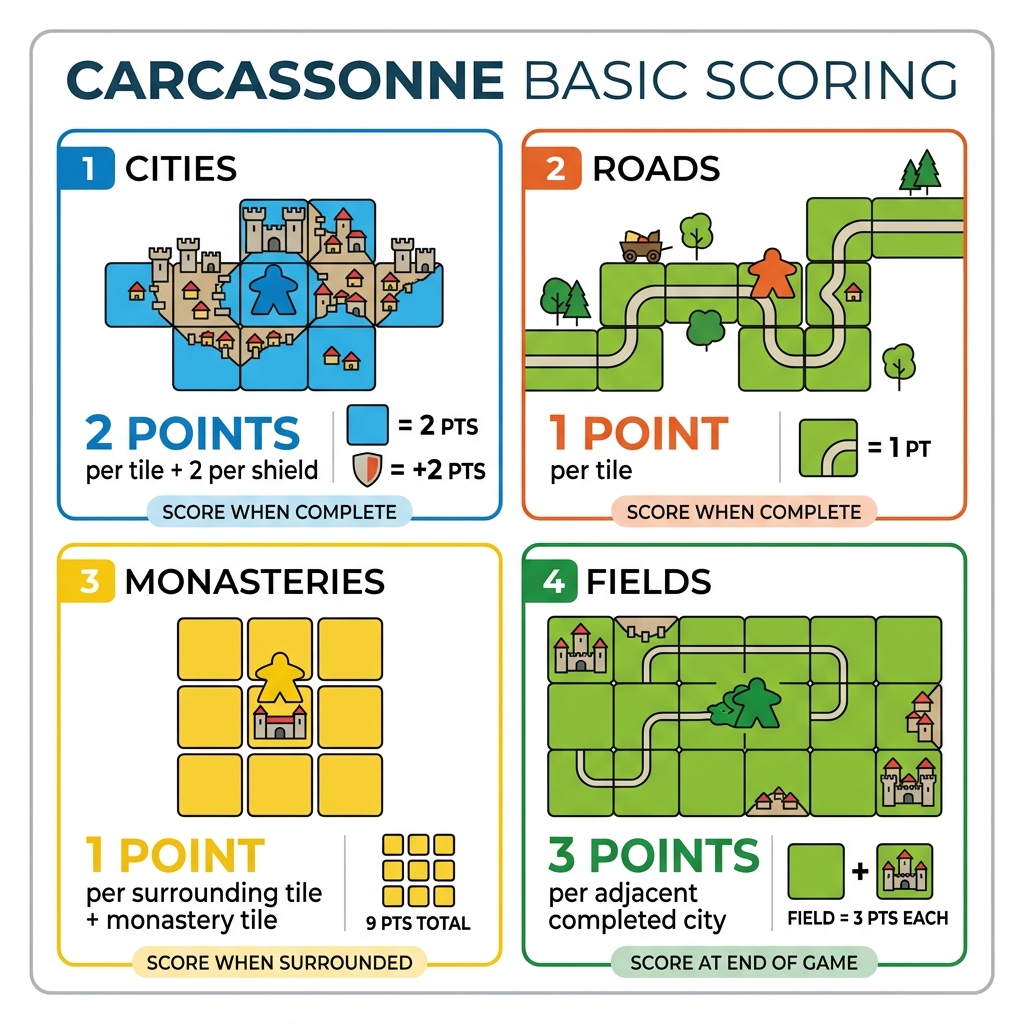
To rule the landscape of Southern France, we must first master the math. In Carcassonne, points are generated by four main features: Cities, Roads, Monasteries (Cloisters), and Fields. While the rules seem straightforward, the strategic weight of each feature varies wildly depending on whether the game is in the opening, middle, or endgame phase.
Cities are the heavy hitters. A completed city scores 2 points per tile and 2 points per coat of arms (pennant). However, an uncompleted city at the end of the game only scores 1 point per tile/pennant. This 50% reduction is a massive penalty. We recommend focusing on small, two-tile cities early on. These “football” shaped cities provide a quick 4 points and, more importantly, return your meeple to your supply immediately.
Roads are often undervalued. They score 1 point per tile whether finished or not. While they rarely provide the massive point swings of a large city, they are vital for meeple retrieval and defensive blocking.
Monasteries are the most efficient single-tile investments. A fully surrounded monastery scores exactly 9 points. The trick is to place them in “busy” areas where other players are already building. If you place a monastery in a hole surrounded by three or four existing tiles, you’ve already done half the work.
| Feature | Points (Completed) | Points (Incomplete at End) |
|---|---|---|
| City | 2 per tile + 2 per pennant | 1 per tile + 1 per pennant |
| Road | 1 per tile | 1 per tile |
| Monastery | 9 (when surrounded) | 1 per adjacent tile + 1 for self |
| Field | N/A | 3 per completed adjacent city |
Understanding these values is the first step in developing a board game mechanics explained approach to your tabletop sessions.
Meeple Management in Your Carcassonne Strategy Guide
In Carcassonne, your meeples (or followers) are your only currency. You start with 7, and if you run out of them mid-game, you are effectively paralyzed. You cannot claim new features, and you must wait for a project to finish before you can act again. This is known as the “meeple trap.”
A pro-level carcassonne strategy guide suggests a 3-3-1 split:
- 3 Long-term Meeples: These are committed to large cities, monasteries, or early high-value farms.
- 3 Short-term Meeples: These are used for “quick-fire” scoring—2-tile cities or 2-tile roads that return to your hand within a turn or two.
- 1 Reserve Meeple: This meeple stays in your hand until the very last tile. It is your insurance policy for a late-game monastery draw or a “freeloading” opportunity on someone else’s road.
Recycling meeples is the heartbeat of winning play. If you have five meeples stuck in unfinished cities on the board, you aren’t playing to win; you’re playing to watch others score. Always be planning ahead in board games to ensure at least one meeple returns to your supply every few turns.
Effective Opening Moves
The first ten tiles of the game set the “geography” of the board. Many beginners make the mistake of building away from the starting tile to avoid conflict. We suggest the opposite. Stay close to the action.
The starting tile features a road and a city segment. If you draw a city tile, expand the existing city. If you draw a road, continue the path. The goal of the opening moves is not to score 50 points immediately, but to establish “presence” in areas that will eventually become large fields or interconnected city hubs. According to best opening moves for board games, the most effective start is one that keeps your options open while forcing opponents to commit their meeples to features that are difficult to close.
Advanced Carcassonne Strategy Guide: Sabotage and Merging
Once you’ve moved past the basics, Carcassonne becomes a game of “What’s mine is mine, and what’s yours is ours.” This is where the concepts of merging and sabotage come into play.
Merging (also known as joining or parasitism) is the art of placing a tile near an opponent’s feature, claiming it with your own meeple, and then connecting the two features with a subsequent tile. If you and an opponent both have one meeple in a city when it closes, you both get the full points. If you manage to get two meeples in while they only have one, you “steal” the city and they get zero.
This “shared joy” is often the only way to catch up to a leader. In fact, players who compete at the Carcassonne World Championships often spend more time trying to join existing cities than starting their own.
Defensive Blocking and Trapping Tactics
If you can’t join them, break them. Defensive blocking is a vital part of any carcassonne strategy guide. The goal is to create “unfillable spaces.”
In the base game, there are certain tile combinations that simply do not exist. For example, there is no tile that has a city on one side, a road on another, and two fields. By placing tiles strategically, you can create a hole in the map that requires a non-existent tile to finish. If an opponent has a meeple in a massive city that needs that specific tile to close, that meeple is “trapped” for the rest of the game.
Using 3-edge city tiles is a classic sabotage move. If an opponent is building a nice, manageable city, add a tile that opens up three new sides. Suddenly, their “small” city needs four more tiles to close instead of one. This forces them to waste turns and meeples defending a project that may never finish. This is a staple of a competitive board game strategy guide.
Sabotaging Opponent Progress
Sabotage isn’t just about blocking; it’s about reducing probability. If an opponent needs a very specific tile (like a straight road with city on both sides) to finish a 20-point project, and you know three of those tiles have already been played, you should play aggressively to make that gap even harder to fill.
By stranding their followers, you reduce their “meeple throughput.” Every meeple of theirs that sits on the board doing nothing is a meeple they can’t use to claim a 9-point monastery. We find that the best tactics for underrated board games often involve this kind of psychological and mathematical pressure.
The Farmer’s Gambit: Winning the End-Game with Fields
Fields are the “dark horse” of Carcassonne. They score zero points during the game but often decide the winner during final scoring. A single meeple placed as a farmer can easily score 15 to 30 points if it touches five or ten completed cities.
The timing of farmer placement is critical.
- Too Early: You lose a meeple for the entire game. If you place a farmer on turn 5, you’re playing with only 6 meeples for the next 45 minutes.
- Too Late: The high-value fields are already claimed or blocked off by roads.
We recommend looking for field opportunities around the mid-point of the game (when about 30-40 tiles are left). Look for “pivotal fields”—large grassy areas that touch multiple cities currently under construction. If you can secure majority control of a field that eventually touches six completed cities, you’ve just secured 18 points.
For those looking to dive deeper into these nuances, The Book of Carcassonne by Steve Dee and Dan Chard offers incredible insights into the “Farmer’s Gambit.”
Advanced Tile Knowledge for Your Carcassonne Strategy Guide
To play at a high level, you must know the deck. The base game has 72 tiles, but they are not evenly distributed.
- There are only 2 monasteries with roads.
- There are zero tiles with two roads and two city edges that don’t connect.
- There are 44 tiles that have a city feature of some kind.
Knowing these heuristics allows you to calculate the odds of drawing the piece you need. If you are waiting for a specific “T-junction” road to finish a project, and you’ve already seen three on the board, you might want to abandon that project. This level of “tile counting” is what separates the casual players from the masters. It’s also one of the best tips for multiplayer board game success.
Player Count Dynamics
Your carcassonne strategy guide must change based on how many people are sitting at the table.
- 2-Player Games: This is pure “cut-throat” combat. Every point you deny your opponent is as good as a point earned for yourself. Blocking and trapping are your primary tools.
- 3-5 Player Games: This is a game of diplomacy and “opportunistic sharing.” You cannot block everyone. Instead, you should look to “freeload” on the projects of the person in the lead. If the leader is building a massive city, find a way to merge into it. You both get the points, but the leader doesn’t pull further ahead of you.
In a 2-player game, you have roughly 35 turns. In a 5-player game, you only have about 14. This means in larger games, you must make every single tile count. There is no room for “slow” projects. For more on this, check out top strategy tips for two-player games.
Frequently Asked Questions
How do I manage my limited supply of 7 meeples?
Always aim to have at least one meeple in your supply. Use “cycle” moves—placing a tile that completes a feature immediately—to get points without losing your meeple for a turn. If you have only two meeples left, stop starting new large cities and focus on finishing what you have.
When is the best time to place a farmer?
Mid-game is usually ideal. Placing a farmer too early (the first 10-15 tiles) locks up a resource for too long. Placing it too late (the last 10 tiles) might mean you can’t connect to the “big” fields. Aim for the “sweet spot” when cities are starting to close, but the fields haven’t been divided by roads yet.
How can I steal a city from an opponent?
You cannot place a meeple on a feature that is already claimed. To steal a city, you must place a city tile near the opponent’s city (but not touching it) and place your meeple there. Then, on a later turn, you must find a tile that connects your city segment to theirs. If you have more meeples in the finished city than they do, you take all the points!
Conclusion
Mastering Carcassonne is about balancing tile efficiency with aggressive disruption. Whether you are building small, profitable cities or navigating the complex world of field majorities, every tile placement is an opportunity to outmaneuver your friends.
Remember the golden rules of our carcassonne strategy guide: keep a meeple in reserve, don’t be afraid to share points to move ahead, and always keep an eye on the remaining tiles. By focusing on high-probability moves and protecting your limited followers, you’ll find yourself ruling the roads and claiming the castles in no time.
Now that you’ve got the tactics down, it’s time to put them to the test. Whether you’re playing the physical board game or practicing on a digital app, these strategies will give you the edge you need. Ready to master your next game night? Grab your tiles and let’s get building! At iBest Health Insurance, we believe that a sharp mind and a fun game night are key components of a healthy, balanced lifestyle. Happy gaming!
