
Why Every Serious Player Needs a Risk Board Game Strategy Guide
A solid risk board game strategy guide separates players who win consistently from those who rely on lucky dice rolls. At iBest Health Insurance, we understand that whether you are navigating a game board or your own wellness, success comes down to how you manage potential hazards.
Quick answer — the core principles to win at Risk:
- Control continents early — especially Australia or South America for easy, defensible bonuses
- Attack with at least 2:1 odds — ideally 3:1 to keep losses manageable
- Turn in RISK cards quickly — armies now beat a bigger bonus later
- Minimize your borders — fewer entry points means stronger defense
- Target the leader — or whoever gives you the most armies when eliminated
- Read your opponents — beginners play emotionally; veterans play the board
Risk is one of the most famous strategy board games ever made. It has been played for over 60 years, and the core rules have barely changed. But most players still lose because of strategy, not bad luck.
Here is a hard truth: if you lose a game of Risk despite a strong starting position, the dice probably aren’t to blame. As one experienced player put it, you lost because you didn’t know your opponents — not because fortune turned against you.
This guide covers everything from turn structure and dice math to continent priorities, card timing, and the psychology of the players sitting across from you.
Whether you are picking up Risk for the first time or looking to finally beat that one friend who wins every game, this guide gives you a clear, practical path to world domination.
Mastering the Basics: A Risk Board Game Strategy Guide
Before we can plot to overthrow our friends and family, we must master the mechanics. Risk is a game of attrition and resource management. Every turn is an opportunity to grow your “interest” in the form of new troops. If you aren’t gaining more than you’re losing, your empire is in trouble.
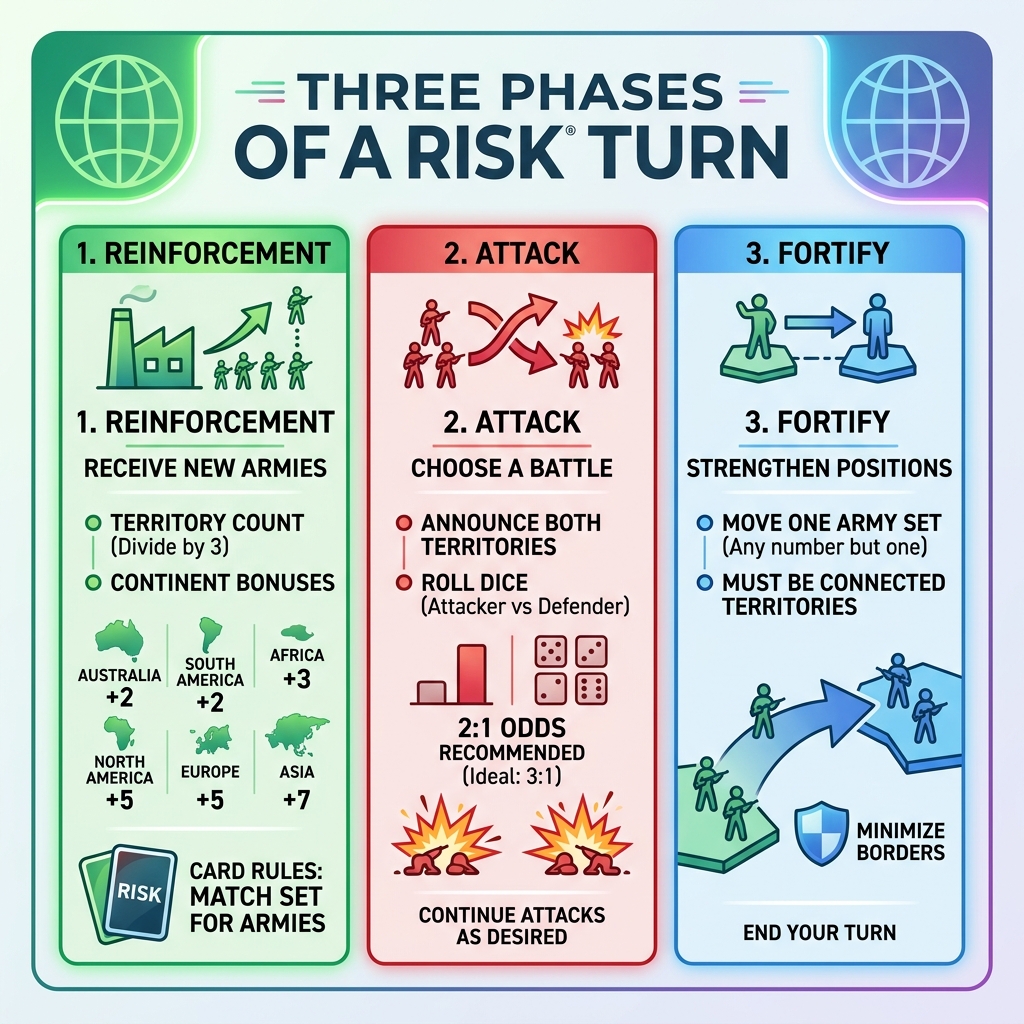
The Three Phases of a Turn
Every turn in Risk follows a strict three-step structure. Skipping a step or performing it out of order is a rookie mistake that can cost you the game.
- The Reinforcement Phase: This is where you get your new “toys.” You receive armies based on the number of territories you own (total territories divided by 3, with a minimum of 3), any continent bonuses you hold, and any RISK card sets you trade in.
- The Attack Phase: This is optional but crucial. You can attack any adjacent territory where you have at least two armies. You can attack as many times as you want, provided you have the troops to sustain the losses.
- The Fortify Phase: After all the bloodshed, you get one move. You can move any number of troops from one of your territories to another connected territory you control. This is vital for shoring up your borders before your opponents take their turns.
For a deeper dive into the initial setup, check out this Risk Game Rules and Setup guide. Understanding that you must always leave at least one troop behind in every territory you own is the golden rule of world domination.

Mastering the Reinforcement Phase
Success in Risk is an “arms race.” The player who consistently deploys the most troops wins. We recommend calculating your reinforcements immediately at the start of your turn to avoid confusion. If you hold 11 territories, you get 3 troops. If you hit 12, you get 4. This small jump is why taking just one more territory can be the difference between holding a border and watching it crumble.
Probability and Your Risk Board Game Strategy Guide
Many players complain that “the dice hate them.” In reality, the dice follow predictable patterns. If you understand the math, you can make “calculated risks” rather than “blind gambles.”
The most important takeaway for any risk board game strategy guide is the Attacker’s Advantage. While the defender wins all ties, the attacker gets to roll three dice against the defender’s two. This statistical edge means that in a long enough battle, the attacker usually wins—if they bring enough friends.
The Magic Ratios
- 3 Dice vs. 1 Die: The defender loses a troop 66.0% of the time. This is your “safe” attack.
- 3 Dice vs. 2 Dice: This is the most common big battle scenario. The defender loses two troops 37.2% of the time, both lose one troop 33.6% of the time, and the attacker loses two troops 29.2% of the time.
- 2 Dice vs. 2 Dice: Avoid this! The attacker loses two troops 44.8% of the time. This is where “suicide missions” happen.
As a rule of thumb, we suggest a 3:1 army ratio for any territory you absolutely must take. If they have 5 troops, show up with 15. It sounds like overkill, but it ensures you have enough surviving troops to actually hold the territory and maintain your momentum.
Early Game Placement and Setup in Your Risk Board Game Strategy Guide
Winning starts before the first die is rolled. During the initial troop placement, your goal isn’t to take the whole world; it’s to create a “core” that can’t be easily broken.
If you are playing a version where you choose your territories, focus on consolidation. Spreading your troops thin across the globe is a recipe for an early exit. Instead, pick a continent you want to target and cluster your forces there. This makes your early turns efficient.
Opening Moves
Your first few turns should focus on two things: earning a card and securing a bonus. We often see beginners try to conquer half of Asia on turn one. Don’t do that. Instead, look for the Best opening moves for board games that prioritize defensible positions.
Buffer Zones are your best friend. If you control a continent, don’t put all your troops on the continent’s border. Put them one territory outside the continent if possible. This forces your opponent to break through your “shield” before they can even touch your bonus-providing territories.
The Mathematics of War: Dice Probabilities and Monte Carlo Analysis
To truly master the risk board game strategy guide, we have to look at the Gaussian distribution—the “Bell Curve” of war. While any single roll is random, 100 rolls are very predictable. This is the same logic used in the insurance industry: while we can’t predict one person’s health outcome, we can use data to protect everyone.
According to The Strategy of Risk and Probability Analysis from MIT, the most “interesting” battles occur when army sizes are nearly equal. However, as the number of troops increases, the variance actually works in the attacker’s favor.
In a large-scale battle (say, 20 vs. 20), the attacker has a much higher chance of winning than the 3:2 dice ratio suggests. This is because the attacker can keep rolling three dice as long as they have four or more troops, while the defender is often reduced to one die as their numbers dwindle.
Risk Assessment
We use a simple mental “Monte Carlo” analysis:
- If you have a 70% chance to win a battle but losing means you lose your only continent, don’t do it.
- If you have a 40% chance to win but success means eliminating a player and taking their five cards, risk it.
Calculated aggression is the hallmark of a veteran. You aren’t just attacking to take land; you are attacking to improve your statistical position for the next turn.
Continent Conquest: From the Australia Turtle to North American Might
Not all land is created equal. In Risk, the map is your greatest ally or your worst enemy.
The Australia Legend: A Trap for Second Place?
Australia is the most famous strategy in the game. It’s easy to take, has only one entrance (Siam), and gives a +2 bonus. However, many veterans call this the “coward’s strategy.” While it guarantees you won’t lose early, it often leaves you “trapped.” If you stay in Australia, you aren’t gaining enough cards or influence to stop someone who takes North America or Europe. Use Australia as a stepping stone, not a permanent home.
South America: The Better Base
South America also gives a +2 bonus but has two entrances (North Africa and Central America). It’s the perfect “mid-tier” base for aggressive players because it allows you to branch out into either the Americas or Africa.
North America: The Crown Jewel
North America is widely considered the “best deal” on the board. It offers a massive +5 bonus and only has three “choke points” (Alaska, Greenland, and Central America). If you can secure North America, you are almost halfway to winning the game.
The Problem Continents: Africa, Europe, and Asia
- Africa (+3): Decent, but it’s a crossroads. You will be attacked from all sides.
- Europe (+5): Too many borders. You’ll spend all your bonus troops just trying to hold the walls.
- Asia (+7): The “Noob Trap.” While +7 sounds great, Asia is impossible to hold. You will be “continent broken” by every other player on the board.
For more on how to manage these territories, see our competitive board game strategy guide.
Advanced Tactics: Card Escalation and the Human Factor
The “escalation” of RISK cards is what ends the game. In most standard rules, the value of card sets increases every time anyone trades them in (4, 6, 8, 10, 12, 15, and then +5 for every set after).
Card Strategy
A common mistake is hoarding cards to get a bigger bonus. We advise against this. Armies now are almost always better than armies later. Using a 10-troop bonus on turn 4 to take a continent will provide more total troops over the next three turns than waiting for a 15-troop bonus on turn 6.
Also, remember the “Matching Territory” rule: if you trade in a card that features a territory you currently occupy, you get 2 extra armies on that specific territory. This is a great way to sneakily reinforce a border.
Identifying Opponent Skill Levels
Risk is a social game. To win, you must categorize your opponents. We use the Level 0-3 system to assess their “risk profile”:
- Level 0 (The Beginner): Plays with their heart. If you attack them once, they will spend the rest of the game trying to destroy you, even if it means they lose too. Strategy: Leave them alone or eliminate them completely in one turn.
- Level 1 (The Negotiator): Tries to talk their way out of everything. They will promise alliances they can’t keep. Strategy: Use them to weaken the leader, then take their land.
- Level 2 (The Tactician): Understands the map and the dice. They play conservatively. Strategy: Look for the Tips for multiplayer board game success and try to out-maneuver them by taking away their continent bonuses.
- Level 3 (The Veteran): They don’t care about “revenge” or “fairness.” They only care about the win. They will act friendly until the moment they can eliminate you. Strategy: This is your primary target. You must prevent them from getting a foothold early.
Mid and Late Game Maneuvers
As the game progresses, the board becomes cluttered with “death stacks” — huge piles of 20+ troops. This is where the game is won or lost.
Target Prioritization
- Eliminate the Weak: If a player has 3 cards and only 5 troops left, kill them. You immediately take their cards. If that gives you 5 or 6 cards, you must trade them in immediately (even if it’s not your turn in some variants, or at the start of your next reinforcement phase). This “card chaining” is how you sweep the board.
- Break the Leader: If someone has a +5 continent bonus, you must break it. Even if you can’t hold the territory, sending a small force to take one country in their continent denies them those 5 extra troops next turn.
- Avoid the “Kingmaker” Scenario: Don’t weaken a player so much that the next person in the turn order can easily finish them off and take their cards. You want to be the one who gets the “bounty.”
Handling Alliances and Diplomacy
Alliances in Risk are temporary by definition — there can only be one winner. However, they are necessary for survival.
We recommend Offensive Treaties over defensive ones. Instead of saying “Don’t attack me,” say “Let’s both attack the guy in North America.” This keeps your “ally” focused away from your borders.
The 2-Player Dynamic
In 2-player Risk, the game often uses “Neutral Armies.” These act as buffers. A key Strategy tips for two-player games is to use the neutral armies as a shield. Force your opponent to waste their troops clearing out neutrals while you build up your core.
Secret Missions and Capitals
If you are playing “Secret Mission Risk,” your strategy changes entirely. You don’t need to conquer the world; you just need to finish your goal. If your goal is to destroy the “Blue” player, don’t worry about continents. Just follow Blue around the map like a shadow.
Frequently Asked Questions about Risk Strategy
Is the Australia “Turtle” strategy actually effective?
It is effective for staying in the game, but rarely for winning it. In a 4-6 player game, the “Australia Turtle” usually finishes in 2nd or 3rd place. To win, you eventually have to leave the nest and take a second continent. If you wait too long, the player holding North America will simply have too many troops for you to overcome.
When is the optimal time to trade in RISK cards?
The optimal time is whenever it allows you to either take a continent or eliminate another player. If you have a set of cards and using them won’t result in a significant gain, you might wait one turn, but remember: having 5 cards makes you a massive target for everyone else.
How do you counter a player who is playing “suicidally”?
“Suicidal” players (Level 0) are dangerous because they don’t care about winning. The best counter is distance. Don’t share a border with them if you can help it. If they attack you, don’t retaliate immediately unless you can wipe them out. If you fight back emotionally, you both lose, and a third player will win the game.
Conclusion
At its heart, Risk is a game of patience, probability, and people. World domination isn’t about being the loudest person at the table or the one with the luckiest dice; it’s about being the one with the best plan. By mastering the three phases of a turn, understanding the 3:1 attack ratio, and choosing your continents wisely, you place yourself in the top tier of players.
Always remember to maintain strategic flexibility. A plan that works in the early game might fail in the mid-game. Much like choosing the right health insurance plan, Planning ahead in board games requires looking at all the variables and preparing for the unexpected.
We hope this risk board game strategy guide helps you crush your enemies (and friends) with grace and efficiency. For more tips on strategy and planning for a secure future, Visit iBest Health Insurance. Now, go forth and conquer!
