
What Every Player Needs to Know: A Pandemic Board Game Guide
This pandemic board game guide covers everything you need to play, strategize, and win — from first setup to advanced tactics. At iBest Health Insurance, we understand that managing a global health crisis — even on a game board — requires the same proactive strategy and teamwork we value in real-world healthcare.
Quick answers for new players:
- Goal: Cure all 4 diseases before the game ends you
- Players: 2 to 4 (45 minutes per game)
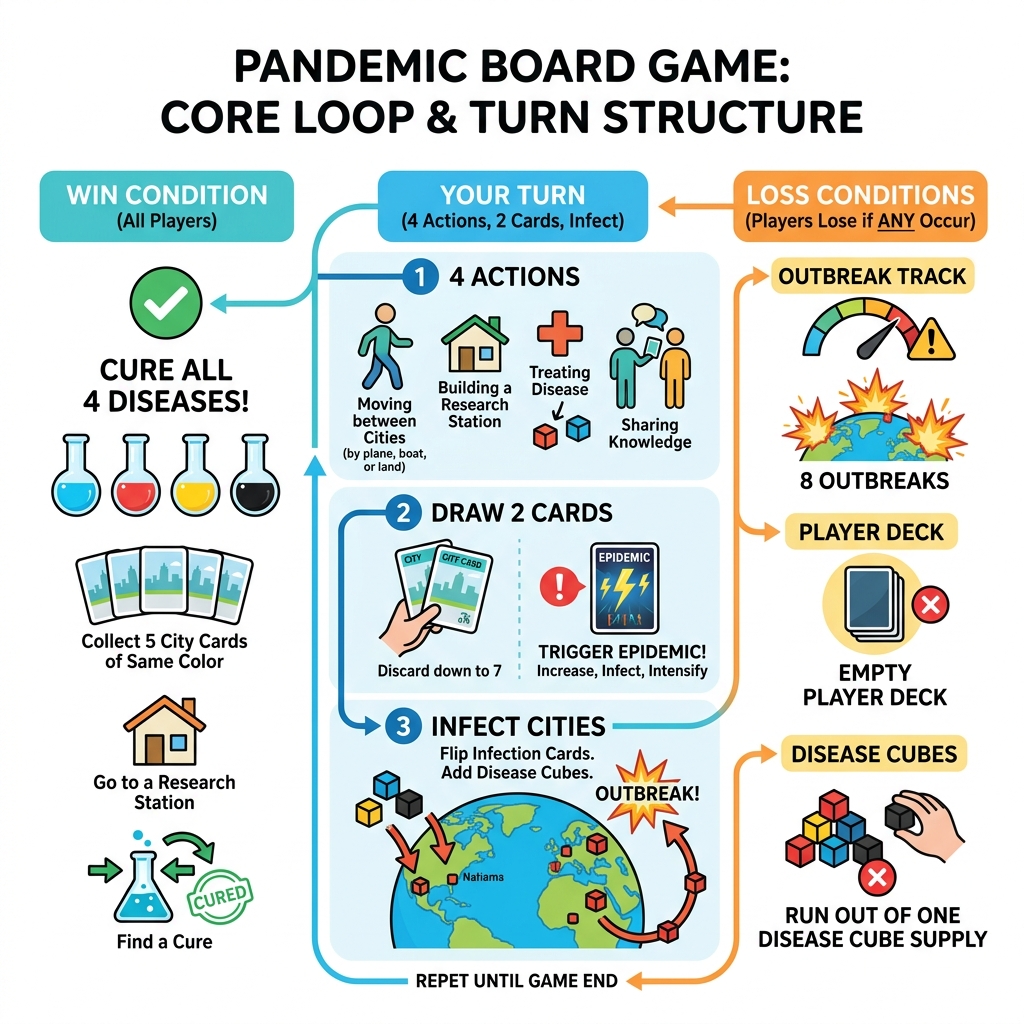
- Your turn: Take 4 actions → draw 2 cards → infect cities
- How to win: Discard 5 same-color cards at a research station to cure each disease
- How to lose: 8 outbreaks, empty player deck, or any disease cube supply runs out
- Difficulty: 4 epidemic cards (beginner), 5 (normal), 6 (heroic)
Pandemic is a cooperative strategy board game designed by Matt Leacock and released in 2008. Every player works together against the game itself — not against each other. That single design choice makes it one of the most popular and enduring board games ever made.
The premise is simple but tense. Four deadly diseases are spreading across the globe. Your team of specialists has limited time and limited resources to find all four cures. Every decision matters.
What makes Pandemic so compelling — and so challenging — is that luck alone won’t save you. The game rewards players who think ahead, communicate openly, and use each role’s unique strengths at the right moment. Even experienced players only win on the hardest difficulty roughly 20–30% of the time.
Whether you just opened the box or you’re trying to crack heroic mode, this guide will walk you through every layer of the game.
Important pandemic board game guide terms:
Mastering the Basics: A Pandemic Board Game Guide to Setup and Rules
Just as iBest Health Insurance emphasizes preparation to mitigate health risks, setting up Pandemic correctly is half the battle. We often find that new players struggle with the “Infection” deck versus the “Player” deck, so let’s break down the components and the board.
The game board represents a global map of 48 cities. These cities are grouped into four colors (Blue, Yellow, Black, and Red), representing the four diseases. Our journey always begins in Atlanta, which is the home of the CDC (Centers for Disease Control and Prevention). This is where the first research station is placed and where all player pawns start.
Game Components and Initial Infection
To get started, we need to sort the 96 disease cubes (24 of each color), place the outbreak marker at “0,” and set the infection rate marker at the first “2” spot. According to the How To Play Pandemic | Step-By-Step Instructions | Board Game Halv, the initial infection phase is what sets the stage for the crisis. We draw nine cards from the Infection Deck:
- The first three cities get 3 cubes each.
- The next three cities get 2 cubes each.
- The final three cities get 1 cube each.
This puts 18 cubes on the board before we even take our first turn. It creates immediate “hotspots” that we must address before they spiral into outbreaks.
Difficulty Levels and Role Assignment
The difficulty of the game is determined by the number of Epidemic cards we shuffle into the Player Deck. We recommend 4 cards for an introductory game, 5 for a normal challenge, and 6 for a “Heroic” or legendary experience.
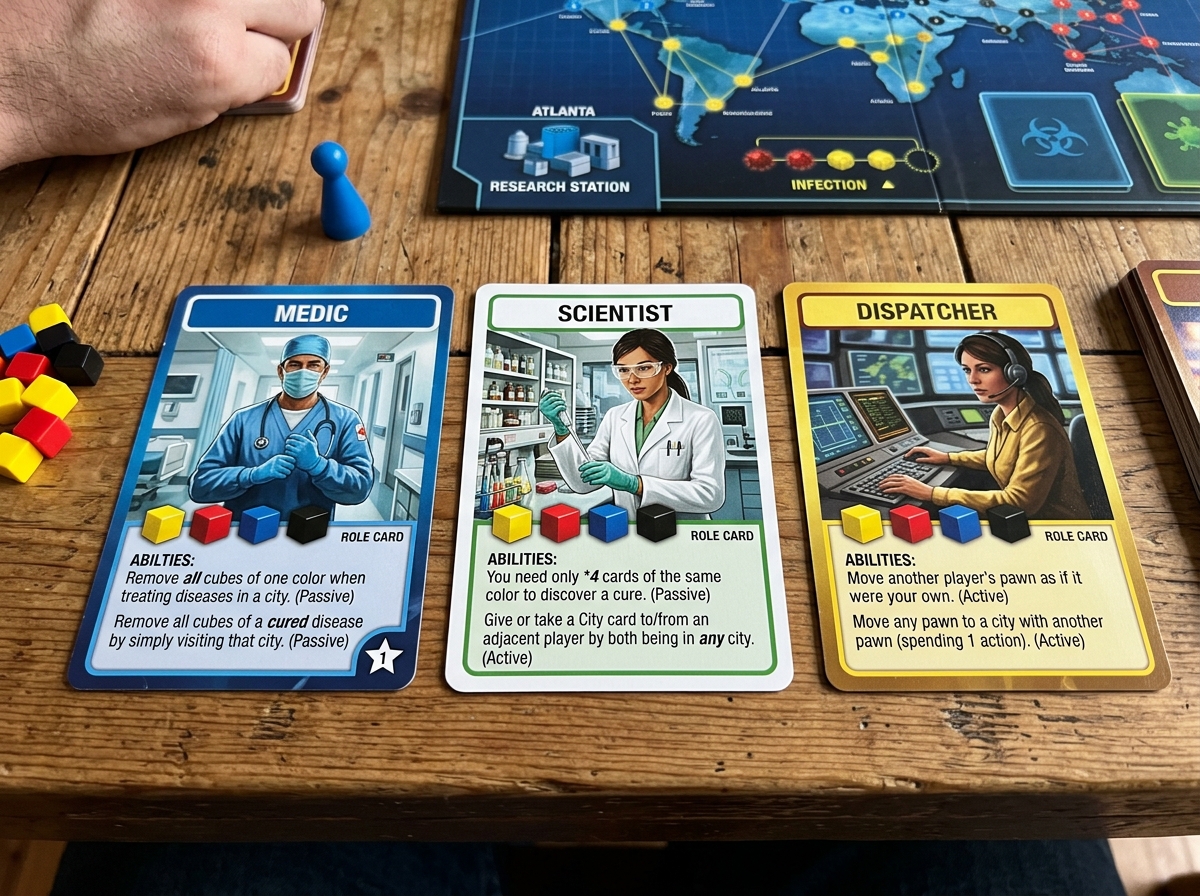
Each of us is dealt a random Role card. These aren’t just for flavor; they provide game-breaking abilities that are essential for victory. For example, the Medic can remove all cubes of one color in a single action, while the Scientist only needs four cards (instead of five) to discover a cure. For more detailed setup steps, you can check out How to play Pandemic: board game’s rules, setup and how to win explained | Dicebreaker.
Understanding the Pandemic Board Game Guide Turn Structure
Every player’s turn follows a strict sequence of three phases. Skipping a step or doing them out of order is a common mistake that can lead to a quick loss.
- Perform 4 Actions: We can move, treat diseases, build research stations, or share knowledge. We don’t have to use all four, but unused actions cannot be saved for later turns.
- Draw 2 Player Cards: We add two cards from the Player Deck to our hand. If we draw an Epidemic card, we must resolve it immediately (more on that later). We must also respect the 7-card hand limit. If we go over, we must discard or play an Event card immediately.
- Infect Cities: We act as the “Infector.” We draw a number of cards from the Infection Deck equal to the current Infection Rate and add one cube to each city shown.
If we want to keep the world safe, we have to balance our actions between long-term goals (curing) and short-term survival (treating). For more tips on managing these phases, see dont-let-the-virus-win-with-these-pandemic-tips.
Core Actions and Role Synergies
Efficiency is the name of the game. In Pandemic, movement is often the most “expensive” action because it consumes the turns we should be using to treat or cure. This coordination mirrors the way iBest Health Insurance connects you with a network of specialists to ensure comprehensive coverage. We have four ways to move:
- Drive/Ferry: Move to an adjacent city connected by a line.
- Direct Flight: Discard a city card to move directly to that city.
- Charter Flight: If we are in a city and have that city’s card, we can discard it to fly anywhere on the board.
- Shuttle Flight: Move between any two cities that both have research stations.
Essential Special Actions
Beyond movement, we have four special actions that drive the game toward its conclusion:
- Build a Research Station: Discard the card matching our current city to place a station. These are vital for Shuttle Flights and are the only places where we can discover a cure.
- Treat Disease: Remove one cube from our current city. If the disease is already cured, we remove all cubes of that color for just one action.
- Share Knowledge: This is how we get cards to the right person. If two players are in the same city, one can give the other the card matching that city. This is notoriously difficult to coordinate but essential.
- Discover a Cure: At a research station, discard 5 city cards of the same color to cure that disease.
Top Role Combinations for Your Pandemic Board Game Guide
The real magic happens when we combine role abilities. Some pairings are so effective they can make Heroic difficulty feel like a walk in the park.
- The Medic + The Dispatcher: This is the “Super Sweeper” combo. The Dispatcher can move other players’ pawns. By moving the Medic through infected areas, the Dispatcher allows the Medic to clear cubes without using their own actions. Once a disease is cured, the Medic removes cubes just by stepping into a city!
- The Scientist + The Researcher: This is the ultimate “Cure Engine.” The Researcher can give any city card from their hand to another player in the same city, regardless of whether they are in that city or not. This allows the Scientist to gather the four cards they need incredibly quickly.
- The Quarantine Specialist + The Operations Expert: While the Operations Expert builds a network of research stations for fast travel, the Quarantine Specialist stands in the middle of a “hot zone,” preventing any new cubes or outbreaks from occurring in her city and all adjacent cities.
For more advanced coordination tips, check out our guide on advanced-strategies-for-cooperative-games.
Advanced Strategies for Normal and Heroic Difficulty
Once we’ve mastered the basic rules, the game gets harder. In Normal and Heroic modes, we can’t just react to the board; we have to predict it.
The Anatomy of an Epidemic
When an Epidemic card is drawn, three things happen in order:
- Increase: The infection rate marker moves up.
- Infect: We draw the bottom card of the Infection Deck and put 3 cubes on that city.
- Intensify: This is the most brutal part. We take the Infection Discard Pile, shuffle it, and place it on top of the Infection Deck.
This means the cities that were just infected are going to come up again immediately. We must use this information to our advantage. If we know which cities are on top of the deck, we can position ourselves to treat them before the next infection phase.
Managing Outbreaks and Connectivity
Outbreaks occur when we need to add a fourth cube of one color to a city. Instead of adding the cube, we advance the outbreak marker and add one cube to every connected city. This can cause chain reactions if adjacent cities also have 3 cubes.
To prevent this, we focus on “hubs.” Cities like Istanbul and Hong Kong each have six connections. An outbreak in one of these cities is devastating because it spreads the disease to six other locations at once. We should prioritize keeping these hubs at two cubes or fewer. For a quick refresher on these mechanics, you can watch Learn How to Play the Pandemic Board Game in 4 Minutes.
Strategic Research Station Placement
Don’t just build research stations everywhere. We recommend building 2 to 4 stations in addition to the one in Atlanta. The best locations are:
- Far from Atlanta to provide a “bridge” to other continents.
- In central hubs (like Karachi or Cairo) that allow easy access to multiple colors.
- At the edges of “problem areas” so we can sweep through and then shuttle back to safety.
Strategic Event Card Timing
Event cards are powerful because they don’t cost an action and can be played at almost any time. However, timing is everything.
- Forecast: This allows us to look at and reorder the top 6 cards of the Infection Deck. Use this after an Epidemic’s “Intensify” step to see exactly what threats are coming.
- One Quiet Night: Skips the next infection phase. This is a lifesaver when the board is covered in 3-cube cities and we are one turn away from a cure.
- Resilient Population: Removes one card from the Infection Discard Pile from the game entirely. Use this on a city with 3 cubes that just came up in an Epidemic to ensure it never bothers us again.
- Government Grant: Builds a research station for free. This is best used early to set up our travel network without wasting cards.
If you enjoy the tactical depth of Pandemic, you might also like these underrated-cooperative-board-games-review.
Winning Tactics: Curing vs. Eradicating
A common trap for beginners is trying to remove every single cube from the board. We have to remember: our goal is to cure, not necessarily to eradicate.
| Feature | Curing a Disease | Eradicating a Disease |
|---|---|---|
| Requirement | Discard 5 cards of the same color at a station. | Cure the disease, then remove all its cubes from the board. |
| Win Condition | Needed for all 4 colors to win. | Not required to win the game. |
| Benefit | Treating now removes all cubes in a city for 1 action. | New cubes of this color are never placed again. |
| Risk | High card cost (5 cards). | High action cost (wasted time removing every cube). |
We should only eradicate if it happens naturally or if it’s very early in the game. If we spend too many actions “cleaning up” a cured disease, we will run out of time to find the remaining cures. The player deck is our clock; once it’s empty, we lose.
Communication and the “Alpha Player” Problem
Since Pandemic is a cooperative game with open information, it’s easy for one experienced player to start “bossing” everyone else around. We call this “Alpha Gaming.” To keep the game fun, we should:
- Share what’s in our hands but let each player make their own final decision.
- Discuss “worst-case scenarios” together.
- Focus on the team goal. It doesn’t matter who discovers the cure, as long as it gets discovered.
Effective communication is the most important tool in our pandemic board game guide. We need to plan two or three turns ahead, especially when coordinating a “Share Knowledge” action. For more on the social dynamics of gaming, see recently-released-cooperative-board-games.
Frequently Asked Questions about Pandemic
How do you handle a chain reaction outbreak?
A chain reaction happens when an outbreak in City A puts a fourth cube in City B, triggering a second outbreak. We move the outbreak marker one space for each city that outbreaks. The only limit is that a single city cannot outbreak more than once per turn. If the marker reaches 8, humanity loses.
Can you win if you run out of disease cubes?
No. If we need to place a cube of a certain color and the supply is empty, the game ends immediately in defeat. This represents the disease becoming too widespread to contain. This is why “manage” the cubes, even if we aren’t close to a cure. We don’t need to clear the board, but we must keep enough cubes in the box to survive the next infection phase.
What is the best player count for winning?
Pandemic scales differently depending on the number of players.
- 2 Players: Often considered the “easiest” because cards are concentrated in fewer hands, making it easier to find cures. Each player also gets more turns before the deck runs out.
- 4 Players: The most challenging. Each player only gets a few turns total, and city cards are spread thin across four hands. Coordination and the “Share Knowledge” action become absolutely critical here.
- 3 Players: A middle ground, but often tricky because the math of “sharing cards” doesn’t always divide evenly.
Conclusion
Winning at Pandemic requires a mix of tactical cube management and strategic long-term planning. We must use our roles effectively, communicate constantly, and respect the “clock” that is the player deck. It’s okay to let a few outbreaks happen if it means getting that final cure one turn faster.
At iBest Health Insurance, we believe that teamwork and strategy are the keys to overcoming any challenge, whether on a board game map or in real life. We hope this pandemic board game guide helps you and your team save humanity!
If you’re looking for more tabletop adventures, check out these underrated-indie-cooperative-games-2026 or visit our homepage at https://www.ibesthealthinsurance.com/ for more lifestyle and wellness tips. Now, get back to Atlanta—there’s a world to save!
