
Why Every Monopoly Player Needs a Real Strategy Guide
A monopoly strategy guide is the difference between being the first one out and the last one standing. Most people think Monopoly is mostly luck. It isn’t.
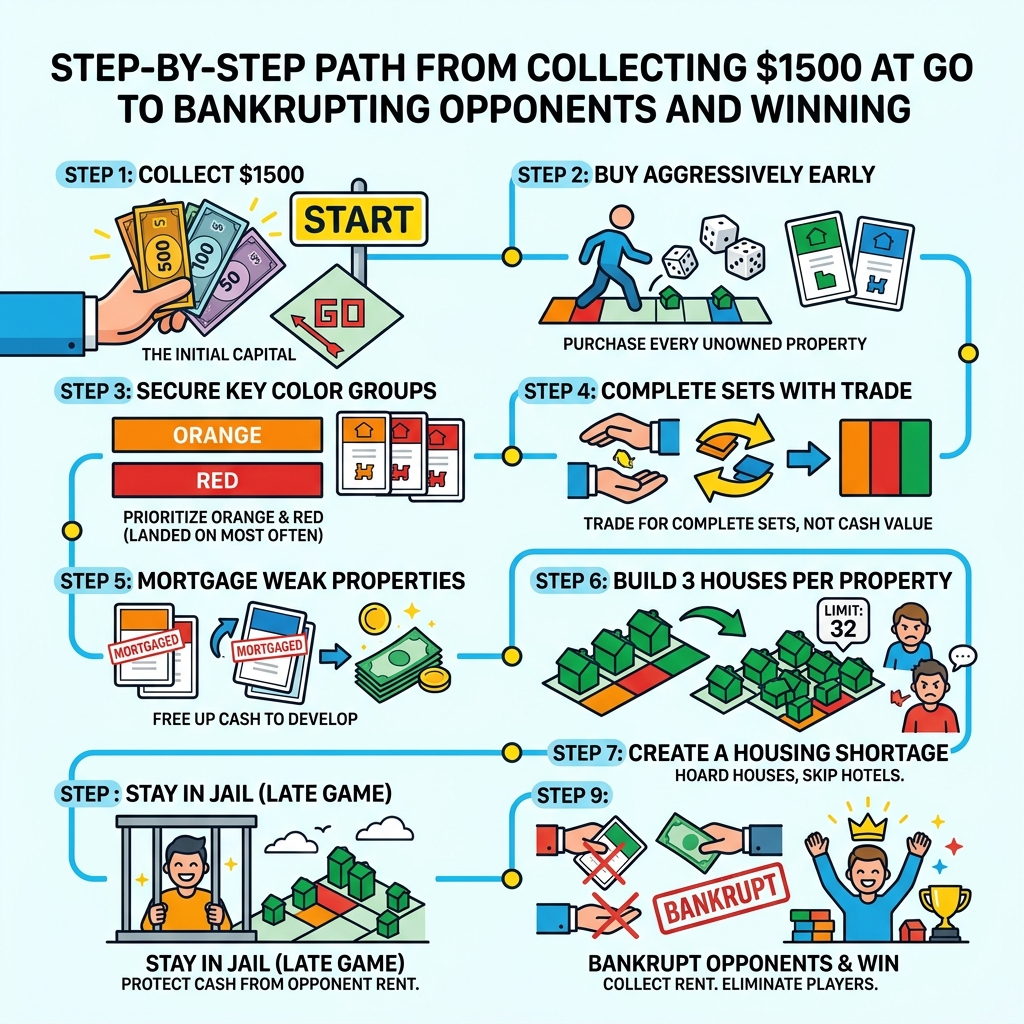
Here’s a quick breakdown of the core winning strategies, so you can act on them right away:
- Buy aggressively early – Purchase nearly every property you land on in the first few laps
- Prioritize orange and red properties – These are landed on most often due to their position after Jail
- Build 3 houses per property – This is the sweet spot for rent returns and blocking opponents
- Hoard houses, skip hotels – With only 32 houses in the game, keeping houses off the market hurts opponents
- Use auctions – When you decline to buy, the bank auctions the property, sometimes for far less than face value
- Stay in Jail late-game – Once properties are developed, sitting out a few turns protects you from big rents
- Mortgage weak properties – Free up cash to build on your best color groups
- Trade for complete sets, not cash value – A monopoly beats a pile of money every time
Monopoly is the best-selling board game of all time, and official games should last around 90 minutes to 2 hours – but most home games drag on for hours because of house rules and poor strategy.
The game isn’t about owning the most properties. It’s about bankrupting your opponents through rent. That requires planning, not just lucky dice rolls.
Whether you’re playing the classic edition or the Monopoly Mega Edition with its Speed Die and skyscrapers, the same core principles apply. This guide walks you through all of them.
Mastering the Monopoly Strategy Guide: The Foundation of Victory

To truly dominate the board, we first have to unlearn the “house rules” that have likely plagued family game nights for decades. Playing by the official rules ensures a fair, efficient, and predictable outcome. Most people play with rules that actually make the game harder to win and much longer to finish. For instance, putting tax money under Free Parking or granting $400 for landing on GO creates an influx of cash that prevents players from going bankrupt. In a competitive monopoly strategy guide, the goal is to drain the economy, not stimulate it.
The Power of Official Rules
When we stick to the official rules, the game moves at a brisk pace. One of the most forgotten rules is the Auction. According to the official rulebook, if a player lands on an unowned property and chooses not to buy it at the printed price, the Banker must immediately auction it to the highest bidder. This is a crucial part of best opening moves for board games because it allows us to snag properties for significantly less than their face value if our opponents are low on cash.
Early-Game Aggression
We start the game with $1,500. While that might feel like a lot, it disappears quickly. Our strategy in the first two or three laps around the board is simple: buy everything. If you land on it and it’s unowned, buy it. Even if it’s a property you don’t particularly want, owning it gives you “trade bait” later.
Official Rule Advantages:
- Auctions: You can often pick up properties for $10 or $50 if no one else bids.
- No Free Parking Payouts: Keeps the total money in the game low, making rent more lethal.
- Even Building: Prevents players from loading all their houses on one property, forcing a balanced (and expensive) development strategy.
Property Prioritization and Dice Probabilities
Winning Monopoly is a math game. If we understand which squares are landed on most frequently, we can invest our limited capital where it will yield the highest Return on Investment (ROI).
The Magic of Seven
In Monopoly, we use two six-sided dice. The most common sum rolled is 7 (with a 1 in 6 chance), followed by 6 and 8. This statistical reality dictates which properties are “hot zones.”
The Jail Effect: Why Oranges are King
Statistically, Jail is the most visited square on the board. Players go to Jail via the “Go to Jail” space, drawing a card, or rolling three doubles in a row. Because so many players start their turn from the “Just Visiting” section of Jail, the properties located 6, 8, and 9 spaces away are landed on more than any others.
These are the Orange properties: St. James Place, Tennessee Avenue, and New York Avenue. They are relatively cheap to build on, and their proximity to Jail makes them a statistical goldmine. Following closely behind are the Red properties, specifically Illinois Avenue, which is the single most landed-on property on the entire board.
While the Dark Blue properties like Boardwalk and Park Place offer massive payouts, they are rarely landed on and are incredibly expensive to develop. In the real world, property growth can be unpredictable, as seen in real-world property growth data, but on the Monopoly board, the Oranges and Reds are the most consistent performers for capital growth and rental yield.
Advanced Building Tactics: The 3-House Rule and Housing Shortages
Once we have a monopoly (all properties of one color group), we need to develop them. But how many houses should we build? Many beginners rush to buy Hotels, thinking the higher rent is always better. This is a mistake.
The 3-House Rule
The “sweet spot” for development is exactly three houses per property. Why? Because the jump in rent from two houses to three is the largest in the game. For example, on the Orange set, rent might jump from $100 to $450 just by adding that third house. The cost to go from three houses to four, or from four houses to a hotel, doesn’t offer nearly the same percentage increase in profit. We want to reach three houses on every property in our set as quickly as possible. This requires planning ahead in board games to ensure we have the cash ready the moment we complete a set.
Creating a Housing Shortage
There is a secret weapon in the Monopoly box: the 32-house limit. There are only 32 green houses available. If the Bank runs out, no one can build any more houses until someone sells theirs or upgrades to a hotel.
By building four houses on each of our properties and refusing to upgrade to hotels, we can effectively “lock” the housing market. If we own two or three monopolies and put four houses on each, we can use up nearly all the houses in the game. This prevents our opponents from developing their own sets, even if they have the money. It’s a ruthless tactic, but it’s a cornerstone of any expert monopoly strategy guide.
Implementing Your Monopoly Strategy Guide for Development
When developing, we must follow the rule of even building. We cannot put two houses on one property until every property in that set has one house.
Pro-Tip: Build your houses just before an opponent’s turn, especially if they are approaching your “kill zone.” This keeps your cash liquid for as long as possible while surprising them with a high rent bill. For more on this, check out our board game planning and decision tips.
The Art of the Deal: Trading and Mortgaging
Rarely will we land on every property in a color group naturally. To win, we must master the art of the deal.
Strategic Mortgaging
Don’t be afraid to mortgage properties. If we have two properties in the Orange set and need cash to buy the third from an opponent, we should mortgage our single properties (like a lone Green or a Utility) to raise the funds.
We can also use mortgaged properties as “speed bumps.” If we are low on cash and an opponent is about to land on our undeveloped properties, mortgaging them doesn’t hurt us much (since the rent is low anyway), but it provides the capital needed to build houses on our primary monopoly. This type of liquidity management is essential for winning tactics for card-based board games.
Trading for Sets vs. Value
In a trade, the face value of the cards doesn’t matter; the potential for a monopoly does. We would gladly trade a “valuable” Green property for a “cheaper” Orange property if it completes our set.
Trading Secrets:
- Win-Win Trades: Propose a trade where both you and an opponent complete a set – but make sure your set is in a higher-traffic area (like Orange vs. Light Blue).
- Blocking: If an opponent is one card away from a dangerous monopoly (like the Reds), do everything in your power to acquire that card first so you can use it as leverage.
- Cash is King: Sometimes, throwing in $50 or $100 “sweetener” is all it takes to get a deal done.
For more advanced negotiation, see our competitive board game strategy guide.
Late-Game Survival and Special Editions
As the game progresses and the board becomes a minefield of houses and hotels, our strategy must shift from offense to defense.
The Late-Game Jail Strategy
In the early game, being in Jail is a nightmare because we can’t buy properties. We should pay the $50 or use a card to get out immediately. However, in the late game, Jail is our best friend.
When the board is covered in opponent’s houses, the safest place to be is behind bars. While in Jail, we still collect rent on our properties, but we don’t have to move, meaning we can’t land on an opponent’s hotel. We should stay in Jail for the full three turns or until we are forced to roll our way out. Think of this as the ultimate safety net against high-rent districts.
Railroads vs. Utilities
- Railroads: These are excellent early-to-mid-game investments. Owning all four generates $200 every time someone lands on them. Since they are located in the center of each side, the probability of someone landing on at least one is high.
- Utilities: Generally, skip them. The ROI is incredibly low. Even owning both only yields a maximum of $120 (on a roll of 12), and the odds of landing on them are slim.
The Mega Edition and Speed Die
If we are playing the Monopoly Mega Edition, the strategy changes slightly. The Speed Die introduces “Mr. Monopoly,” who whisks us to the next unowned property (early game) or the next property where rent is owed (late game). This makes the game much faster and more volatile.
In this version, we can also build Skyscrapers and Train Depots. According to expert tips from Flavor365, Skyscrapers can increase rent to astronomical levels, making it even more important to control the housing market early. Use your Bus Tickets wisely – save them for the late game to skip over an opponent’s high-rent district or to land exactly on the space we need to complete a set. These extra layers require specific tips for multiplayer board game success.
Frequently Asked Questions about Monopoly Strategy
Why should I avoid the Dark Blue properties?
The “Boardwalk Trap” is real. While Boardwalk and Park Place have the highest rent, they are only two properties (making them easier for opponents to avoid) and are the most expensive to develop. We often spend so much money trying to build there that we go broke before anyone lands on them. Oranges and Reds provide a much more consistent income.
Is it better to stay in Jail or pay to get out?
It depends on the stage of the game. Early game: Pay to get out and buy properties. Late game: Stay in as long as possible to avoid paying rent to others while still collecting your own.
How do I use auctions to my advantage?
If we know an opponent is low on cash, we can land on a property and decline to buy it. During the auction, we can often win the property for a fraction of its cost because our opponent simply cannot afford to outbid us.
Conclusion
Winning at Monopoly isn’t about the luck of the draw; it’s about understanding the economy of the board. By prioritizing high-traffic properties like Oranges and Reds, mastering the 3-house rule, and using the housing shortage to our advantage, we can turn a simple board game into a masterclass in strategy.
These tactics reflect broader planning skills such as diversification, understanding ROI, and managing liquidity. For more insights into mastering your favorite tabletop challenges, explore our more info about board game planning. Now, go forth, roll the dice, and may you be the one to collect everyone else’s $1,500!
