
The Business Expansion Strategy Review That Won’t Put You to Sleep
Why Every Growing Company Needs a Business Expansion Strategy Review
A business expansion strategy review is the structured process of evaluating how well your company’s growth plan is working — and deciding what to change, double down on, or cut entirely.
Here’s what a solid review covers at a glance:
| Review Area | What You’re Evaluating |
|---|---|
| Market penetration | Are you gaining share in existing markets? |
| Product/service development | Are new offerings driving revenue? |
| Geographic expansion | Are new locations or regions performing? |
| Financial health | Are margins, cash flow, and ROI on track? |
| Operational readiness | Can your systems and team handle the scale? |
| Risk exposure | Are threats identified and managed? |
Most businesses don’t fail because they had the wrong idea. They fail because they scaled before they were ready — or kept pushing a strategy that wasn’t working because no one stopped to honestly evaluate it.
Think about it this way: a business that opened four locations successfully, then nearly collapsed trying to open six more simultaneously, isn’t a story about bad luck. It’s a story about skipping the review step.
Growth and expansion are not the same thing. Growth means doing more of what already works. Expansion means doing something structurally different. Confusing the two is one of the most expensive mistakes a company can make.
That’s exactly why a regular, honest expansion strategy review matters — not as a box-ticking exercise, but as a genuine health check on whether your company is moving in the right direction, at the right pace, with the right resources.
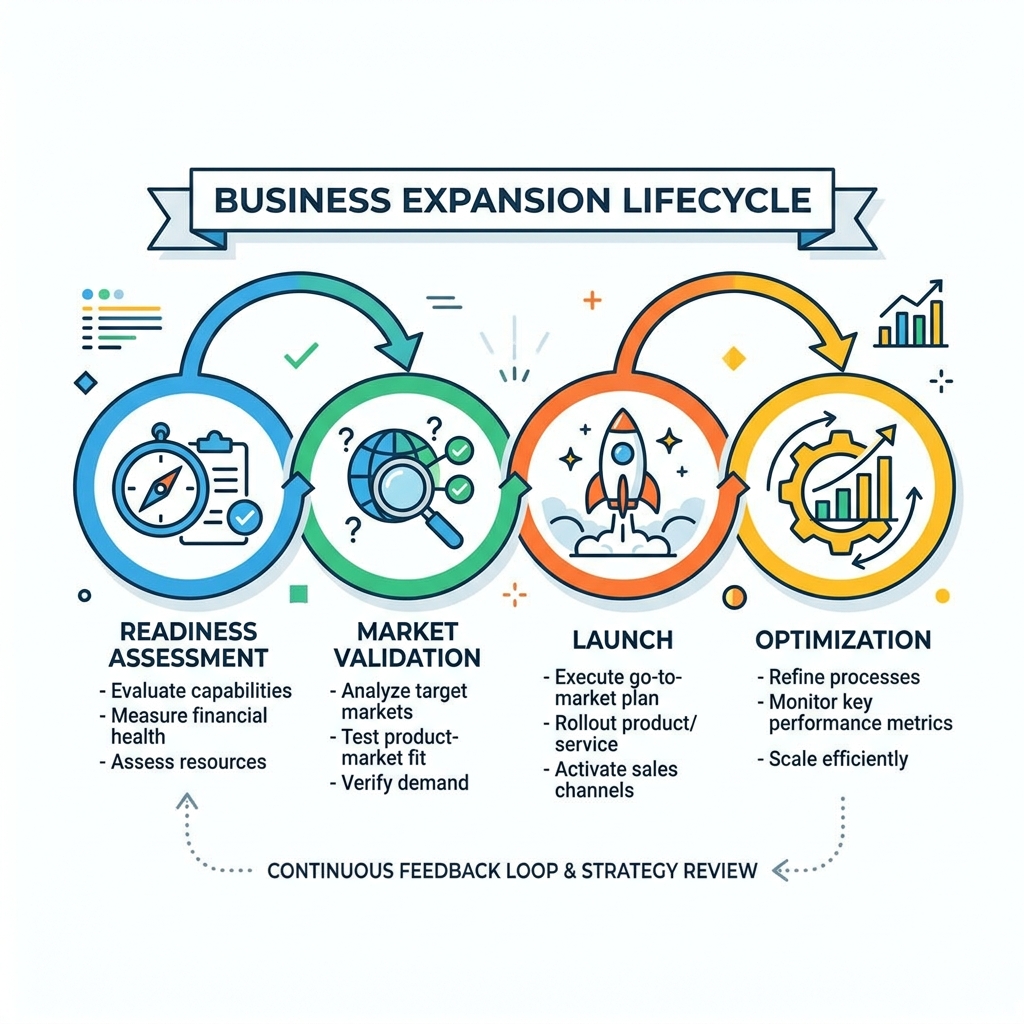
Core Pillars of a Business Expansion Strategy Review
When we sit down to conduct a business expansion strategy review, we aren’t just looking at a spreadsheet of bank balances. We are looking at the structural integrity of the entire organization. Expansion is thrilling—it’s the corporate equivalent of a growth spurt—but it places immense pressure on your foundation.
The core pillars of a review help us determine if the expansion is actually creating value or just creating “busy-ness.” We focus on revenue growth, yes, but we also look deeply at risk diversification. Are we entering new markets to protect ourselves from a downturn in our original niche? Or are we just chasing shiny objects?
A successful review follows a Business Expansion Blueprint that prioritizes sustainable scaling over rapid, uncontrolled bursts. We want to see economies of scale kicking in—where your costs per unit or service decrease as your volume increases. If your costs are rising faster than your revenue during expansion, your review should trigger a “stop and fix” order.
Finally, we look at brand reputation. Expansion can dilute a brand if quality isn’t maintained. Whether you are a tech firm or a service provider, your reputation is your most valuable asset. If your expansion into a new territory is resulting in one-star reviews, it’s time to rethink the strategy.
Analyzing Market Penetration and Development
Market penetration is often the “safest” form of expansion because we are dealing with what we already know. We are selling more of our existing products to our existing customers. During a business expansion strategy review, we ask: Have we truly exhausted our current market?
Sometimes, the best expansion isn’t a new city, but a better loyalty program or a more aggressive pricing strategy in your home turf. Think of it like a “base game” in hobbies. Before you buy every add-on, you want to make sure you’ve mastered the core rules. For those interested in how “extra content” can revitalize an existing interest, you might find More info about board game expansions quite illustrative of how to keep an audience engaged without reinventing the wheel.
Market development, on the other hand, takes that “base game” to a new crowd. This could mean moving from B2B to B2C, or moving from the North to the South. The review here must focus on adaptation. What worked in Seattle might flop in Miami. We look at demographics, local buying habits, and competitive pricing to see if our “proven” model actually translates.
Reviewing Product Development and Diversification
This is where the innovation cycles live. Product development involves creating new offerings for your loyal fans. We look at R&D budgets and the “hit rate” of new launches. Are we solving new problems for our customers, or just adding features nobody asked for?
When we review product development, we can learn a lot from established franchises. For example, The complete 7 Wonders buyers guide to expansions shows how a core product can be expanded with “modules” that keep the experience fresh. In business, these “modules” are your new service lines or product iterations.
Diversification is the boldest move—new products for new markets. It’s the highest risk but offers the highest reward. Tesla didn’t just make cars; they moved into solar panels and battery storage. During our review, we must be brutally honest: Do we have the core competency to play in this new sandbox, or are we just hoping for the best?
Strategic Frameworks for Scaling Operations
To scale effectively, we need a framework that matches our risk tolerance and capital availability. There is no one-size-fits-all approach, but there are proven paths.
| Strategy | Pros | Cons | Ideal For |
|---|---|---|---|
| Franchising | Rapid growth, low capital req. | Less control, profit sharing | Proven, replicable service models |
| M&A (Mergers) | Instant market share, talent | High cost, culture clashes | Quick entry into complex markets |
| Partnerships | Shared risk, local expertise | Revenue split, loss of autonomy | Entering foreign or niche markets |
| Licensing | Passive income, low effort | Brand risk, limited upside | Intellectual property-heavy firms |
We often look toward the Six strategies for growth outperformance to guide these choices. Whether it’s vertical integration (buying your suppliers) or joint ventures, the goal of the review is to ensure the chosen framework is actually delivering the efficiency we promised our stakeholders.
The Role of Market Research in Your Business Expansion Strategy Review
Market research is the antidote to “growth by gut feeling.” A review isn’t complete without a fresh look at the Total Addressable Market (TAM). Is the market growing, or are we fighting for a bigger slice of a shrinking pie?
We analyze competitor moves—did a rival just lower their prices? Did a new startup disrupt the delivery model? We also look at consumer behavior. In 2025, consumer preferences shift faster than ever. If your expansion strategy was built on data from 2022, it’s already obsolete.
Just as enthusiasts look for New expansion packs for board games to see what the latest trends are, businesses must constantly scan the horizon for “new packs” of customers and technologies.
Financial Modeling and Risk Mitigation
If the business expansion strategy review had a heart, it would be the financial model. We aren’t just looking at history; we are looking at pro forma statements for the next 3 to 5 years.
Key questions we answer in the review:
- Cash Flow: Do we have enough “runway” to reach profitability in the new market? Domestic expansion often takes 12-18 months to turn a profit; international can take 36 months.
- Emergency Funds: Are we maintaining 3-6 months of operating expenses?
- Capital Deployment: Is the money going toward revenue-generating assets (like sales talent and tech) or just fancy new offices?
Learning How to write an expansion business plan is essential for this phase. It’s not just about getting a loan; it’s about creating a “license to scale” that proves the ROI to yourself and your investors.
Global vs. Domestic: Navigating New Frontiers
Expanding domestically is like playing on “Normal” difficulty. Expanding globally is “Legendary” difficulty. The stakes are higher, the rules are different, and the potential for expensive mistakes is massive.
In a global business expansion strategy review, we look at:
- Cultural Intelligence: Does our marketing land, or does it offend?
- Language Localization: Did you know 40% of consumers will never buy from a website not in their native language? Offering your product in Chinese, Hindi, and Spanish could grow your potential audience by 268%.
- Local Compliance: Tax structures and labor laws can sink an expansion faster than a lack of customers. Many of our peers now use Employer of Record (EOR) hiring to test markets without the four-month headache of setting up a local subsidiary.
We can draw insights from 9 Proven Business Expansion Strategies which highlight that global hiring grew by triple digits in 2022. The world is getting smaller, but the complexity of managing a diverse international team is only growing.
Metrics to Measure Your Business Expansion Strategy Review Success
You can’t manage what you don’t measure. In our reviews, we move past “vanity metrics” (like total users) and dive into “sanity metrics.”
- Unit Economics: Are we making a profit on every single customer, or are we “losing money on every sale but trying to make it up in volume”? (Hint: that doesn’t work).
- Customer Acquisition Cost (CAC) vs. Lifetime Value (LTV): If it costs $100 to get a customer who only spends $80 over three years, your expansion is a leak, not a fountain.
- Churn Rate: Are we losing customers as fast as we’re gaining them?
Just as players might be Ranking Wingspan expansions from Oceania to Asia to see which adds the most value to their game night, we rank our expansion territories. If the “Asia” branch is outperforming the “Oceania” branch, we need to know why and reallocate our capital accordingly.
Preparing Infrastructure and Leadership for Scale
Expansion puts a spotlight on every crack in your foundation. If your current systems require you to manually enter data, they will break when you double your orders. We review “Scalable Tech”—automation tools, CRM integrations, and cloud infrastructure that can grow with us.
Leadership is the other half of the equation. We often see founders who are great at “doing” but struggle at “leading leaders.” A review should assess whether the management team has the training and the standardized processes to maintain quality control across multiple time zones.
Building a business is like Building a better kingdom with Carcassonne expansions; you need a solid strategy for where to place your “tiles” (resources) so the whole map stays connected and strong.
Learning from Expansion Setbacks and Failures
Let’s be real: not every expansion works. Even giants like Coca-Cola and Starbucks have had to retreat from certain markets. The difference between a “failure” and a “pivot” is the business expansion strategy review.
When an expansion stalls, we perform a root-cause analysis. Was it the market? The timing? The team? Or was it the product-market fit? We build resilience by creating feedback loops where the “boots on the ground” can tell the “suits in the office” what’s actually happening.
We also emphasize exit planning. Knowing when to fold is just as important as knowing when to bet. If a market isn’t reaching its KPIs after 24 months, we need a pre-approved plan to either pivot or withdraw. It’s about strategic adaptation, not stubbornness.
For a bit of perspective on how to handle “resource management” when things get tight, The ultimate guide to Settlers of Catan expansions offers some great metaphors for trading, building, and expanding even when your opponents (competitors) are blocking your path.
Frequently Asked Questions about Expansion Reviews
How do I know if my business is ready to expand?
The biggest sign of readiness is “Operational Autonomy.” If you can leave your business for a month and it doesn’t fall apart, you have the systems to scale. You also need healthy margins, a loyal customer base, and a “referral engine” that works without you having to push it constantly.
What is the most common mistake in expansion strategy?
Expanding too fast without a plan. We call it “The Growth Trap.” Companies get a little bit of success, get excited, and try to open ten locations at once. This drains cash flow, burns out the team, and usually leads to a decline in quality that kills the brand.
How does global expansion differ from domestic growth?
The complexity is the main difference. In domestic growth, you know the laws, the language, and the culture. In global expansion, you have to relearn how to sell, how to hire, and how to stay compliant. It requires much more “Humility” and a willingness to listen to local experts.
Conclusion
A business expansion strategy review isn’t just about looking at the past; it’s about designing the future. By maintaining strategic coherence and focusing on leadership quality, we ensure that our growth is not just big, but “good.”
At iBest Health Insurance, we believe that the same principles of care and long-term planning that apply to your health should apply to your business. Whether you are scaling a tech startup or a local service, take the time to review your roadmap. Growth is a journey, not a race.
Ready to take the next step in your business journey? Make sure your team is protected as you grow. Visit iBest Health Insurance to see how we can support your expanding workforce with plans that scale with you.
