
The Classic Monopoly Game Guide: Rules, Setup, and Winning Strategies
This monopoly game guide covers everything you need to play correctly and win more often. At iBest Health Insurance, we know that planning, budgeting, and risk management matter both at the game table and in everyday financial decisions, which is why strategy-focused content like this fits our broader lifestyle and family planning resources.
Quick answer — how Monopoly works:
- Goal: Be the last player standing by bankrupting all opponents.
- Setup: Each player starts with $1,500 and places their token on GO.
- Turn: Roll two dice, move clockwise, and act on the space you land on.
- Buy: Purchase unowned properties or send them to auction.
- Build: Own a full color set, then build houses and hotels to raise rent.
- Win: Force every other player into bankruptcy.
Monopoly has been a staple of game nights since Charles B. Darrow handmade the first boards during the Great Depression. Parker Brothers picked it up in 1935, and the game has since been published in many countries and languages. It’s simple enough for an 8-year-old, yet deep enough that seasoned players consistently outperform beginners.
The gap between knowing the rules and winning the game is bigger than most people realize. Luck matters, but property selection, building timing, and trading decisions matter far more.
This guide walks you through the official rules and then goes deeper — into the strategies that actually work.
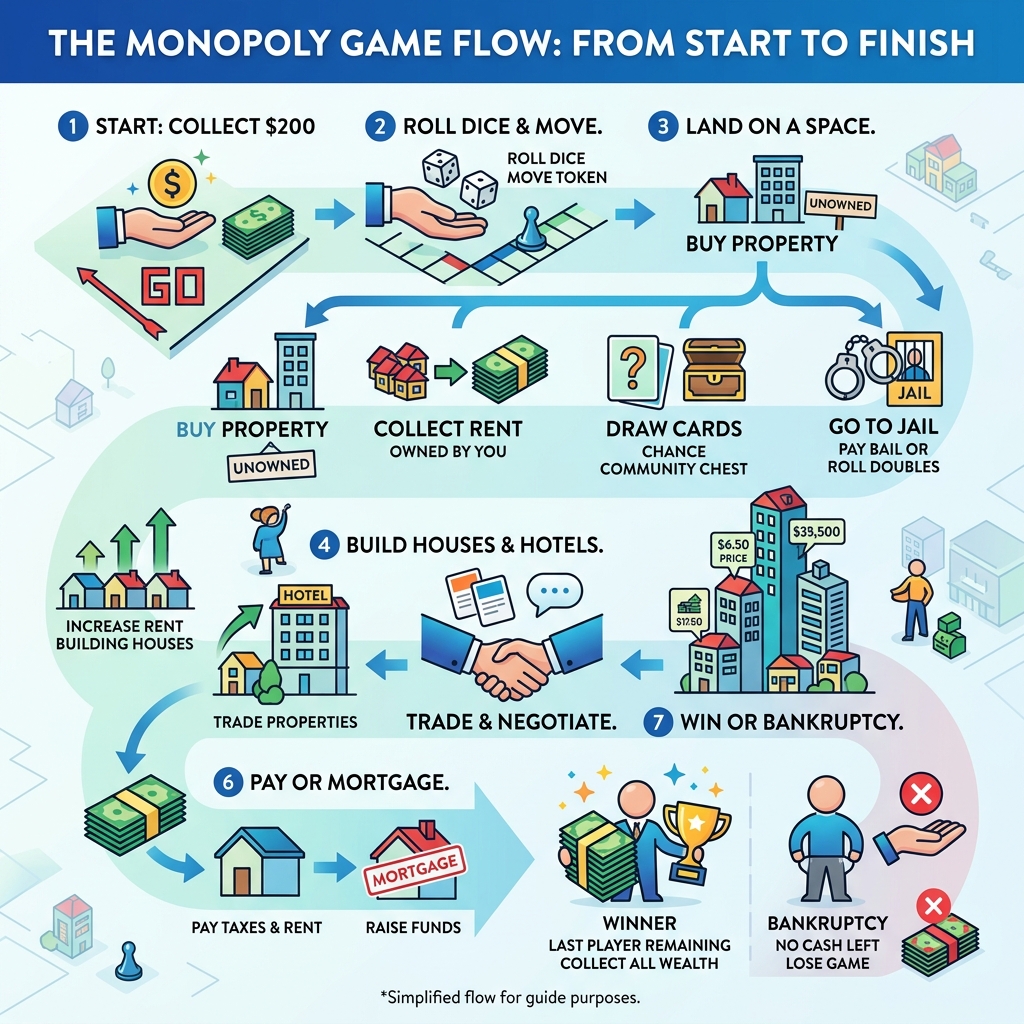
Monopoly game guide terms you need:
Essential Setup and Equipment for Play
Before we start rolling the dice, we need to make sure the board is prepped correctly. A standard Monopoly set is a finely tuned machine of economic chaos, and missing even one piece can throw off the balance.
What’s in the Box?

Every classic Monopoly set includes:
- The Gameboard: The iconic square track featuring 40 spaces.
- 8 Tokens: Modern sets include the Top Hat, Rubber Ducky, Scotty Dog, Hazel the Cat, Race Car, Penguin, Battleship, and T-Rex.
- 28 Title Deed Cards: One for every property on the board.
- 32 Houses and 12 Hotels: These are the engines of your wealth.
- 16 Chance and 16 Community Chest Cards: The “wild cards” of the game.
- 2 Standard Dice: To determine movement.
- Monopoly Money: A pack of colorful bills totaling $20,580 in a standard set.
For a deeper look at the official documentation, you can refer to the Official Monopoly Rules and Gameplay Guide.
Starting Money Denominations
Each player begins with exactly $1,500. While it might be tempting to just hand over a stack of cash, the official distribution is specific to ensure the Bank doesn’t run out of small bills too early:
- 2 x $500
- 2 x $100 (or 4 x $100 in some newer editions)
- 2 x $50
- 6 x $20
- 5 x $10
- 5 x $5
- 5 x $1
Setting Up Your Monopoly Game Guide for Success
To begin, we place the board on a flat surface and shuffle the Chance and Community Chest cards, placing them face-down on their designated spots. Each player chooses a token and places it on the “GO” space.
One of the most important steps is choosing the Banker. This person needs to be organized and, ideally, good at quick math. The Banker manages the Bank’s money, the Title Deeds, and the supply of houses and hotels. If the Banker is also playing, they must keep their personal funds strictly separate from the Bank’s cash.
As we’ve noted in our beginner-strategy-guide-for-tabletop-games, a clean setup prevents disputes later. The Bank never actually “goes broke”—if it runs out of cash, the Banker can simply issue IOUs by writing on pieces of paper.
Managing Properties in Your Monopoly Game Guide
The heart of the game is property management. When you land on an unowned property, you have a choice: buy it for the listed price or let it go to auction.
The Auction Rule (The “Forgotten” Rule): Many players don’t realize that if a player lands on a property and declines to buy it at the printed price, the Banker must immediately auction it to the highest bidder. Bidding can start at any price, and even the player who originally declined to buy it can participate. This is a vital part of board-game-planning-and-decision-tips because it keeps the game moving and allows savvy players to pick up properties at a discount.
Once you own all properties in a color-group (a “Monopoly”), you can charge double rent on unimproved lots. This is the first step toward building your empire.
Core Gameplay Mechanics and Movement
The game begins with each player rolling both dice. The player with the highest total goes first, and play proceeds clockwise.
The Turn Structure
On your turn, roll the dice and move your token the corresponding number of spaces.
- Passing GO: Every time you land on or pass the GO space, the Banker pays you a $200 salary. If a card sends you to GO, you collect the $200 immediately.
- Rolling Doubles: If you roll doubles, you move, take your action, and then roll again. However, if you roll three sets of doubles in a row, you don’t move the third time—you go directly to Jail.
- Landing on Property: If you land on an owned property, you must pay rent. The owner must ask for the rent before the second player following you throws the dice, or the debt is void!
For more specific movement nuances, check the Instructions Manual & Rules for Monopoly.
Navigating Jail and Special Board Spaces
Jail is one of the most misunderstood parts of any monopoly game guide. You end up in Jail if you land on the “Go to Jail” space, draw a card telling you to go there, or roll three doubles.
How to get out of Jail:
- Pay a $50 fine on your next turn before rolling.
- Use a “Get Out of Jail Free” card.
- Roll doubles on any of your next three turns.
- If you fail to roll doubles by your third turn, you must pay $50 and move the distance of your last roll.
While in Jail, you are not “out” of the game. You can still collect rent, trade properties, and buy houses. In the late game, Jail is actually a safe haven where you can avoid landing on opponents’ expensive hotels! This is a classic tip for tips-for-multiplayer-board-game-success.
Other Spaces:
- Free Parking: Officially, this is just a “resting place.” No money is awarded here.
- Income Tax: You must pay $200. (Older rules allowed a 10% total worth option, but modern rules stick to the flat fee).
- Chance and Community Chest: Follow the instructions on the card immediately.
Building Houses and Hotels
Once you own all properties of a color-group, you can start building. But there are strict rules to follow:
- The Even Building Rule: You must build “evenly.” You cannot put two houses on one property until every property in that color-group has at least one house. The same applies to selling them back.
- Four Houses to a Hotel: Once you have four houses on every property in a set, you can return them to the Bank and pay for a Hotel. You can only have one Hotel per property.
- Building Shortages: There are only 32 houses. If the Bank runs out, you cannot build until someone else sells theirs. This is a key part of the competitive-board-game-strategy-guide—experienced players often refuse to upgrade to hotels just to keep houses off the market, preventing opponents from building at all!
Financial Strategy: Mortgages and Bankruptcy
Cash flow is the lifeblood of Monopoly. Much like having a health insurance policy to protect your savings, understanding how to use mortgages can provide a necessary safety net during a financial crunch in the game. If you run low on cash, you may need to mortgage your properties.
Mortgaging Rules
To mortgage a property, you must first sell all buildings on that color-group back to the Bank at half their original cost. Then, turn the Title Deed card face-down.
- The Bank gives you the mortgage value listed on the back of the card.
- No rent can be collected on mortgaged properties.
- To “un-mortgage,” you must pay the Bank the mortgage amount plus 10% interest.
Trading is allowed at any time and is often the only way to complete a set. You can trade properties for cash, other properties, or “Get Out of Jail Free” cards. As we discuss in best-opening-moves-for-board-games, a smart trade is often better than a lucky roll.
Handling Bankruptcy and Winning the Game
Bankruptcy occurs when you owe more than you can pay, even after selling all buildings and mortgaging all properties.
- Owed to another player: Turn over all your assets to that player. They must immediately pay the Bank 10% interest on any mortgaged properties they receive.
- Owed to the Bank: All your assets are auctioned off by the Banker, and you are eliminated from the game.
The last player remaining with money and property is the winner! Proper planning-ahead-in-board-games ensures you are the one collecting the deeds rather than handing them over.
Pro Strategies to Master the Monopoly Game Guide
If you want to win consistently, you need to look at the math. Not all properties are created equal.
Property ROI and Landing Probabilities
| Property Group | Landing Probability | Strategy Value |
|---|---|---|
| Oranges | Highest | Best investment in the game. |
| Reds | High | Excellent late-game power. |
| Railroads | High | Great early-game cash flow. |
| Utilities | Low | Generally poor investments. |
| Dark Blues | Low | High “swing” potential but risky. |
The Orange Monopoly Strategy: Statistically, the Orange properties (St. James Place, Tennessee Avenue, and New York Avenue) are the most landed-on spaces in the game. Why? Because they are situated exactly 6, 8, and 9 spaces away from Jail—the most common exit points. Own these, and you will bankrupt your friends.
The “3-House Rule”: The biggest jump in rent occurs between the second and third house. For example, on Illinois Avenue, rent jumps from $300 (2 houses) to $750 (3 houses). The cost of the fourth house or a hotel rarely offers the same return on investment. Get three houses on a set as fast as possible, then stop. This also helps create a housing shortage, as mentioned in The Ultimate Guide to Winning at Monopoly.
Speed Die and Short Game Variants
If you don’t have four hours to spare, many modern editions include a Speed Die.
- 1, 2, or 3: Add this to your regular dice roll.
- Bus Icon: Choose to move the value of one or both of the standard dice.
- Mr. Monopoly: Move your regular roll, take the action, then move forward to the next unowned property (or the next property you’d owe rent on).
There are also “Short Game” rules where three properties are dealt to each player at the start, and the game ends after the second player goes bankrupt. These variations are great examples of strategy-tips-for-euro-style-games where time management is key.
Frequently Asked Questions about Monopoly Rules
Can you collect rent while in Jail?
Yes! This is one of the most common misconceptions. While you cannot move your token, you are still a property owner. You can collect rent, participate in auctions, trade properties, and buy or sell houses. In fact, staying in Jail as long as possible is a valid pro strategy during the late game to avoid landing on an opponent’s Boardwalk hotel.
What happens if you land on Free Parking?
According to the official monopoly game guide, nothing happens. It is simply a “free” square where you rest for a turn without penalty. Many families use a “House Rule” where all tax money goes into the center of the board and is collected by whoever lands on Free Parking. While fun, this actually makes the game last much longer by injecting extra cash into the economy, preventing bankruptcies.
Do you have to land on a property to buy it?
Yes. You must land directly on a property to have the first right of refusal to buy it at the listed price. However, if you land there and don’t buy it, it goes to auction. This means you can technically buy a property during someone else’s turn if they land on it and choose not to purchase it!
Conclusion
Mastering Monopoly is about more than just the luck of the dice. It’s about understanding the “even building” rules, utilizing auctions to your advantage, and prioritizing the high-traffic Orange and Red sets. By following the official rules and avoiding the common “Free Parking” house rules, you can ensure a faster, more competitive game.
At iBest Health Insurance, we believe that strategy and preparation are the keys to success, whether you’re managing a real estate empire on a board or looking out for your family’s future. For more ways to sharpen your mind and your game, check out our category/strategy-tips.
Ready to dominate your next game night? Visit iBest Health Insurance for more lifestyle and strategy guides!
