
Why Board Game Strategy Guides Change the Way You Play
Board game strategy guides are the fastest way to stop losing and start winning at your favorite tabletop games. Whether you’re picking up Catan for the first time or diving deep into Smash Up expansions, the right guide cuts your learning curve dramatically.
Quick answer — the best board game strategy guides cover:
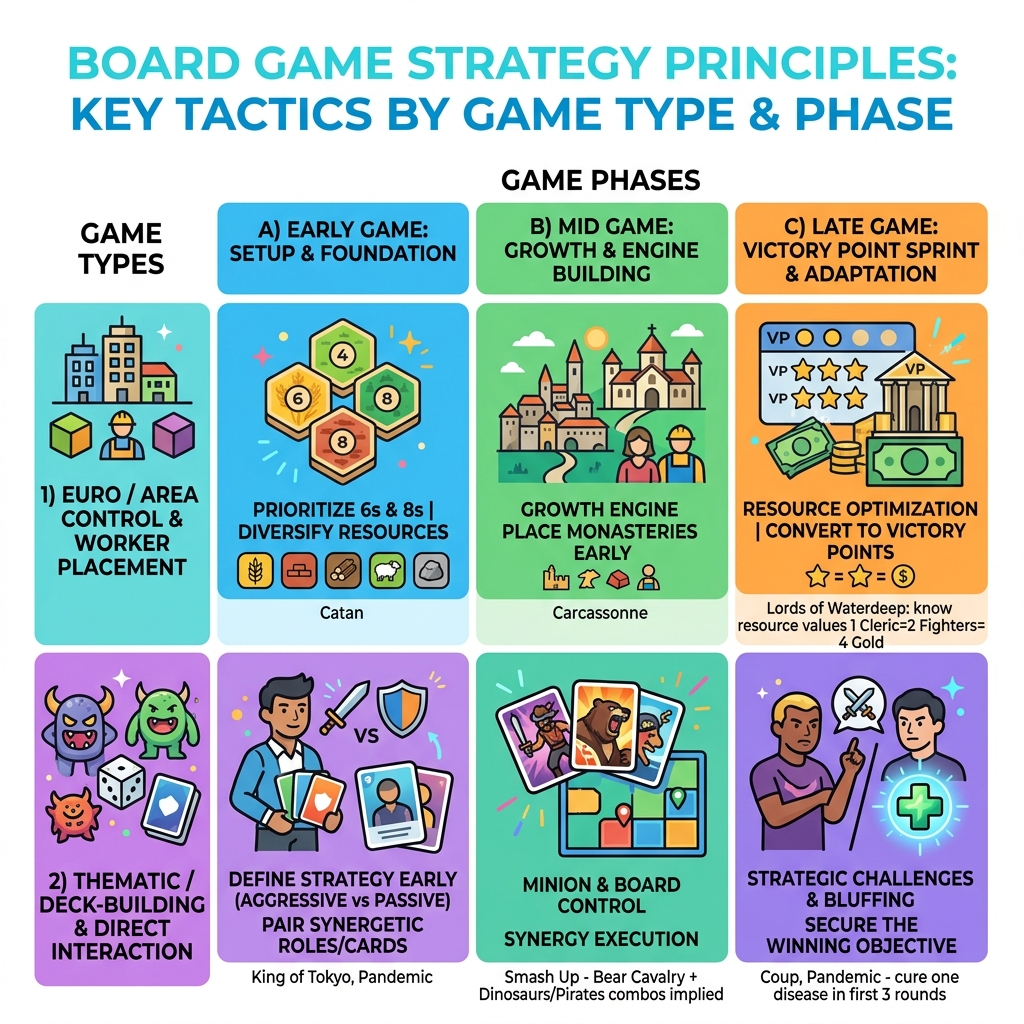
- Catan — prioritize 6s and 8s, diversify resources, adapt to the board
- Carcassonne — place monasteries early, use defensive tile laying
- King of Tokyo — commit to aggressive or passive strategy based on player count
- Pandemic — use role combos like Dispatcher + Medic, cure one disease in the first 3 rounds
- Lords of Waterdeep — know resource values (1 Cleric = 2 Fighters = 4 Gold)
- Smash Up — pair Bear Cavalry with Dinosaurs or Pirates for maximum minion control
- Coup — challenge Duke claims strategically (46.15% success odds if you don’t hold the card)
The tabletop hobby is overwhelming. New expansions drop constantly. Every game has hidden depth that rulebooks never explain. And nothing kills a game night faster than feeling like you’re the only one who doesn’t know what they’re doing.
Good strategy guides don’t just tell you what to do. They explain why certain moves work — so you can adapt when the board surprises you.
This roundup covers the sharpest, most actionable guides for popular games, from casual classics to complex euro-style builders.
Essential Board Game Strategy Guides for Classics
When we sit down for a “classic” game night, we often rely on nostalgia and luck. However, the most popular games on the planet have been mathematically “solved” to a high degree. If you want to dominate the next family gathering, you need to move beyond rolling and hoping.
Catan: The Power of Probability
In Catan, your game is often won or lost in the first five minutes. The Best Beginner Strategy for Catan emphasizes that you must respect the “pips.” Statistically, 6 and 8 are the most frequent rolls (13.9% probability each), followed by 5 and 9.
We recommend a “two-pronged attack” during setup. Your first settlement should grab the highest probability numbers available, while your second should fill the gaps in your resource variety. If your first spot is heavy on Ore and Wheat, ensure your second touches Sheep or Brick. Remember: resources in your hand are a liability. If you have more than seven cards, spend them on a Development Card to “bank” that value before a 7 is rolled.
Monopoly: The 3-House Rule
Forget the utilities and railroads; they are traps for the unwary. To win at Monopoly, you need to control the housing market. There are only 32 houses in the game. By building exactly three houses on every property in a color set, you maximize the rent jump while creating a massive housing shortage that prevents opponents from developing their own sets.
Focus your efforts on the Orange and Red properties. Because they sit just after the Jail space, they are statistically the most landed-on spots on the board. For more insights on crushing the competition, check out this competitive board game strategy guide.
Kingdomino: Terrain Prioritization
Kingdomino may look simple, but top-tier players on Board Game Arena play it with surgical precision. Data shows that winners emphasize Fields, Forests, and Lakes. In fact, top players score about 11% more points from Fields than the average player.
The Kingdomino Strategy Guide suggests segmenting your board: keep high-frequency tiles in the center to maintain connection options and push low-value “edge” tiles like Mountains to the periphery. Most importantly, top players discard tiles 20% less often than beginners by keeping their board edges open for any possible domino.

Mastering Modern Strategy: From Smash Up to Carcassonne
Modern “hobby” games require a different mental toolkit. These games often involve asymmetric powers or tile-laying mechanics where every turn alters the board state for everyone else.
Smash Up: Faction Synergies
In board game strategy guides, Smash Up is a favorite because of the “combo” potential. If you are playing with the Awesome Level 9000 expansion, the Bear Cavalry is widely considered the strongest faction.
Their “Cub Scout” minion allows you to move an opponent’s smaller minion to its base, while the “High Ground” action lets you destroy minions that move there. Pair Bear Cavalry with Pirates or Dinosaurs to create a “movement engine” that clears the board of rivals before a base scores. For more help with card-driven games, see these winning tactics for card-based board games.
Carcassonne: The Defensive Meeple
Carcassonne is often played too passively. To win, you must be opportunistic. Monasteries are the most valuable tiles in the game because they offer high points and a guaranteed way to get your follower back quickly.
We suggest placing monasteries early in the game; in a 2-player game, you have roughly 35.5 turns to complete them, but that drops to just 14.2 turns in a 5-player game. Use “defensive” tile laying to cap off an opponent’s city before it gets too large, or “piggyback” on their progress by placing a tile that connects your knight to their nearly finished structure.
King of Tokyo: Know Your Player Count
Your strategy in King of Tokyo must shift based on how many people are at the table. In a 2-player game, staying in Tokyo is usually optimal because you can deal consistent damage. However, in a 4-player game, the “attack ratio” is 3:1 against you. If you stay in Tokyo too long, you’ll be eliminated before you can heal.
Advanced Tactics for Engine Builders and Worker Placement
In “Euro” games, efficiency is everything. You aren’t just playing a game; you’re building a machine that converts raw materials into victory points.
Lords of Waterdeep: The Economy of Cubes
To master Lords of Waterdeep, you must understand resource equivalence. Expert players use a “base value” system to decide which actions are worth taking:
- 1 Cleric/Wizard = 2 Fighters/Rogues
- 2 Fighters/Rogues = 4 Gold
- 4 Gold = 2 Intrigue Cards
Controlling the Builder’s Hall is the most powerful move in the game. By building early, you ensure that every time an opponent uses your building, you get a free resource. This “passive income” is often the difference between first and second place. Learn more with our strategy tips for euro-style games.
Suburbia and The Manhattan Project
In Suburbia, the game is divided into A, B, and C stacks. Your strategy must evolve through these phases:
- Early Game (A Stacks): Focus entirely on Income. You need cash to buy the big tiles later.
- Mid Game (B Stacks): Shift to Reputation. This grows your population (points) every turn.
- Late Game (C Stacks): Pure Population. Buy the high-VP tiles like Skyscrapers and Stadiums, even if they ruin your income.
In The Manhattan Project, the “Plutonium Path” is generally more efficient than Uranium. Focus on training your workers into Scientists and Engineers early. An optimal Mine produces 3 yellowcake per engineer, which can be converted via a Plutonium Reactor (1 scientist + 1 yellowcake) into a finished bomb much faster than the Uranium enrichment route.
Cooperative Survival and High-Stakes Bluffing
Sometimes the “opponent” is the game itself, or perhaps the person sitting across from you is lying to your face. Both require specialized board game strategy guides.
Pandemic: The 3-Round Rule
Pandemic is a race against time. On the hardest difficulty, you only win about 50% of the time, even with perfect play. Our top tip? You must find a cure for at least one disease within the first 3 rounds.
The Dispatcher + Medic combo is the gold standard for board control. Use the Dispatcher to move the Medic into infected hotspots, allowing the Medic to clear cubes without wasting their own actions on movement. For more on high-level co-op play, read about advanced strategies for cooperative games.
Forbidden Desert: Managing the Storm
In Forbidden Desert, death usually comes from thirst or being buried in sand. We recommend staying within four spaces of “well” meeting points at all times. As the game progresses, assess the three loss conditions (Water, Sand, Storm deck) every single turn. If you are one “Sun Beats Down” card away from losing, someone must prioritize digging for a well or sharing water.
Coup and Innovation: The Math of Lies
Bluffing is a science. In Coup, claiming the Duke early is the strongest move for building a coin advantage. If an opponent claims a Duke and you don’t have one in your hand, you have a 46.15% chance of winning a challenge. If you do have one Duke in your hand, the odds of them lying increase significantly (30.77% chance they actually have it).
In Innovation, a card game by Carl Chudyk, “Splaying” is your most powerful tool. Splaying your cards (spreading them out to reveal more icons) allows you to dominate “Demand” effects. Don’t be afraid to share “Dogmas” with opponents; if the card benefits you more than them, the shared action is still a net win for you. Check out the full Innovation Strategy Guide for more card-specific tips.
Frequently Asked Questions about Board Game Strategy Guides
How do expansions affect board game strategy guides?
Expansions often introduce “power creep” or entirely new mechanics that render old strategies obsolete. For example, the Awesome Level 9000 expansion for Smash Up introduced “Talent” abilities. Unlike standard abilities that trigger when played, Talents can be used once every turn. This changed the game from a “burst” style of play to a “sustained engine” style. When using expansions, always look for faction synergies that exploit these new recurring abilities.
What are the best board game strategy guides for beginners?
For beginners, we recommend focusing on games with “open information” like Catan or Kingdomino. These games rely on basic probability and resource balance rather than complex hidden card combos. The key is to learn the “initial placement” rules — in almost every board game, the first two minutes dictate 50% of the outcome. You can find more help in our beginner strategy guide for tabletop games.
How does player count change strategy in dice-rolling games?
In games like King of Tokyo, player count is the most important variable. In a 2-player game, the game is a “sprint” to 20 points or a knockout. In a 4-to-6 player game, it becomes a “marathon” of survival. You must be much more conservative with your health in high-player count games because you will be attacked multiple times before your turn comes back around. Check out these tips for multiplayer board game success for more advice.
Conclusion
Mastering the tabletop isn’t about having the best luck; it’s about making the best decisions with the cards and dice you’re dealt. From the probability-driven hexes of Catan to the high-stakes bluffing of Coup, using board game strategy guides allows you to see the hidden patterns that lead to victory.
At iBest Health Insurance, we know that a great game night is about more than just winning—it’s about the mental growth and social connection that comes from strategic play. By applying these tactics, you’ll not only improve your win rate but also deepen your appreciation for the incredible design behind your favorite games.
For more expert advice on leveling up your game night, explore our board game planning and decision tips or Visit iBest Health Insurance to see how we support a healthy, active lifestyle—both on and off the board.
