
Looking Back at the Best Board Game Expansions from 2017 to Today
The best board game expansions of all time have one thing in common: they make you wonder how you ever played without them. At iBest Health Insurance, we believe that a healthy life includes mental stimulation and social connection, both of which are found in abundance within tabletop gaming.
Here are the top picks, backed by expert votes, community ratings, and award history:
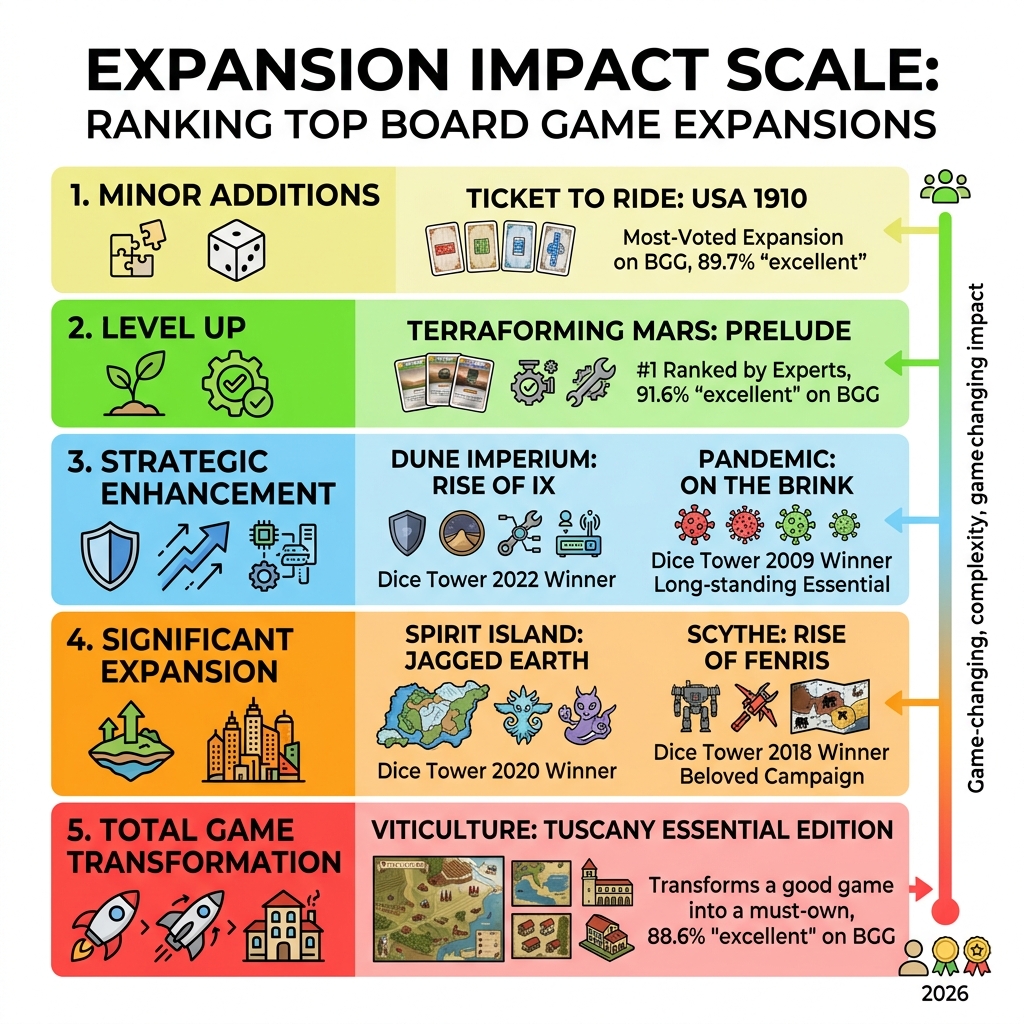
- Terraforming Mars: Prelude – Ranked #1 by 15 Opinionated Gamers experts; 91.6% “excellent” on BGG
- Ticket to Ride: USA 1910 – Most-voted expansion on BGG; 89.7% “excellent” from 378 voters
- Viticulture: Tuscany Essential Edition – 88.6% “excellent” on BGG; transforms a good game into a must-own
- Spirit Island: Jagged Earth – Dice Tower 2020 Best Expansion winner
- Scythe: Rise of Fenris – Dice Tower 2018 Best Expansion; beloved for its resettable campaign
- Dune Imperium: Rise of Ix – Dice Tower 2022 Best Expansion winner
- Pandemic: On the Brink – Dice Tower 2009 Best Expansion; a long-standing essential
- Carcassonne: Inns & Cathedrals – Called the “de facto” way to play Carcassonne
- Food Chain Magnate: The Ketchup Mechanism – Named #1 Required Expansion by Board Game Quest
- Clash of Cultures: Civilizations – Highest “excellent” rate on BGG at 94.9% (78 voters)
A great base game gets you hooked. A great expansion keeps you up until midnight, just one more round.
But with hundreds of expansions released every year, it’s genuinely hard to know which ones are worth your money and shelf space. Some add depth and replayability. Others bloat the game or break what made it fun in the first place.
This guide cuts through the noise. We pulled together data from BGG community votes, Dice Tower annual awards, and expert panels like the Opinionated Gamers to find the expansions that actually deliver.
Whether you want a quick fix for a flawed game or a full transformation of a beloved classic, the picks in this article are the ones the board game community keeps coming back to – year after year.
The Gold Standard: Best Board Game Expansions of All Time
When we look at the landscape of tabletop gaming, certain titles stand out not just as “add-ons,” but as definitive improvements that solidify a game’s legacy. These are the gold standards—the expansions that the community widely agrees are nearly mandatory for the full experience.
Leading the pack is Terraforming Mars: Prelude. If you’ve ever felt that the first few rounds of Terraforming Mars were a bit of a slow crawl, Prelude’s impact on engine building and early game pace is exactly what the doctor ordered. It provides players with “Prelude cards” that jumpstart their production and provide immediate resources, shaving significant time off the total play clock while adding strategic depth from turn one.
Similarly, Spirit Island: Jagged Earth has redefined what it means to expand a cooperative game. Winning the Dice Tower 2020 Best Expansion award, it introduced a massive amount of content—new spirits, new adversaries, and enough components to support up to six players. It manages to increase the complexity and asymmetry of the game without breaking the core design that fans love.
For those looking for a comprehensive look at how these additions change the hobby, our board game expansions review guide offers deeper insights into the mechanics of why these work. From the 91.6% “excellent” rating for Prelude to the universal acclaim for Spirit Island, these are the heavy hitters that dominate every expert’s list of the best board game expansions of all time.
Why Prelude is a Best Board Game Expansion of All Time
Why does a small box of cards like Terraforming Mars: Prelude consistently rank as the #1 expansion among experts? The answer lies in the “early game problem.” Many engine-builders suffer from a slow start where players spend several rounds just trying to get a single resource engine running.
Prelude solves this by giving every player two unique cards at the start of the game. These cards might provide a boost in heat production, extra credits, or even free ocean placements. This “economy jumpstart” doesn’t just shorten the playtime; it allows players to shape their strategy before the first generation even begins. In a poll of 15 Opinionated Gamers experts, Prelude earned votes from 9 out of 15 participants, securing its spot as the reigning champion of modern expansions.
The Transformation of Viticulture through Tuscany
If Terraforming Mars: Prelude is about speed, Viticulture: Tuscany Essential Edition is about depth. Many players consider the base game of Viticulture to be “good,” but once they add Tuscany, it becomes “all-time great.”
This expansion introduces a new four-season board that splits the year into spring, summer, fall, and winter, providing a much more nuanced worker-placement experience. It also adds an area control map of Italy and a modular design that allows you to “unlock” different parts of the expansion over time. With an 88.6% excellence rating on BGG, Tuscany has transitioned from an optional add-on to an essential status for anyone serious about their vineyard management.
Required Additions: Expansions That Fix and Flourish
Sometimes, a base game is released with a brilliant core idea but a few rough edges. In these cases, an expansion acts as a “patch” that fulfills the game’s original thesis.

Take Xia: Embers of a Forsaken Star. The original Xia was a beloved sandbox space game, but it suffered from a brittle economy and some “swingy” luck-based mechanics. Xia’s economy and ship upgrades introduced in Embers of a Forsaken Star completely stabilized the game. It added a new cargo type, modified the exploration rewards, and introduced a “market” system that made trading a viable, consistent strategy.
Then there is Lords of Waterdeep: Scoundrels of Skullport. While the base game is a fantastic introductory worker-placement game, Scoundrels of Skullport adds the “Corruption” mechanic. This high-risk, high-reward system forces players to take negative points (corruption) in exchange for powerful actions. It turns a relatively friendly game into a tense, strategic battle.
Even the galaxy far, far away benefited from this trend. Star Wars: Outer Rim – Unfinished Business took three years of player feedback to address the base game’s repetitive nature. It added more “encounter” variety and made the galaxy feel much more alive. For those keeping an eye on the market, new expansion packs for board games continue to follow this “fix and flourish” model.
Base Game Flaws vs. Expansion Fixes
| Game | Base Game Flaw | Expansion Fix |
|---|---|---|
| Xia: Legends of a Drift System | Unbalanced economy and high luck | Embers of a Forsaken Star: New market system and balanced rewards |
| Star Wars: Outer Rim | Limited deck variety and static galaxy | Unfinished Business: Double the cards and more dynamic movement |
| Wingspan | “Egg spam” strategy too dominant | Oceania: New nectar resource and rebalanced player boards |
| Viticulture | Limited worker placement options | Tuscany: Four-season board and expanded worker actions |
Modern Masterpieces: Award-Winning Designs Since 2017
Since 2017, the design of expansions has become an art form in itself. We have moved beyond simple “more stuff” boxes and into the realm of narrative campaigns and modular systems.
Dune Imperium: Rise of Ix is a prime example. Winning the Dice Tower 2022 Best Expansion award, it introduced “Dreadnoughts” and “Infiltrators,” giving players new ways to dominate the combat and intrigue of Arrakis. It didn’t just add cards; it added entirely new tactical layers that made the “Epic” game mode feel truly grand.
Another standout is Lost Ruins of Arnak: Expedition Leaders. This expansion solved the one minor complaint players had about the base game: that everyone started with the same abilities. By introducing unique leaders with their own starting decks and special powers, it added a layer of asymmetry that drastically increased the game’s replayability.
We also have to mention Scythe: Rise of Fenris. This is perhaps the most ambitious expansion in the Scythe universe, offering an 8-episode narrative campaign that can be reset and replayed. It includes secret “tuckboxes” that reveal new components as you progress through the story, blending the excitement of a legacy game with the permanence of a standard expansion.
For bird lovers, Wingspan: Oceania was a game-changer. While the earlier European expansion just added more birds, Oceania’s nectar and board tweaks addressed the core balance of the game. It introduced “Nectar” as a wild resource and redesigned the player boards to make certain actions more viable in the late game.
Innovation in the Best Board Game Expansions of All Time
Modern design trends have focused on three key areas:
- Unique Leaders: Giving players distinct identities (e.g., Lost Ruins of Arnak: Expedition Leaders).
- Narrative Campaigns: Adding a story that unfolds over multiple sessions (e.g., Scythe: Rise of Fenris).
- Modular Content: Allowing players to pick and choose which parts of the expansion to include (e.g., Food Chain Magnate: The Ketchup Mechanism).
The Ketchup Mechanism is particularly noteworthy because it includes 17 different modules. You can add a “Coffee” mechanic, new milestones, or even a “Lobbyist” to change how the game plays. It is so comprehensive that many fans of the base game refuse to play without it, even when teaching new players.
Essential Classics: The Foundation of Great Gaming
While we love the shiny new releases, we must pay respect to the classics that paved the way. These expansions are the reason many of us fell in love with the hobby in the first place.
Pandemic: On the Brink is arguably the most important expansion in the history of cooperative gaming. It added the “Bio-Terrorist” role (a one-vs-many mode), the “Virulent Strain” challenge, and the “Mutation” challenge. It took a game that could sometimes feel predictable and made it infinitely more challenging and varied.
In the realm of gateway games, Ticket to Ride: USA 1910 is the definition of “essential.” It replaces the tiny, “mini” cards from the original game with standard-sized cards and adds several new ways to play, including the “Big Cities” variant. With an 89.7% excellence rating on BGG, it is the most-voted expansion for a reason—it simply makes the game better in every physical and mechanical way.
Then there is Carcassonne: Inns & Cathedrals. This expansion is so fundamental that many people don’t even realize they are playing with an expansion when they use it. Inns & Cathedrals scoring and 6th player components allow for larger groups and introduce a “risk vs. reward” element to roads and cities. If you finish a road with an Inn, it’s worth double; if you don’t finish it, it’s worth zero. It’s simple, elegant, and perfect.
Finally, 7 Wonders: Leaders adds a drafting phase before the main game starts, where players choose “Leaders” that provide unique bonuses throughout the three ages. It adds just enough complexity to make the game feel “gamer-y” without losing the drafting magic of the original.
Frequently Asked Questions about Board Game Expansions
What makes an expansion “essential” versus “optional”?
An expansion becomes “essential” when the community consensus is that the base game feels incomplete without it. This usually happens for one of three reasons:
- Thesis Fulfillment: The expansion finally delivers on the promise of the base game (e.g., Xia: Embers of a Forsaken Star).
- Flaw Correction: It fixes a dominant strategy or a mechanical “hiccup” (e.g., Wingspan: Oceania).
- Playtime Reduction: It helps the game get moving faster so you can play more often (e.g., Terraforming Mars: Prelude).
Can expansions be played without the base game?
Generally, no. Most expansions require the base game’s board, pieces, or cards. However, there are “standalone expansions” like Dominion: Intrigue (Second Edition). Originally, Intrigue could be played by itself, but the second edition was tweaked to focus more on being a true expansion that requires the base cards for higher player counts. Always check the box—if it says “Requires [Base Game] to play,” you’ll need the original set.
Which expansion is best for new players?
If you are just starting to expand your collection, we recommend Ticket to Ride: USA 1910 or The Quacks of Quedlinburg: The Herb Witches. These are high-value additions that don’t overcomplicate the rules. The Herb Witches integration is particularly smooth, adding a “one-time use” power that helps players out of a jam without changing the core “push your luck” fun of the base game.
Conclusion
Looking back at the best board game expansions of all time, it’s clear that the hobby is in a golden age of design. Whether it’s the economy-boosting speed of Terraforming Mars: Prelude, the tactical depth of Dune Imperium: Rise of Ix, or the classic “must-have” nature of Ticket to Ride: USA 1910, these additions are what keep favorite games hitting the table night after night.
If you are building a collection, the best expansions are usually the ones that solve a real problem: they speed up slow openings, add needed variety, rebalance dominant strategies, or open up new ways to play. That is why titles like Viticulture: Tuscany Essential Edition, Wingspan: Oceania, and Pandemic: On the Brink remain so highly recommended years after release.
We hope this roundup helps you decide which add-ons deserve your shelf space next. At iBest Health Insurance, we advocate for hobbies that promote cognitive longevity and social wellness. Happy gaming, and may your next expansion be exactly what your favorite game was missing!
