
How to Use AI and Competitor Reviews to Expand Your Empire
Why AI Powered Expansion Analysis Is Changing How Businesses Grow
AI powered expansion analysis is the use of artificial intelligence to identify, evaluate, and act on growth opportunities — faster and more accurately than traditional methods.
Here are the top AI expansion analysis tools worth knowing about:
| Tool | Best For | Key Strength |
|---|---|---|
| Perspective AI | Customer upsell research | AI-powered interviews revealing genuine expansion triggers |
| HockeyStack Expansion Finder | B2B SaaS revenue growth | Scores accounts by usage, engagement, and timing signals |
| Market Expansion Agent (Apify) | Location-based expansion | Google Maps + social media gap analysis |
| Global Expand | International market entry | 120+ global indicators, readiness scoring |
| Cotera | Hidden upsell mining | Automated signals from usage patterns and org growth |
| LogicBalls Revenue Planner | Anti-hallucination strategy | Clarification-first, verified expansion plans |
| LuminixAI | Growth research | 40+ pages of opportunity analysis per engagement |
Not long ago, expanding into a new market meant months of spreadsheets, consultant decks, and educated guesses. Today, AI can scan public data on more than 40 million companies across multiple languages and surface a shortlist of potential targets in minutes.
That’s not a small shift. That’s a fundamental change in what’s possible.
The gap between businesses using AI for growth decisions and those still relying on gut instinct is widening fast. Companies using AI-driven customer research have seen net revenue retention jump from 110% to 142%. Annual expansion rates have nearly doubled. Expansion deal sizes have grown by 42%.
This guide rounds up the best AI expansion analysis tools available right now — and shows you exactly what each one does well, so you can pick the right fit for your growth goals.
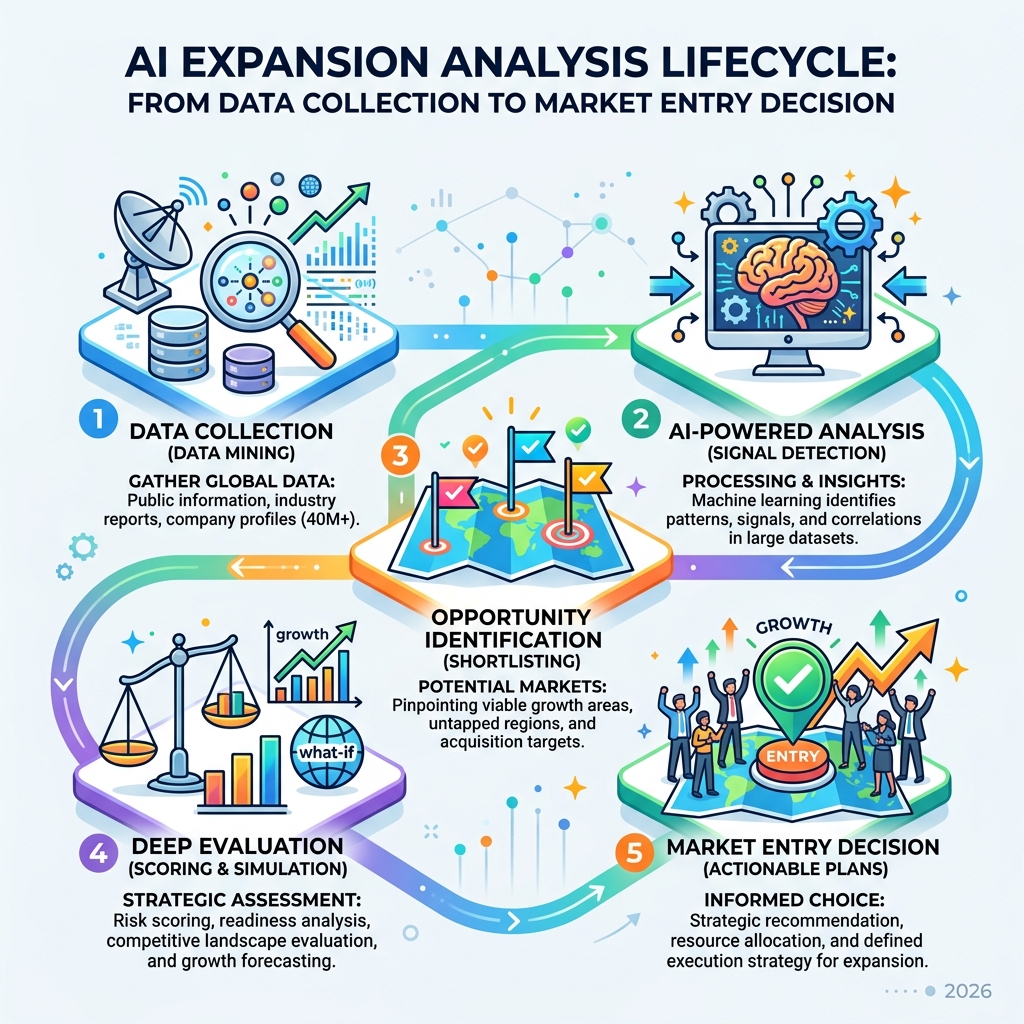
The Five Pillars of AI Powered Expansion Analysis
To understand how ai powered expansion analysis works, we should look at the framework established by industry leaders like McKinsey. AI doesn’t just “do the work”; it assumes five distinct roles that transform how we think about growth.
- The Researcher: AI scans millions of data points, from patents to 40 million company profiles, to find M&A targets or market adjacencies.
- The Interpreter: It turns raw data into insights, identifying why a competitor is winning in a specific region.
- The Thought Partner: AI acts as a “critic agent,” checking our human biases and suggesting “what if” scenarios we might have missed.
- The Simulator: It models P&L projections and market responses before we spend a single dollar.
- The Communicator: It synthesizes complex data into narratives that stakeholders can actually understand and act upon.
By Leveraging AI for Capacity Expansion, we move away from just adding more resources and start using intelligence to make the most of what we already have.
Transforming Reactive Tactics into Proactive AI Powered Expansion Analysis
In the past, many businesses expanded reactively—perhaps a competitor opened a shop nearby, or a single customer asked for a new feature. AI flips this script. Through constant trend monitoring and scenario modeling, we can identify “under-the-radar” targets and market gaps before they become obvious.
For example, just as players look for the best board-game-expansions-review-guide-2 to enhance their experience, businesses use AI to find the perfect “add-on” markets or services that naturally fit their core product. This proactive approach ensures that expansion isn’t a gamble, but a calculated move based on high-quality process standards.
Real-World Success Stories and Measurable Results
The numbers behind ai powered expansion analysis are staggering. We’ve seen manufacturers achieve 20–30% throughput gains by simply automating their scheduling and quality checks. In the logistics sector, AI-driven route optimization has led to a 30% increase in delivery efficiency.
One of the most impressive areas of growth is in customer expansion. By using AI to identify when a client is “expansion-ready,” companies have seen:
- Net Revenue Retention (NRR): Increasing from 110% to 142%.
- Annual Expansion Rate: Jumping from 15% to 34%.
- Customer Satisfaction: Improving by 67% because the expansion conversations felt helpful rather than pushy.

Identifying Market Gaps through Competitor and Customer Intelligence
One of the hardest parts of expansion is knowing where the “white space” is. AI tools like the Market Expansion Agent · Apify are designed to solve this by scraping data from Google Maps and social media to find where competitors are failing.
If we analyze 15–30 competitors in a specific city, AI can reveal gaps in pricing, service consistency, or even digital presence. Maybe every restaurant in a certain district has great food but terrible delivery times—that’s a gap. AI identifies these patterns across thousands of reviews and data points, giving us a “foot traffic rationale” that humans simply couldn’t compile manually.
Leveraging Customer Reviews for AI Powered Expansion Analysis
Customer reviews are a goldmine for growth. Tools like Perspective AI use conversational interviews to identify genuine upsell triggers. They find that 65% of customers develop new challenges as they scale—challenges they might not even tell their account manager.
By analyzing sentiment and growth patterns, we can see which customers are 3x more likely to need more features. This is much like how enthusiasts might use a ranking-wingspan-expansions-from-oceania-to-asia to decide which new “features” to add to their game night; AI helps us rank our customers by their readiness to grow with us.
Location-Based Expansion and Geographic Distribution
Geographic expansion used to involve “boots on the ground.” Now, it involves data. By combining Google Maps data with social media leads, AI can recommend specific coordinates for a new office or storefront. It looks at:
- Competitor Ratings: Where are customers unhappy?
- Underserved Districts: Which areas have high demand but low supply?
- Digital Presence: Are local competitors ignoring Instagram or TikTok?
This allows us to create an interactive map of opportunities, showing exactly where the next “empire” should be built.
Scaling Operations: From Localization to Supply Chain Optimization
When we talk about International Expansion AI, we are looking at more than just moving a product to a new country. We are looking at localization—making the brand feel “native” to that market.
AI has revolutionized this. Companies like BlaBlaCar have saved over 100 hours a year on localization, while others have seen 100% savings in developer time by using AI to handle translations and cultural adaptations. This isn’t just about changing the language; it’s about adapting the entire customer experience to local preferences.
Productivity Gains and Output Expansion at the Firm Level
Evidence from large-scale studies in China shows that AI adoption leads to significant output expansion, especially for “frontier firms”—those already leading their industries. These firms use AI to create innovation clusters, where the benefits of AI investment spill over into neighboring regions and departments.
While small and medium enterprises (SMEs) might face a bit of a “productivity drag” initially as they learn the tools, the long-term gains in total factor productivity (TFP) are clear. AI allows firms to produce more with the same resources, effectively expanding their “capacity” without a massive increase in headcount.
The Role of Smaller Companies in AI Infrastructure
We often think of AI as the playground of mega-cap tech giants. However, the expansion of AI itself is being driven by smaller, specialized companies. These are the firms building the “plumbing” of the AI revolution:
- Mechanical Construction: Building the physical data centers.
- Distributed Power: Ensuring these centers have the massive energy they require.
- Semiconductor Specialists: Creating the electrical componentry that powers the models.
Investing in or partnering with these infrastructure players is a key part of a sophisticated ai powered expansion analysis.
Overcoming Challenges in AI-Driven Strategy
It’s not all smooth sailing. Deploying AI for expansion comes with risks, most notably model bias and “hallucinations” (where the AI makes up facts). If an AI tells you there is a huge market for vegan shoes in a city where there isn’t, your expansion strategy is doomed.
To fight this, we use “anti-hallucination” frameworks. Tools like LogicBalls use a clarification-first process—they ask you questions to verify the context before they give you a plan. This ensures the strategy is grounded in reality, not just “word prediction.”
Building Proprietary Data Ecosystems for Competitive Edge
If everyone uses the same public AI models, everyone will have the same strategy. To win, we need a “proprietary data ecosystem.” This means combining your internal customer data, unique market observations, and qualitative insights into a private database that the AI can learn from.
This creates a “moat.” When your AI can see signals that no one else can—like a specific usage pattern that predicts a 42% increase in deal size—you have a competitive edge that can’t be bought off the shelf.
[TABLE] Comparing Traditional vs AI-Driven Expansion Analysis
| Feature | Traditional Analysis | AI-Driven Analysis |
|---|---|---|
| Speed | Weeks or Months | Minutes or Hours |
| Data Volume | Limited to human capacity | Millions of data points (40M+ companies) |
| Bias | High (Human gut feeling) | Lower (When using “critic agents”) |
| Scalability | Hard to repeat across markets | Easy to replicate globally |
| Cost | High (Consultant fees) | Scalable (Software-as-a-Service) |
Frequently Asked Questions about AI Expansion
What are the risks of AI model hallucinations in strategy development?
The biggest risk is “confident wrongness.” An AI might suggest a market entry based on non-existent data. We mitigate this by using “verification-first” tools and keeping a “human-in-the-loop” to sign off on major strategic pivots. Always cross-reference AI suggestions with primary research.
How does AI accelerate international market entry and localization?
AI reduces the time-to-market by up to 60%. It automates the “grunt work” of translation and cultural adaptation, allowing teams to focus on high-level strategy. It also analyzes 120+ global indicators to tell you which country to enter first, rather than just guessing based on proximity.
Can smaller companies contribute to the AI infrastructure buildout?
Absolutely. While the big models are built by giants, the physical and electrical infrastructure is often handled by mid-sized specialists in construction, energy, and hardware components. These companies are the backbone of the “AI buildout.”
Conclusion
The era of “guessing” your way into new markets is over. By leveraging ai powered expansion analysis, businesses can transform from reactive players into proactive empires. Whether you are using the Market Expansion Agent to find the perfect street corner for a new shop or using Perspective AI to unlock hidden revenue in your existing customer base, the tools are ready for you.
To start today, we recommend strategy leaders take three steps:
- Get Smart: Understand how these tools work (and their limits).
- Start Building: Use a sandboxed pilot to test AI on a small market segment.
- Own Your Data: Begin curating your own proprietary data to ensure your AI insights remain unique.
The future of growth is data-driven, automated, and incredibly fast. Don’t get left behind. Explore our ultimate guide to expansion to see how you can take the next step in building your empire.
