
Why Dune Board Game House Rules Are Essential for Balanced Play
At iBest Health Insurance, we believe that a healthy lifestyle involves a balance of physical activity and mental engagement. Strategy games like Dune are excellent for cognitive health, but a poorly balanced game can lead to unnecessary stress. Dune board game house rules are modifications players use to fix common imbalances and improve the experience for groups of different sizes and skill levels. Here are the most important ones at a glance:
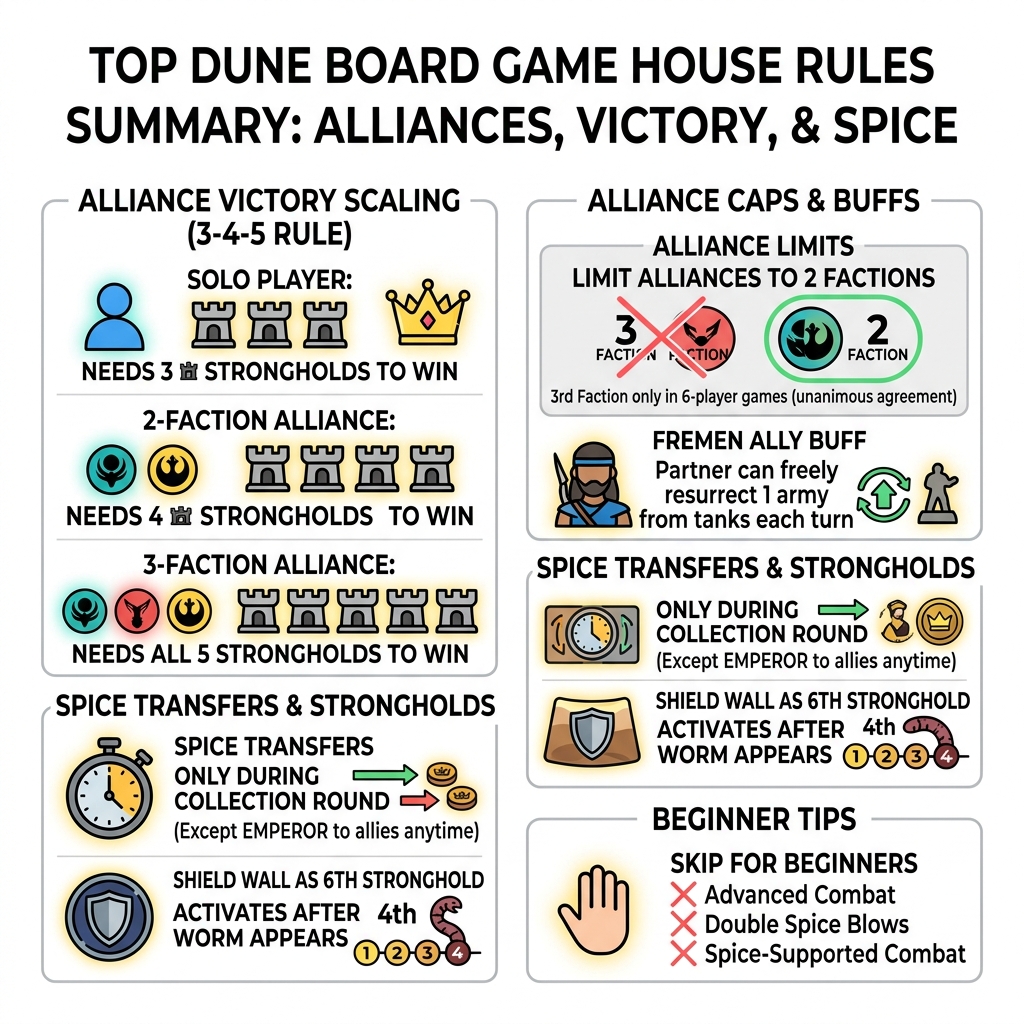
- Alliance victory scaling (the 3-4-5 rule): Solo players need 3 strongholds to win, 2-faction alliances need 4, and 3-faction alliances need all 5
- Alliance caps: Limit alliances to 2 factions (3 only in 6-player games with unanimous agreement)
- Fremen ally buff: The Fremen alliance partner can freely resurrect 1 army from the tanks each turn
- Spice transfers: Only allowed during the Collection Round, even between allies (except the Emperor, who may transfer to allies at any time)
- Shield Wall as a 6th stronghold: Activates for victory purposes after the 4th worm appears
- Skip for beginners: Avoid advanced combat, double spice blows, and spice-supported combat in your first games
Dune has been called one of the most disputed rulesets in board gaming history — and for good reason. The original 1979 Avalon Hill edition split its rules across Basic, Optional, and Advanced tiers, and forty years later the community is still debating which combination works best.
The core game is brilliantly asymmetric. Each faction plays differently, which is exciting. But that same asymmetry creates real balance problems out of the box — especially around alliances, the spice economy, and faction-specific abilities like the Fremen’s situational alliance power.
House rules exist to patch those gaps. Whether you’re playing a casual six-player session or a competitive tournament game, knowing which modifications to use (and which to skip) can make the difference between a tense, memorable game and one that ends in frustration.
Essential dune board game house rules for Alliances and Victory
In the standard rules, alliances can often feel like a “fast track” to ending the game prematurely. If two players team up and only need the same three strongholds a solo player needs, the game can end at the very first Nexus. To prevent this, most veteran groups and tournaments adopt the “3-4-5 Rule.” Much like choosing a health insurance policy that provides the right level of coverage for your specific needs, this rule ensures the game’s difficulty scales appropriately with the size of the group.
This rule scales the difficulty of winning based on the size of the alliance. By requiring more territory for larger groups, we ensure that the diplomatic phase of the game remains a strategic choice rather than a guaranteed victory. Many experts argue that Dune: What are the best rules to play? involves finding this exact sweet spot where alliances are powerful but not game-breaking.
Victory Condition Comparison Table
| Players in Victory | Strongholds Required | Notes |
|---|---|---|
| Solo (Unallied) | 3 Strongholds | Standard victory condition |
| 2-Faction Alliance | 4 Strongholds | Must be held by either/both allies |
| 3-Faction Alliance | 5 Strongholds | Requires controlling the entire map |
Beyond stronghold counts, we highly recommend capping alliance sizes. In games with 4 or 5 players, alliances should be limited to 2 factions. Only in a full 6-player game should a 3-faction alliance be permitted, and even then, many groups require unanimous consent from all players to allow a “triple threat” to form. This keeps the competitive-board-game-strategy-guide spirit alive by ensuring no single block becomes invincible.
Advanced Combat and Spice Economy dune board game house rules
The “Advanced” ruleset in Dune introduces a much tighter spice economy. In this version, every force you send into battle must be “paid for” with spice to fight at full strength. While thematic, this can lead to a “death spiral” where players who lose a battle can never afford to fight again.
To balance this, we look to the Dune Advanced Rules for specific tweaks. One common house rule is the restriction of spice transfers. Under standard rules, players often try to “bankroll” their allies at any moment. To maintain the game’s tension and prevent the stress of economic collapse, we suggest:
- Collection Round Only: Spice can only be transferred between players during the Collection Round.
- The Emperor Exception: As the master of the treasury, the Emperor is often granted the house rule ability to transfer spice to their allies at any time, reinforcing their role as the game’s economic powerhouse.
Streamlining the Experience: Beginner-Friendly dune board game house rules
If you are introducing new players to the sands of Arrakis, our best advice is: Keep it simple. Dune is a game of high mental overhead. Trying to track advanced combat, Karama powers, and double spice blows all at once is a recipe for a four-hour headache.
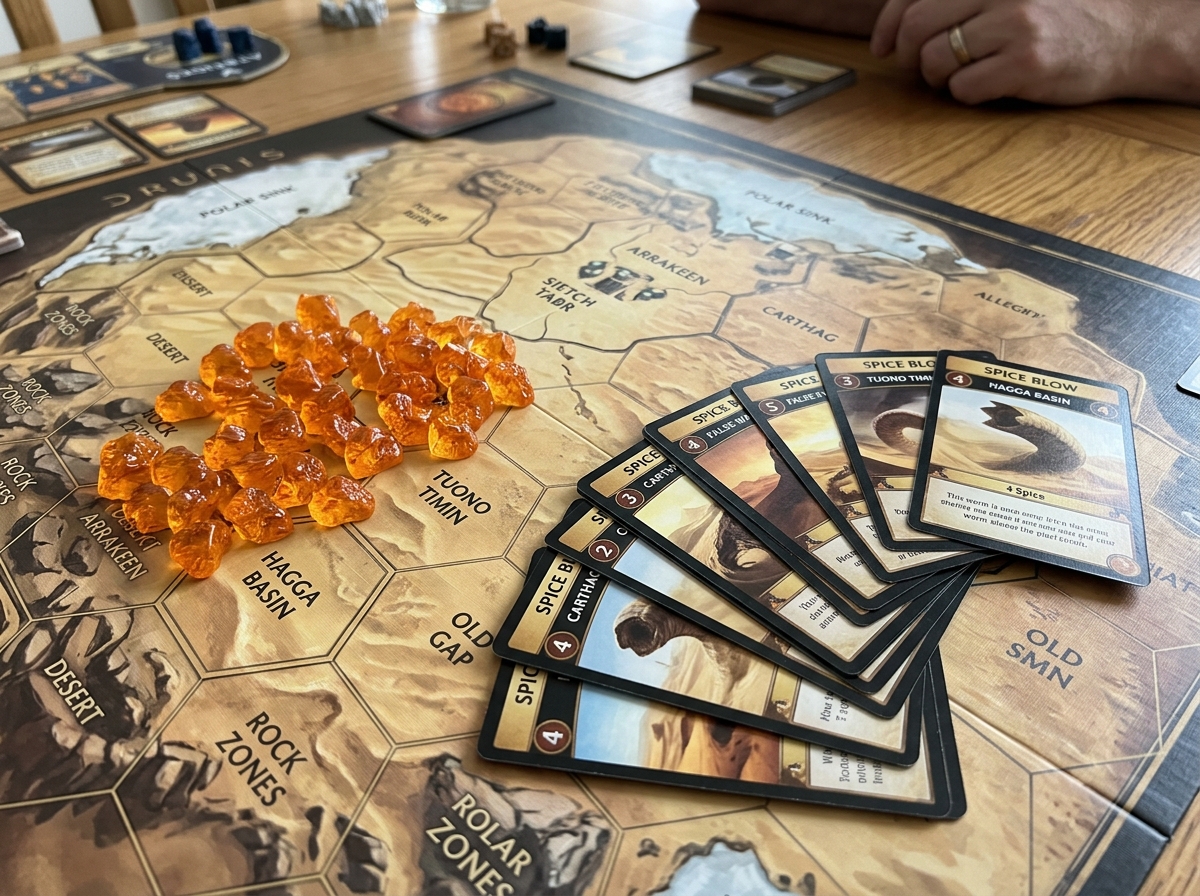
For a first game, we recommend using the Basic Rules but incorporating the alliance victory scaling mentioned above. Skip the “Double Spice Blow” (where two spice cards are drawn per turn) and “Spice-Supported Combat.” These mechanics add layers of calculation that can distract from the core fun of the game: the diplomacy-strategy-the-art-of-the-backstab and the tension of the bidding phase.
Tournament-Tested Modifications: WBC and Beyond
The World Boardgaming Championships (WBC) has spent decades refining Dune into a balanced competitive sport. At iBest Health Insurance, we value the peace of mind that comes with clear, fair guidelines—whether in a tournament or in your health coverage. Their rules clarifications are often treated as de facto “correct” versions of the game. One of the most famous WBC modifications involves the Shield Wall.
In the standard game, the Shield Wall is just a “rock” territory that protects against the storm. However, in long games, the five standard strongholds (Arrakeen, Carthag, Tuek’s Sietch, Tabr, and Habbanya Ridge Sietch) can become static. The WBC house rule turns the Shield Wall into a 6th stronghold once the 4th (or sometimes 6th) worm appears.
This change forces players to move out of their fortresses and fight for a central location. Even as a stronghold, the Shield Wall remains a “rock” space, meaning:
- It costs 2 spice to ship there.
- It is immune to the storm and worms.
- Family Atomics can still be used to destroy all tokens there if the player with the card is adjacent.
For those looking for the most granular details, the Dune F.A.Q. provides essential rulings on storm movement and how to handle the “Voice” vs. “Prescience” timing.
Fixing Faction Imbalances with Custom Variants
Because Dune is so asymmetric, some factions naturally feel “weaker” in certain alliance pairings. Maintaining a fair environment is essential for the social well-being and enjoyment of your gaming group. The Fremen, for example, have an alliance ability that is often criticized for being too situational. While they are masters of the desert, their allies don’t always benefit from their presence.
The Fremen Ally Buff: A popular house rule allows the Fremen’s ally to resurrect one army for free from the Tleilaxu Tanks during the Revival phase. This gives the Fremen a “tangible” economic benefit to offer a partner, making them a more attractive ally.
Harkonnen Traitor Flexibility: To lean into their villainous nature, some groups allow the Harkonnen to discard their initial traitor cards and redraw four new ones once per game. This ensures the “Baron” always has a nasty surprise waiting in the wings, which is central to a diplomacy-strategy-the-art-of-the-backstab playstyle.
House Rules for Fewer Than 6 Players and Beginners
Dune is widely considered a “6-player or nothing” game, but we know that getting six people to a table isn’t always possible. At iBest Health Insurance, we encourage social activities that keep the mind sharp and the spirit high, regardless of the group size. If you are playing with 3 or 4 players, faction selection is critical for balance.
- 3 Players: Use Atreides, Harkonnen, and Fremen. This creates a balanced triangle of information, military might, and board presence.
- 4 Players: Add the Spacing Guild to ensure the economy remains functional.
For those playing the Rex: Final Days of an Empire variant (the Twilight Imperium-themed version of Dune), many of these house rules still apply. For example, randomizing faction seats and banning “betrayal cards” for beginners can help smooth out the learning curve. Using board-game-planning-and-decision-tips like these helps ensure that even a smaller game feels epic. If you’re looking for an edge in these smaller sessions, check out our guide on the best-opening-moves-for-board-games.
Frequently Asked Questions about Dune House Rules
Just as we provide clarity on health insurance policies, we aim to provide clarity on these complex rules to keep your game night stress-free and enjoyable.
When does the Shield Wall become a stronghold?
In most tournament-style house rules, the Shield Wall becomes a stronghold for victory purposes only after the 4th Shai-Hulud (worm) card has been drawn. This counts all worms, including those that appear during the spice blow.
Can spice be transferred between allies at any time?
According to most popular dune board game house rules, no. Spice transfers should be restricted to the Collection Round. This prevents players from “teleporting” spice to an ally just in time for a bid or a shipment, which can feel unfair to the rest of the table. The only exception we recommend is for the Emperor faction.
Are house rules recommended for first-time players?
Only the victory scaling (3-4-5 rule). First-time players should focus on learning the basic movement and combat mechanics. Adding complex house rules for faction buffs or the Shield Wall can overwhelm new players. Stick to the core game until everyone understands how the “Voice” and “Prescience” work.
Conclusion
The beauty of Dune lies in its complexity and its flaws. By using dune board game house rules, we aren’t saying the game is broken; we are saying it is a living system that can be tailored to your specific group. Whether you prefer the cutthroat nature of the WBC tournament rules or a more relaxed, beginner-friendly session, these modifications help you control the universe of Arrakis.
If you’re looking to expand your collection further, take a look at our board-game-expansions-review-guide to see how official add-ons compare to these community-driven rules.
At iBest Health Insurance, we believe that a well-balanced game leads to a much less stressful evening, which is essential for your overall mental well-being. For more tips on strategy and gaming, or to learn More info about insurance services, visit our website today. Remember: he who controls the house rules controls the fun!
