
What Makes Pandemic Legacy Season 2 a Must-Play Legacy Game
Pandemic Legacy Season 2 is a standalone cooperative board game for 2-4 players, set 71 years after a global plague wiped out most of humanity. This guide focuses on what the game is, how it plays, and why it stands out among legacy board games.
Quick facts at a glance:
| Feature | Details |
|---|---|
| Players | 2-4 (best with 4) |
| Age | 13+ |
| Playtime per session | ~60 minutes |
| Campaign length | 12-24 games (expect 16-18) |
| BGG Rating | 8.0/10 (18,000+ ratings) |
| BGG Overall Rank | #71 |
| Complexity | 3.24 / 5 |
| Retail Price | $89.99 |
| Requires Season 1? | No – fully standalone |
Instead of curing diseases like in the original Pandemic, here you deliver supplies to struggling cities across a post-apocalyptic world. You start on floating ocean stations called havens, and gradually push outward into unknown, dangerous territory.
Every game leaves a permanent mark. Stickers get placed. Cards get torn. The board evolves. No two campaigns ever look the same.
Whether you’re deciding if it’s worth the price, or you want to understand the mechanics before your first session – this guide covers everything.
The Core Mechanics of Pandemic Legacy Season 2
When you sit down to play Pandemic Legacy Season 2, you are not just playing a standard game of Pandemic. While the DNA of the original system – drawing player cards, managing an infection deck, and bracing for epidemics – is present, the core loop has been inverted. In the original game, the board starts “dirty” with disease cubes that you must remove. In Season 2, the board starts “clean,” and it is your job to keep it that way by adding resources.
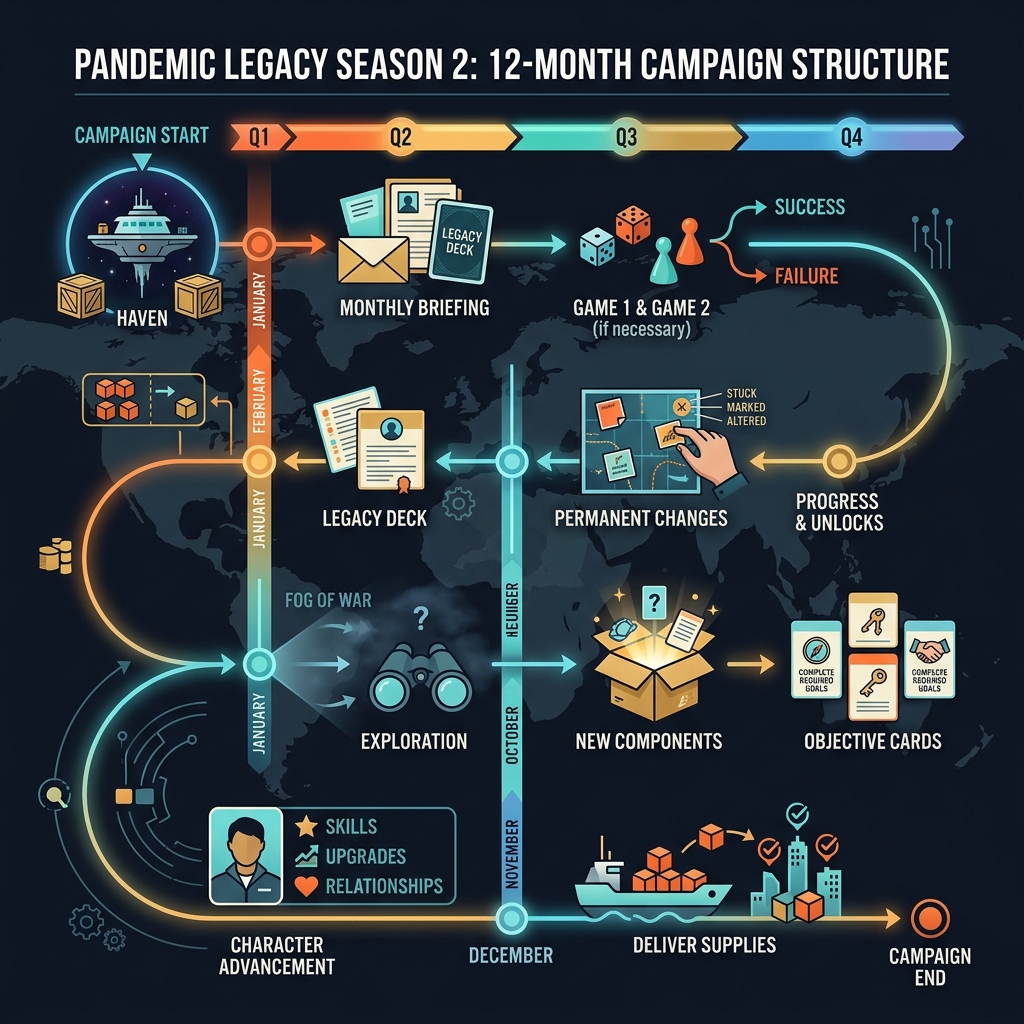
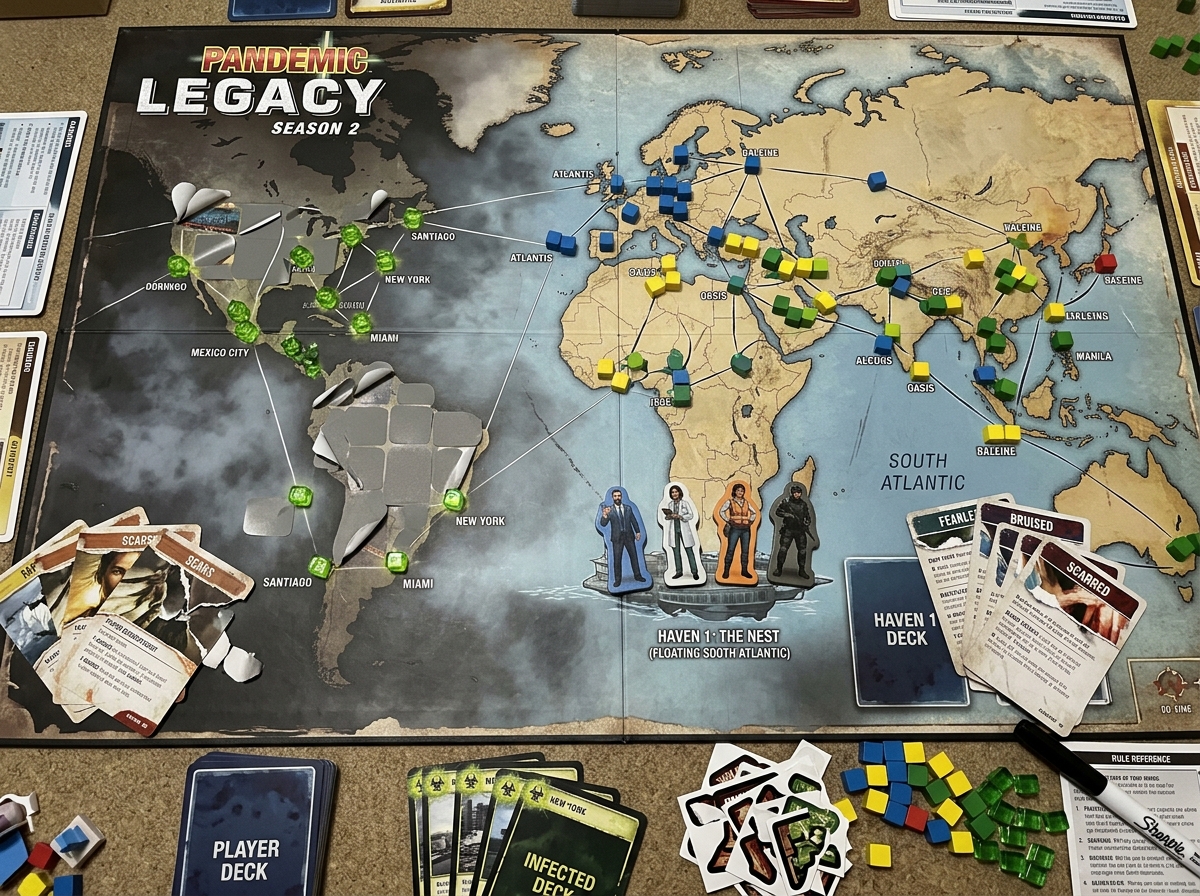
The game board itself is a mystery. Large portions of the map are obscured, representing areas of the world that have gone “dark” since the collapse of civilization 71 years ago. As you progress through the 12-month campaign, you literally peel back the fog of war using stickers and hidden components to reveal the state of the world.
For those who want to dive deep into the technicalities before their first session, the Pandemic Legacy: Season 2 Official Rules provide the full framework. However, understanding the basic flow is essential for advanced strategies for cooperative games.
Core Player Actions
On your turn, you have four actions to spend. These include:
- Drive/Ferry/Sail: Move between connected locations. You cannot “sail” over land – common sense applies here.
- Make Supplies: Take supply cubes from the general stockpile and put them on your character card.
- Deliver Supplies: Place supply cubes from your character card onto your current city.
- Share Knowledge: Give or take a city card from another player at your location.
- Build Supply Center: Discard five cards of the same color to build a permanent base.
- Recon: Explore new parts of the map (more on this below).
Managing Supplies and Preventing the Plague
In pandemic legacy season 2, the “enemy” is the absence of resources. Instead of disease cubes appearing during the infection phase, you remove supply cubes that you previously placed there. If a city is empty of supplies and its card is drawn from the infection deck, a green Plague Cube is placed instead.
Plague cubes are devastating. They cause “incidents” (similar to outbreaks), lower the city’s population, and can cause “exposure” to any characters standing in that city. Managing the logistics of making and delivering supplies is the heartbeat of the game. It is a tense balancing act that makes this one of the most underrated cooperative board games review candidates when compared to its predecessor, as the strategy is entirely fresh.
Exploring the World with the Recon Action
The “Recon” action is perhaps the most exciting addition to the Pandemic universe. By discarding specific sets of cards at certain locations, you can “recon” adjacent dark areas. This allows you to open sealed entries in the dossiers, reveal new map stickers, and expand “The Grid.”
According to the community at Pandemic Legacy: Season 2 | Board Game Geek, the sense of discovery is what keeps players coming back. You are not just trying to win a game; you are trying to find out what happened to the rest of the world. Every time you recon a new area, the game might introduce new rules, new components, or plot twists that change your objectives for the rest of the month.
Character Development and the Legacy System
In a legacy game, your characters are not just pawns; they are people with histories. At the start of the campaign, you create your own characters from scratch. You choose their names, their ages, their home havens, and their jobs (like Administrator or Instructor).
As you play, these characters grow. You can add “Job Stickers” to give them new abilities, but they can also suffer. If a character is in a city when a plague cube is placed, or if they start their turn in a city with a plague cube, they must scratch off a circle on their Exposure Track.
Exposure, Scars, and Death
When you scratch an exposure circle, you might reveal a Scar. Scars are permanent stickers that give your character a negative trait, such as being “Amnesiac” or “Fragile.” If a character ever runs out of exposure circles, they are eliminated from the game – permanently. Players must build strategic safety nets to protect their characters from these lasting impacts.
To keep your team healthy, we recommend following some dont-let-the-virus-win-with-these-pandemic-tips to ensure you are not taking unnecessary risks with your favorite characters.
How the Pandemic Legacy Season 2 Campaign Evolves
The campaign is structured over 12 months, from January to December. Each month gives you two chances to succeed. If you win the first game of the month, you move to the next. If you lose, you get one more try (the “late month” game) before being forced to move on, regardless of the outcome.
The Legacy Deck acts as the narrator. It tells you when to open certain packages, when to read new rules, and when to trigger “Turning Points.” This deck is the heart of the story, and it ensures that the narrative keeps pace with your successes and failures. You also have Dossiers full of hidden windows that you open when instructed, revealing everything from new stickers to secret missions.
This evolving nature is a hallmark of recently-released cooperative board games that focus on campaign-style play, but pandemic legacy season 2 remains a standout example of how much a game can physically change over time.
Essential Tips for Your Pandemic Legacy Season 2 Campaign
Before you dive into January, here are a few pieces of advice:
- Play the Prologue: The game includes a “Prologue” mode that does not count toward the campaign. Play it as many times as you need to feel comfortable with the supply mechanics.
- Watch Your Rationing Level: When you win, your “Rationing Level” (the number of helpful event cards in the deck) goes down. When you lose, it goes up. This acts as a natural difficulty balancer.
- Spend Production Units Wisely: At the end of each game, you earn Production Units to spend on permanent upgrades, like improving city populations or adding permanent supply centers.
- Take Notes: The game world becomes complex. Do not be afraid to keep a journal of your discoveries and the “Hollow Men” threats you encounter.
Comparing Season 2 to Season 1 and the Original Game
For many players, the big question is how this compares to the well-known Season 1. While Season 1 felt like an “elevated” version of classic Pandemic, Season 2 feels like a complete reimagining.
| Feature | Pandemic Legacy Season 1 | Pandemic Legacy Season 2 |
|---|---|---|
| Primary Goal | Cure 4 Diseases | Deliver Supplies & Recon |
| Start State | Fully mapped world | Mostly “dark” map |
| Travel | Primarily Flights | Primarily Sea/Land |
| Enemy | Disease Cubes | Plague Cubes (from lack of supplies) |
| Setting | Modern Day | 71 Years Post-Apocalypse |
Designer Matt Leacock highlights on Pandemic Legacy: Season 2 – Matt Leacock Games that Season 2 is a fully standalone experience. You do not need to know the plot of Season 1 to enjoy this, though there are narrative “Easter eggs” for those who have played both.
Setting and Storyline Differences
The atmosphere in pandemic legacy season 2 is much grittier. You are not scientists in lab coats; you are survivors living on “Havens” – floating platforms in the Atlantic. Your mission is to reconnect with the mainland cities (like London, New York, and Lagos) and find out why the world went silent.
The threat is not just a virus anymore. You also have to contend with the Hollow Men, a mysterious group of antagonists who interfere with your supply lines. The narrative is more ambitious and, according to many reviews, features major twists.
Component and Edition Breakdown
When you go to purchase the game, you will notice two versions: the Black Edition and the Yellow Edition.
- The Difference: There is no difference in gameplay. The only variations are the box art and the cover of the rulebook.
- What is Inside: Both boxes contain a heavy-duty game board, 10 character cards, 53 player cards, 82 legacy cards, 27 infection cards, and various plastic pieces for supply centers and plague cubes.
- The Dossiers: There are 6 dossiers included that contain the stickers and hidden information you will reveal throughout the year.
Frequently Asked Questions about Pandemic Legacy Season 2
Do I need to play Season 1 before Pandemic Legacy Season 2?
No. While there is a narrative thread connecting the two, Season 2 is designed as a standalone game. The mechanics are different enough that playing Season 1 doesn’t give you a mechanical advantage, though it does help you appreciate the evolution of the system.
What is the difference between the Black and Yellow editions?
As mentioned, the contents are identical. It is purely an aesthetic choice for your shelf. Both typically retail for around $89.99, though prices can vary based on availability.
How many players and how long is the playtime?
The game is for 2-4 players. While it can be played with 2, the consensus among the community is that it is “best with 4” because it allows for a wider spread of character abilities. Each session takes about 60 minutes, though your first few games (and the finale) may take longer as you read new rules.
Conclusion
Pandemic Legacy Season 2 is more than just a board game; it is a shared history that you create with your friends. By the time you reach the end of December, your board will be a unique map of your team’s triumphs and tragedies. It is an emotional campaign that challenges strategic thinking and cooperation under pressure.
If you enjoy cooperative games, campaign progression, and legacy mechanics that permanently reshape the experience, this is an easy title to recommend. Its strongest qualities are the evolving map, the steady drip of discoveries, and the way each session contributes to a larger story.
For More info about health and wellness services, stay tuned to our guide. Now, gather your team, head to the havens, and see if you can bring humanity back from the brink!
