
Why a Cluedo Strategy Guide Separates Winners from Guessers
A good cluedo strategy guide can transform you from a lucky guesser into a consistent winner. At iBest Health Insurance, we believe that maintaining a sharp, analytical mind is a key part of long-term cognitive health. Most players rely on basic elimination. The best players use a system – tracking every card, every disproof, and every opponent move to solve the mystery faster than anyone else at the table.
Quick answer: The core Cluedo strategy in a nutshell
- Set up your scoresheet as a full matrix – one column per player, one row per card
- Mark your own cards immediately and cross off what you know others don’t hold
- Make a suggestion every single turn – any turn without one is wasted
- Record everything, including what other players show each other (not just what they show you)
- Use notation groups to track which card an opponent might have shown from a set of three
- Prioritize rooms – they’re hardest to deduce due to movement restrictions
- Control what you reveal – always show the same card again if you’ve shown it before
- Time your final accusation – guess when you have 1-in-4 odds or better
Most casual players use only one column on their scoresheet and only track their own turns. That leaves enormous amounts of information on the table. With a proper system, you can deduce opponents’ full hands and solve the mystery in a fraction of the time.
In a six-player game, there are 21 cards total and each player holds exactly 3. That means the math is tight – and every clue counts.
This guide covers everything from basic scoresheet setup to advanced deduction techniques like notation groups, the Play Deep method, and bluffing tactics that can push your win rate from the expected 1-in-6 to closer to 1-in-2.
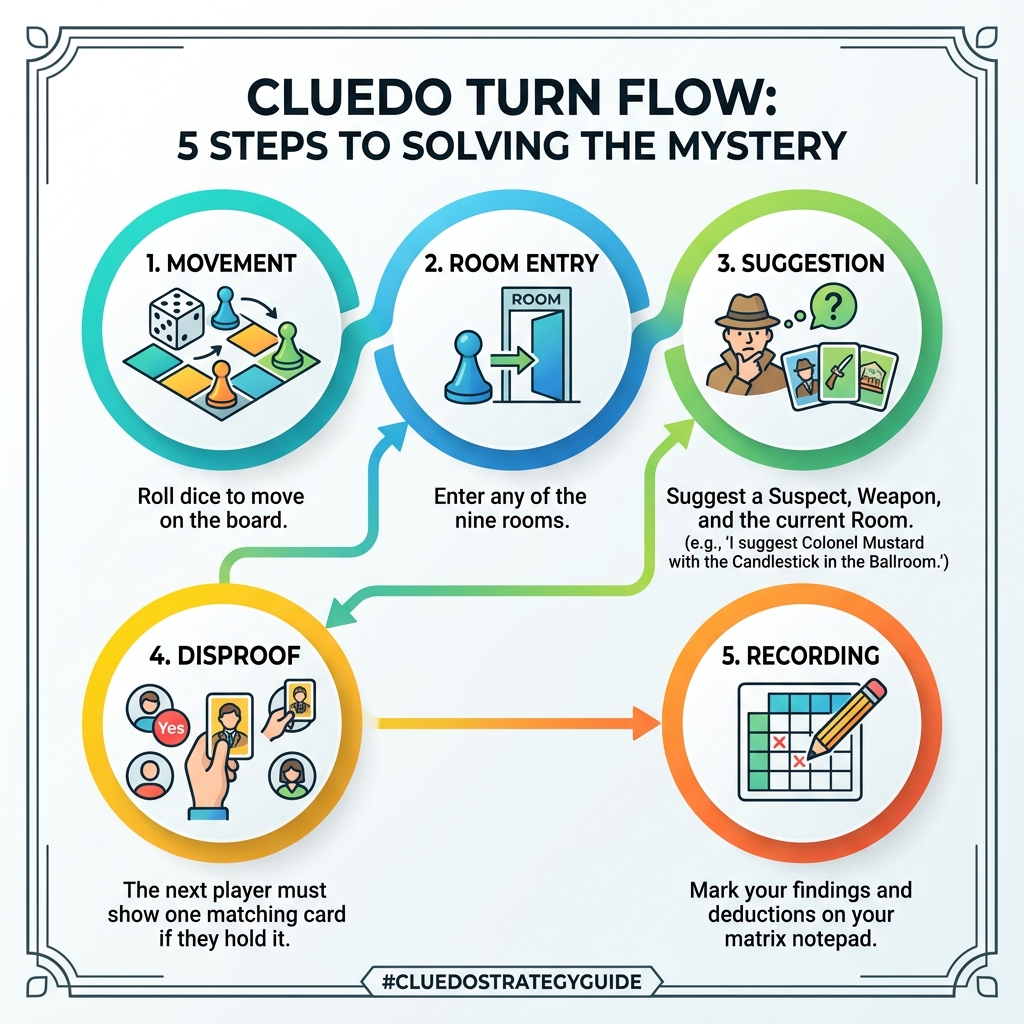
Mastering the Scoresheet: The Ultimate Cluedo Strategy Guide
The single biggest mistake we see players make is using the detective notepad as a simple checklist. If you want to win, you must treat your scoresheet as a data matrix. Instead of one column for the whole game, you should create a column for every player at the table, plus a “Solution” column.
Before the first die is even rolled, label your columns with the initials of each player in clockwise order. This allows you to track exactly who has what. Immediately mark an “O” (or a tick) in your own column for the cards you hold, and put a “/” (slash) or “X” in your column for every other card. This shows you exactly what you don’t have.
Using a detailed notation system is the backbone of winning-tactics-for-card-based-board-games. By organizing your data this way, you aren’t just looking for what’s missing; you are actively solving the hands of your opponents.
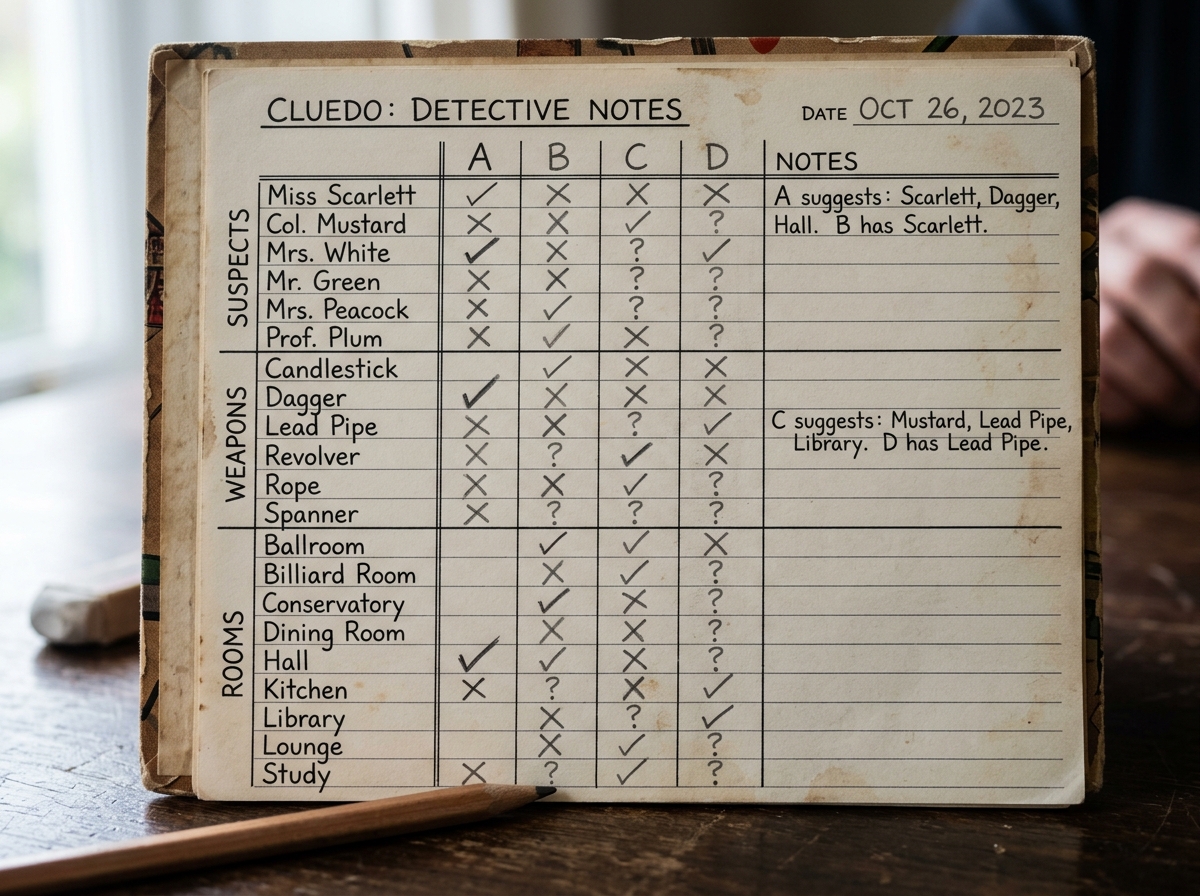
Why Every Pro Needs a Cluedo Strategy Guide for Notation
To play like a pro, you need more than just “yes” or “no” marks. Standard symbols help you visualize the state of the game at a glance.
| Symbol | Meaning | Action |
|---|---|---|
| O | Confirmed Hold | You know for a fact this player has this card. |
| X | Common Knowledge | Everyone knows this card is not in the envelope. |
| / | Private Exclusion | You know this player doesn’t have it, but others might not. |
| ! | Probable Non-Hold | Used when a player shows a card, but you suspect it’s a different category. |
| ? | Probable Hold | A placeholder for deductions you haven’t confirmed yet. |
| Numbers | Notation Group | Links three cards together from a single suggestion (e.g., all marked ‘1’). |
By recording inter-player shows—where Player A suggests something and Player B shows them a card—you gain “hidden” information. Even if you don’t see the card, you know Player B holds at least one of those three items. This is where the process of elimination becomes a superpower.
Solving Opponent Hands Through Counting
In a standard six-player game, each player is dealt exactly 3 cards. This is a vital statistic. If you use our matrix system and eventually mark three “O” symbols in a single player’s column, you have solved their entire hand!
Once a player’s hand is solved, you can immediately put a “/” in every other row for that player’s column. Conversely, if you have marked 18 “/” symbols in a column, the remaining 3 empty spaces must be the cards they hold. Counting ticks and crosses is the fastest way to narrow down the solution envelope without ever having to step into half the rooms on the board.
Advanced Deduction: The ‘Play Deep’ Method and Notation Groups
Once you have mastered basic notation, it’s time to “Play Deep.” This advanced cluedo strategy guide technique moves beyond simple tracking and into logical inference. The core of this method is the use of notation groups.
When Player A makes a suggestion and Player B disproves it, you don’t know which of the three cards was shown. You mark all three cards in Player B’s column with the same number (e.g., a small “1”). This creates a group. As the game progresses and you find out Player B doesn’t have two of those cards, the third one is automatically confirmed as an “O.”
This is a vital part of board-game-planning-and-decision-tips. You can find more on these advanced strategies to truly dominate your next game night.
Implementing a Cluedo Strategy Guide for Every Turn
Your strategy should evolve as the game progresses:
- First Turn: Suggest categories where you have the most “empty” space. Avoid suggesting cards you already hold unless you are bluffing. Your goal is to force a reveal from the person immediately to your left to maximize information gain.
- Second Turn: Look for “notation groups” of 2 rather than 3. If you already know one card in a trio isn’t held by a player, suggesting the other two cards from that group is a high-efficiency move.
- Later Game: Target specific “spaces before numbers.” If you have a column with several numbered groups, focus your suggestions on the cards that would resolve those groups.
Handling Complex Information Scenarios
What happens when a suggestion goes undiproved? If nobody can show a card, it usually means the cards are either in the suggester’s hand or in the envelope. However, be careful—strong players often bluff. If a suggestion isn’t disproved, we recommend marking those cards with the suggester’s column number, assuming a bluff until proven otherwise.
You should also apply the Pigeonhole Principle. If a player has two unknown cards left in their hand, but you have three different notation groups for them, at least two of those groups must overlap. By overlapping these logical sets, you can often “force” a card into a player’s hand mathematically.
Tactical Movement and Character Selection for Early Advantage
Strategy starts before the first suggestion. Your choice of character and your physical movement on the board can give you a head start that others can’t overcome.
Movement Optimization and Board Control
If you want the best opening moves for board games, look no further than Mrs. Peacock. Statistically, Peacock has the best starting position on the board, sitting only 7 squares away from the Conservatory. Every other character is at least 8 squares away from their nearest room.
- Secret Passages: These are your best friends. The corner rooms (Kitchen, Conservatory, Lounge, and Study) allow you to hop across the board without rolling dice. This guarantees a suggestion every turn.
- Blocking: If you know an opponent needs to get to the Library to win, stand in the doorway. In Cluedo, you cannot move through other players. Use your token to physically bottleneck the map.
- Teleporting: When you suggest a suspect, their token is moved to your room. If an opponent is about to enter a room they need, suggest them! You’ll drag them across the house and ruin their movement plan.
Response Strategies When Disproving
When it’s your turn to show a card, don’t just pick one at random. You want to leak as little information as possible.
- Prefer Suspects and Weapons over Rooms: Rooms are the hardest to deduce because you have to physically travel to them. Keep your room cards hidden as long as possible.
- Repeat Shown Cards: If you have already shown Player A the “Dagger,” and they ask for it again in a different suggestion, show it again! Never show a new card if an old one will suffice.
- The “Optimal Response”: If you have multiple cards to show, choose the one that you believe the requester already suspects you have.
Psychological Warfare: Bluffing and Information Control
Cluedo isn’t just a math problem; it’s a game of poker. If you only ever ask about cards you don’t have, your opponents will find it very easy to track your progress.
Aggressive Tactics and ‘Dick Moves’
To maintain an advantage, we sometimes use “aggressive” tactics to disrupt the table:
- The Unfair Summons: If you hold the “Kitchen” card, stay in the Kitchen. Every turn, suggest a different suspect and weapon. When someone disproves it, they are giving you info. When it’s your turn to show a card to someone else, you just keep showing the Kitchen. You are essentially “parking” in a room to farm information while blocking others.
- The Hand-Check: If you have solved an opponent’s entire hand, suggest their entire hand (Suspect, Weapon, and Room) on your turn. It’s a “dick move” because it tells them you know exactly what they are holding, which can rattle their confidence.
- The Suicide Bluff: If you are certain you are going to lose, you can make a false accusation to mess with the remaining players’ notation, though we generally recommend playing for the win!
For more ways to handle competitive environments, check out our tips for multiplayer board game success.
The Final Accusation: Timing and Probability
Waiting for 100% certainty is a recipe for losing. In a competitive game, someone will likely guess before all the cards are revealed.
We recommend making a final accusation if your odds are 1-in-4 or better, especially if you see an opponent heading toward the center of the board. If you have narrowed the rooms down to two possibilities and the suspect/weapon are confirmed, a 50/50 guess is often better than waiting two more turns and letting someone else take the trophy. Proper planning-ahead-in-board-games means knowing when to take a calculated risk.
Frequently Asked Questions about Cluedo Strategy
How does the video game version differ from the board game?
The digital versions, such as those from Marmalade Game Studio, often include automated tracking. The game will cross off cards for you based on what you’ve seen. However, the automated system rarely uses the “Notation Groups” we discussed. To beat “Hard” NPCs or high-level online players, you still need to manually use the advanced notepad features to track what other players are showing each other.
What are the most common beginner mistakes to avoid?
The biggest mistake is wasted movement. If you roll a 2 and can’t reach a room, don’t just wander. Plan your path toward a secret passage. Another mistake is sharing new information. Beginners often show a different card every time they are asked. This is a gift to your opponents. Pick one card per player and stick to it as long as possible.
When is the best time to bluff by suggesting your own cards?
Bluffing is most effective when you have a “partial solution.” If you know the Suspect and Weapon but are torn between two Rooms, suggest one of the rooms along with a Suspect and Weapon you actually hold. This forces the table to reveal info about that specific room without you giving away your progress on the other categories.
Conclusion
Mastering Cluedo is about moving from “clueless” to “detective” through disciplined note-taking and strategic movement. By using a full matrix scoresheet, employing notation groups, and controlling the board through character selection, you can significantly increase your win rate.
At iBest Health Insurance, we value the sharp minds and quick thinking that games like Cluedo foster. Just as a solid strategy helps you solve a mystery, proactive planning is the key to managing your long-term health. Whether you’re blocking an opponent from the Study or deducing a hand through the Pigeonhole Principle, information and preparation are your most valuable resources.
Key Takeaways for Your Next Game:
- Use a full matrix scoresheet to track every player’s hand.
- Choose Mrs. Peacock for the best starting movement advantage.
- Always show the same card to the same player to hide your hand.
- Use secret passages to maximize suggestions per game.
- Don’t be afraid to make a 1-in-4 guess if the competition is closing in.
Ready to put these skills to the test? Grab your magnifying glass, set up your matrix, and we’ll see you in the Billiard Room!
For more strategy guides and lifestyle tips, visit https://www.ibesthealthinsurance.com/.
