
Why a Qwirkle Strategy Guide Changes How You Score
A good qwirkle strategy guide can be the difference between winning by a landslide and falling behind on points every single turn.
Here’s what you need to know right away:
Quick Qwirkle Strategy Snapshot
| Goal | Key Action |
|---|---|
| Score more per turn | Place tiles that connect to 2+ lines at once |
| Earn the 12-point bonus | Complete a line of all 6 colors or shapes (a “Qwirkle”) |
| Block opponents | Fill the 5th spot in a line you can’t complete yourself |
| Manage your hand | Trade tiles when you can’t score more than 4 points |
| Win the endgame | Play one tile per turn and empty your hand first for +6 points |
The rules themselves are simple. Place tiles that share a color or shape. Score one point per tile in every line you create or extend. But simple rules don’t mean simple strategy.
The gap between a player scoring 3 points a turn and one scoring 9+ points a turn isn’t luck. It’s knowing where to place, when to wait, and when to block.
Qwirkle rewards pattern recognition, impulse control, and forward thinking — which is exactly why it won the prestigious Spiel des Jahres award in 2011 and keeps players coming back for more.
Mastering the Basics: A Qwirkle Strategy Guide for Beginners
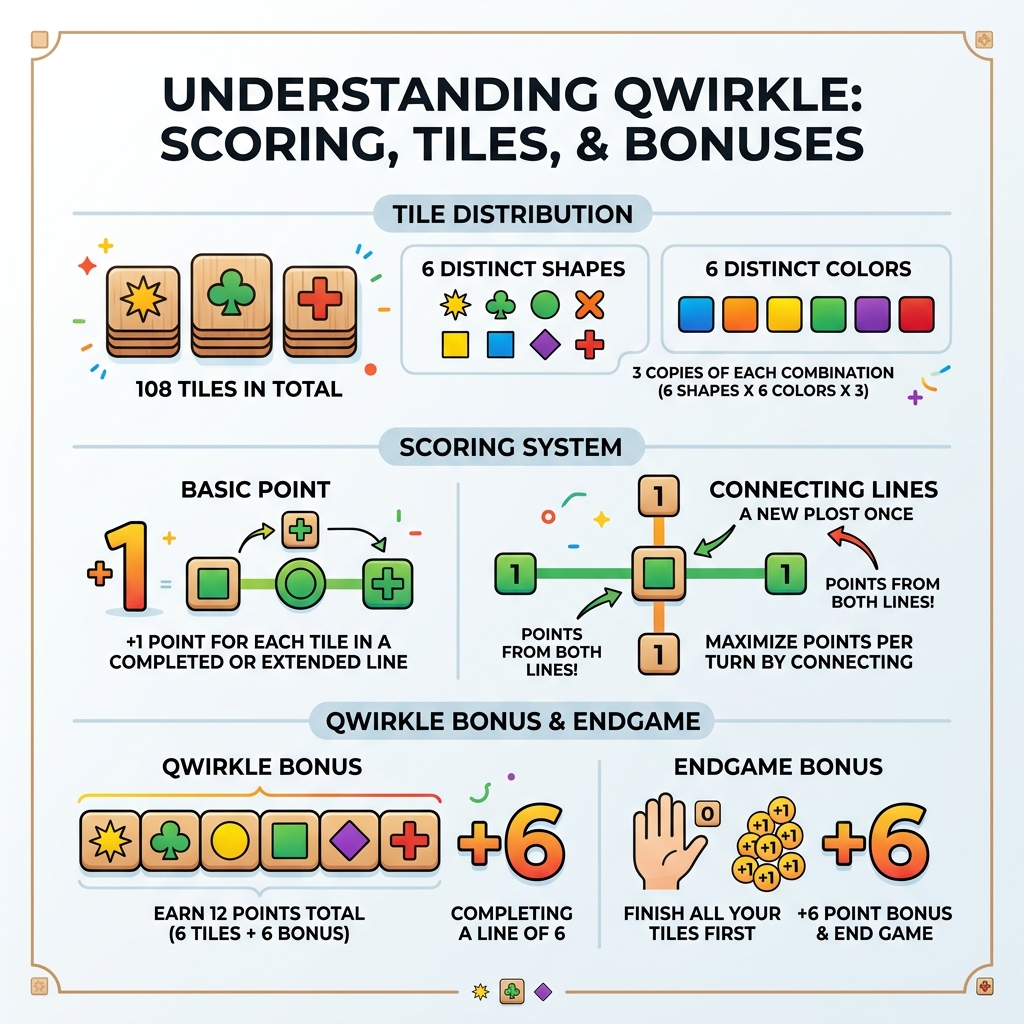
Before we dive into the high-level tactics that will make your friends slightly annoyed at how well you’re playing, we need to ensure our foundation is solid. Qwirkle is a game of 108 wooden tiles. While they look like simple blocks, they are the building blocks of a complex 6×6 grid system.
The Tile Ecosystem
There are six shapes (clover, starburst, square, diamond, circle, and cross) and six colors (red, orange, yellow, green, blue, and purple). Most importantly, there are exactly three copies of every unique tile combination in the bag. If you’re holding two blue clovers and see one on the board, you know with 100% certainty that no more blue clovers exist in the game. This “tile counting” is a pillar of any advanced qwirkle strategy guide.
Setting Up for Success
To start, everyone draws six tiles and stands them up so only they can see them. We determine the starting player by looking for the largest “natural” line in someone’s hand—meaning the most tiles that share one attribute (all same color or all same shape) without duplicates. If there’s a tie, the oldest player starts. For a refresher on the foundational mechanics, you can check out these Qwirkle Rules — How to Play, Score, and Win the Classic Tile Game.
Core Placement Rules
- The Attribute Rule: Every tile in a line must share one attribute (color or shape) and differ in the other.
- The No-Duplicate Rule: You can never have two identical tiles in the same line. For example, a line of red tiles can only have one red square.
- The Connection Rule: Every tile you play must touch at least one tile already on the board (except for the very first move).
- The Hand Refill: At the end of every turn, you draw back up to six tiles.
We often see beginners make the mistake of playing tiles just because they can. In our experience, it is better to play zero tiles and trade your hand (which we’ll cover later) than to play a single tile for one measly point and open up a massive scoring opportunity for the person sitting next to you.

Maximizing Points with Multi-Line Placements
If you want to stay competitive, you should aim to score a minimum of 7 points per turn. If you’re just adding one or two tiles to the end of a long line, you’ll rarely hit that mark. To truly dominate, you need to master the art of the “multi-line placement.”
The Power of the Corner
The most valuable real estate on a Qwirkle board isn’t the long, open lines—it’s the corners. A corner position is where a single tile completes or extends both a horizontal and a vertical line simultaneously.
Imagine a vertical line of 4 green tiles and a horizontal line of 3 squares. If you place a green square at the intersection, you score for both lines. According to game statistics, a single tile placed in a corner connecting a line of 5 and a line of 4 scores 9 points instantly. That is incredible efficiency for one tile!
Parallel Play and Intersections
Instead of building outward into “dead space,” we look for ways to tuck tiles alongside existing rows. If you place a row of three tiles parallel to another row of three, and all the touching edges match attributes, you aren’t just scoring for your row of three; you’re scoring for three separate two-tile “mini-lines” as well.
This approach is detailed further in our competitive board game strategy guide, where we discuss how grid expansion in abstract games like Qwirkle requires looking at the board as a series of intersections rather than just straight paths.
Scoring Comparison Table
| Move Type | Tiles Used | Average Points | Strategy Value |
|---|---|---|---|
| End-of-line addition | 1 | 2-4 | Low |
| New line creation | 2-3 | 2-3 | Medium |
| Corner placement | 1 | 5-9 | High |
| Parallel placement | 3 | 8-12 | Very High |
Using the Qwirkle Strategy Guide to Hunt for 12-Point Bonuses
The “Qwirkle” itself—a completed line of six tiles—is the holy grail of the game. Completing a Qwirkle nets you 6 points for the tiles in the line plus a 6-point bonus, totaling 12 points. If you manage a “Double Qwirkle” (completing two lines of six with one tile), you can score upwards of 24 points plus 12 bonus points. Yes, that’s 36 points in one move. It’s the tabletop equivalent of a grand slam.
Shape vs. Color Recognition
Psychological studies of Qwirkle players suggest that humans recognize color much faster than shapes. This means your opponents are very likely to notice when a color-based line is at four or five tiles. However, they often overlook shape-based lines. We recommend focusing your Qwirkle “hunts” on shapes (e.g., a line of all clovers) because they are easier to sneak under the radar of a tired opponent.
The Art of the Setup
If you have the 5th and 6th tiles for a line in your hand, don’t play the 5th tile immediately. If you do, the next player will almost certainly swoop in and take the Qwirkle bonus. Instead, wait until you can play both, or wait until someone else is forced to play the 5th tile. For more on the official components and how they facilitate these moves, visit the Official Qwirkle at MindWare.
Defensive Play and Opponent Blocking
Qwirkle isn’t just about what you score; it’s about what you don’t let your opponents score. This is where the game turns from a friendly tile-matcher into a high-stakes battle of wits.
The “Rule of Five”
This is the most important defensive rule in any qwirkle strategy guide: Never, ever play the fifth tile in a line unless you can also play the sixth.
By playing the fifth tile, you are essentially handing a 12-point gift to the next player. If you can’t complete the Qwirkle, it is often better to play elsewhere or even trade tiles. If you find yourself in a position where you must play in that area, try to “block” the line.
How to Block Effectively
Blocking involves making a line “dead” or difficult to complete. You can do this by:
- Filling the space: Play a tile adjacent to the Qwirkle-opportunity spot that makes it impossible for the required tile to fit (because it would violate the attribute rules of the new tile you just placed).
- Duplicating attributes: If a line needs a blue starburst to finish, and you can place a blue circle in a way that “cuts off” the line’s growth, you’ve successfully denied those bonus points.
- Strategic Deadlines: Create a situation where the only tile that could finish a line has already been played three times. Once all three copies of a tile are on the board, that line can never be a Qwirkle.
These tactics are essential in smaller games. In fact, our top strategy tips for two-player games emphasize that blocking is actually more important than scoring when you’re playing head-to-head.
Advanced Hand Management in Your Qwirkle Strategy Guide
Your tile rack is your toolkit. If your toolkit is full of duplicate tiles or a mess of unrelated colors and shapes, you won’t be able to build anything substantial.
Retention vs. Expulsion
There are two main styles of hand management:
- Expulsion (Early Game): In the beginning, you want to cycle through tiles quickly. The more tiles you see, the higher the chance you’ll find the specific ones needed for Qwirkles. Aim to play 3-4 tiles per turn, even if the points are lower.
- Retention (Mid-to-Late Game): Once the board is developed, start holding onto “finishing pieces.” If you see a line of four yellow tiles and you have the yellow clover and yellow square, keep them! You are waiting for the board to hit five tiles so you can pounce.
When to Trade Tiles
Many beginners feel that trading tiles is a “wasted turn.” We disagree. If your hand cannot produce a move worth more than 4 points, or if you are holding three sets of duplicates, trading is the superior move. You trade your turn for the potential of a much higher score next round. This is a common theme in winning tactics for card-based board games, where hand quality often dictates victory more than immediate board presence.
Hand Diversity
Always try to keep a diverse mix of shapes and colors. If your hand is all red tiles, you are at the mercy of the red lines on the board. If you have six different colors and six different shapes, you can find a home for your tiles almost anywhere the grid expands.
The Endgame: Emptying the Bag and Your Rack
The game enters the endgame phase the moment the draw bag is empty. At this point, no more tiles can be drawn, and the tension spikes.
The First-to-Finish Bonus
The first player to play all the tiles in their hand once the bag is empty receives a 6-point bonus, and the game ends immediately. This bonus is often the deciding factor in close games.
Playing One Tile at a Time
In the endgame, the math changes. It is usually better to play your tiles one at a time rather than in groups. Why? Because playing tiles individually often allows you to touch more lines and score more cumulative points. For example:
- Playing 2 tiles at once might get you 3 points.
- Playing those same 2 tiles over two separate turns might get you 2 points on the first turn and 3 points on the second (totaling 5).
This requires planning ahead in board games to ensure you don’t accidentally get blocked by an opponent who sees what you’re doing.
Tile Counting for the Win
Since there are no more tiles in the bag, you can look at the board and your hand to know exactly what your opponents are holding. If there are two blue crosses on the board and you have the third one, you know your opponents cannot finish any blue lines or cross lines that require that tile. Use this knowledge to “lock” parts of the board and force your opponents into low-scoring moves.
Frequently Asked Questions about Qwirkle Strategy
What is the most valuable move in Qwirkle?
The most valuable move is a Double Qwirkle placed in a corner position. This occurs when one tile completes two lines of six tiles simultaneously. This move scores 12 points for the first line and 12 points for the second line, plus any points for the tiles already in those lines. While rare, it is the ultimate goal of any advanced player.
When should I trade my tiles instead of playing a turn?
We recommend trading tiles if you cannot score at least 5 points on your turn AND your hand doesn’t have any high-potential tiles (like the 5th or 6th tile for a nearly finished line). If your hand is full of duplicates, trade them immediately. Holding duplicates is the fastest way to lose momentum.
How do I effectively block an opponent from scoring a Qwirkle?
The best way to block is to “kill” the line. If an opponent needs a green starburst to finish a line, try to place a different green tile or a different starburst in a way that occupies the adjacent spaces. This creates a conflict where the green starburst can no longer be legally played in that spot.
Conclusion
At iBest Health Insurance, we believe that keeping your mind sharp is just as important as keeping your body fit. Games like Qwirkle are fantastic for cognitive health because they require “set-shifting”—the ability to switch between thinking about colors and thinking about shapes. This mental flexibility builds working memory and executive functioning skills that serve us well at any age.
By following this qwirkle strategy guide, you’re not just learning how to win a board game; you’re practicing strategic thinking, patience, and pattern recognition. Whether you’re playing with your grandkids or competing in a local tournament, remember to focus on those corner positions, respect the “Rule of Five,” and always keep an eye on how many tiles are left in the bag.
For more ways to keep your brain engaged and your game nights competitive, explore our other board game strategy tips. Now, go grab that bag of tiles and show them what a master strategist looks like!
