
Why Thematic Board Games Belong in Every Serious Gamer’s Collection
Thematic board games are tabletop games that put story, setting, and immersion at the center of the experience. Unlike abstract or purely mechanical games, they pull you into a world — whether that’s fighting through monster-filled dungeons, surviving an alien spaceship, or building a Viking village from the ground up.
Here are the most highly-rated thematic board games right now, based on BoardGameGeek community rankings:
| Rank | Game | BGG Rating | Voters |
|---|---|---|---|
| 1 | Gloomhaven | 8.358 | 56,937 |
| 2 | Pandemic Legacy: Season 1 | 8.281 | 66,509 |
| 3 | War of the Ring: Second Edition | 8.252 | 24,609 |
| 4 | Scythe | ~8.2 | 29,000+ |
Every game on that list does something the best strategy puzzles can’t — it makes you feel something. You’re not just optimizing a score. You’re making decisions that matter to the story unfolding on the table.
That’s the real pull of thematic games. The mechanics serve the narrative. The components — miniatures, map tiles, event cards — exist to deepen your sense of place. And the best ones leave you talking about what happened long after the pieces go back in the box.
Whether you’re a veteran hobbyist or looking to level up your collection, this guide breaks down what makes a thematic game truly immersive, and which titles are worth your time and money.
What Defines the Best Thematic Board Games?
When we talk about the “best” in this category, we aren’t just looking at how balanced the rules are. We are looking for a soul. A thematic board game succeeds when the rules fade into the background and the story takes the lead.
Storytelling and Narrative Depth
In a thematic game, the narrative isn’t just “flavor text” printed at the beginning of a rulebook. It is woven into the gameplay. For instance, in a legacy game like Pandemic Legacy, the choices you make in January have permanent consequences for your world in June. You might find yourself physically tearing up cards or placing permanent stickers on the board. This creates a unique, unrepeatable story that belongs only to your gaming group.
Character Development and Player Agency
We love games where we can see our characters grow. Whether it’s gaining new equipment, leveling up skills, or suffering from “scars” (permanent negative traits), character development creates an emotional investment. When your character narrowly escapes a dungeon with one health point left, that’s not just a mechanical victory—it’s a heroic tale.
World-Building through Components
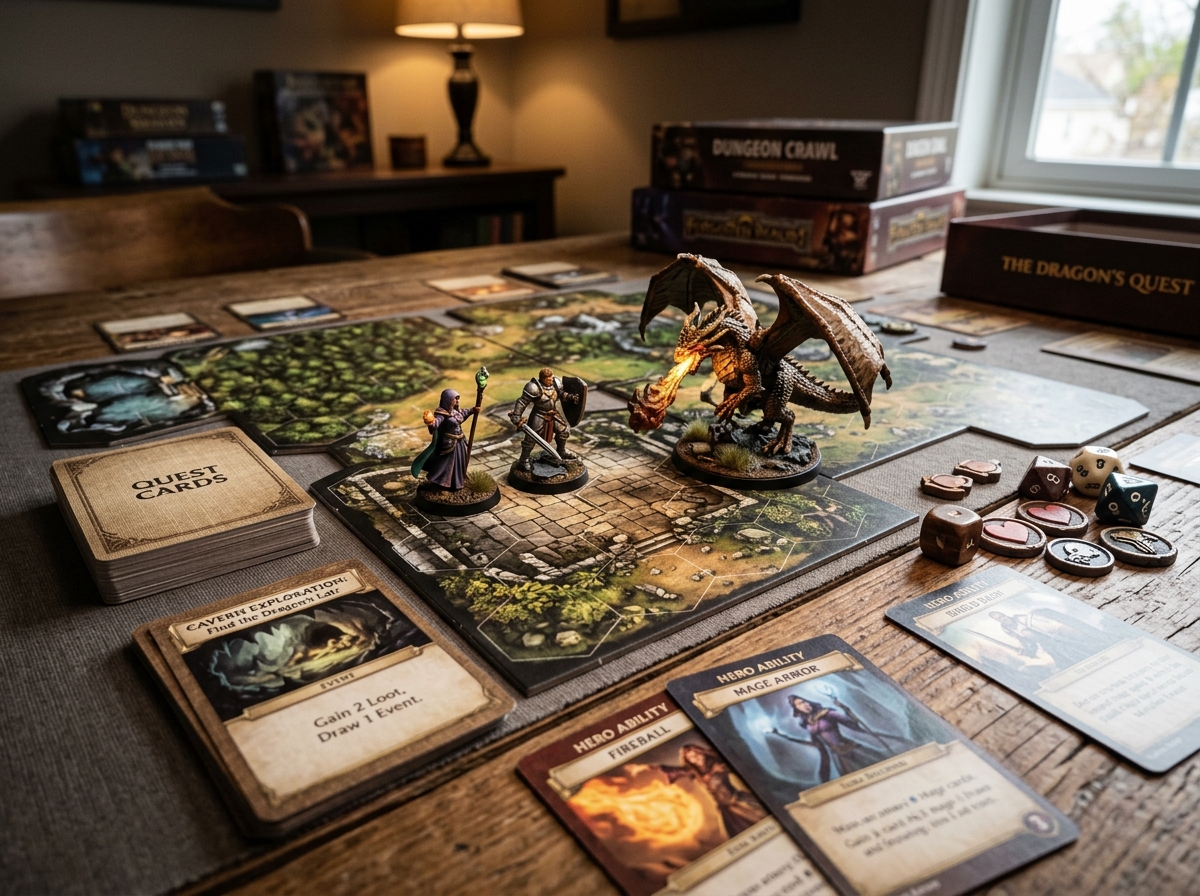
High-quality components are the backbone of immersion. When you see 18 prepainted landmark miniatures in a game like Tapestry, or detailed map tiles that slowly reveal a mysterious land in The 7th Continent, your brain stops seeing a cardboard box and starts seeing a world.
According to the Thematic Games Ranking – Browse Board Games | BoardGameGeek, the top-tier games all share this high level of production value. They use art and tactile pieces to anchor the player in the setting. If you are looking for more examples of how setting drives play, check out our board-games-with-unique-themes-review/ for a deeper dive into unusual concepts.
Top-Rated Hits for Immersive Tabletop Adventures
If you’re ready to dive into the deep end, these titles represent the gold standard of thematic gaming. They vary in complexity, but they all offer an experience that stays with you.
Gloomhaven: The King of the Dungeon Crawl
Currently ranking #1 in the thematic category, Gloomhaven is a behemoth. With a Geek Rating of 8.358 and nearly 57,000 voters, its popularity is undeniable. It’s a cooperative game of tactical combat in a persistent, shifting world. Players take on the roles of wandering mercenaries, each with their own secret motives. As you complete quests, the world changes, new locations are unlocked, and your characters eventually retire to make way for new ones.
Pandemic Legacy: Season 1: The Most-Played Epic
With the highest number of voters (over 66,000), Pandemic Legacy: Season 1 is a masterclass in tension. You start as a team of disease-fighting specialists, but as the months go by, the viruses mutate, cities fall into rioting, and your characters develop relationships and traumas. It’s an emotional rollercoaster that turns a standard cooperative puzzle into a global epic.
War of the Ring: Second Edition: The Ultimate Fantasy Sim
For fans of The Lord of the Rings, this is the definitive experience. It’s a massive game that pits the Free Peoples against the Shadow. While one player manages the military movements of armies across Middle-earth, the other must guide the Fellowship toward Mount Doom. It perfectly captures the “desperate hope” of the books.
Scythe: Dieselpunk Strategy
Set in an alternate-history 1920s, Scythe Board Game Website offers a world of giant mechs and agricultural struggle. It’s an asymmetric game, meaning every faction plays differently. One group might excel at building structures, while another focuses on military intimidation. The art by Jakub Rozalski is legendary, creating a “Scythe universe” that feels lived-in and gritty.
The 7th Continent: A “Choose Your Own Adventure” on Your Table
If you want pure exploration, The 7th Continent | Board Game | BoardGameGeek is your best bet. Inspired by adventure books where “you are the hero,” it uses thousands of cards to create a modular board. You are a cursed explorer trying to find a way to lift the spell. Every action—from building a fire to climbing a cliff—uses an “Action Deck” that doubles as your life force. When the deck runs out, your journey ends.
Comparison of Top Thematic Hits
| Game | Player Count | Average Playtime | Complexity (1-5) |
|---|---|---|---|
| Gloomhaven | 1–4 | 60–120 Min | 3.90 |
| Pandemic Legacy | 2–4 | 60 Min | 2.84 |
| War of the Ring | 2–4 | 150–180 Min | 4.21 |
| Scythe | 1–5 | 90–115 Min | 3.44 |
| The 7th Continent | 1–4 | 5–1000+ Min | 2.90 |
Mechanics That Power Thematic Board Games
How does a game actually make you feel like a Viking or a space explorer? It comes down to the mechanics. In thematic board games, mechanics aren’t just math; they are metaphors.
- Worker Placement with a Twist: In Uwe Rosenberg’s A Feast for Odin, you aren’t just placing workers to get resources. You are managing a Viking village. You have 61 different action options, ranging from hunting whales to raiding overseas. The “puzzle” aspect of fitting your loot onto your player board mimics the spatial challenge of packing a longship or stocking a warehouse.
- Card-Driven Events: These simulate the unpredictability of life. In The 7th Continent, the Presentation – The game – The 7th Continent – Serious Poulp explains how the Action Deck works. Drawing cards for a “success” feels like a gamble because it is a gamble. If you push too hard to climb a mountain, you might exhaust your character, leading to a “Game Over.”
- Asymmetric Abilities: In a game like Scythe, your faction’s unique power reflects its culture. The Crimean Khanate plays differently than the Nordic Kingdoms because their histories and technologies are different. This forces you to stay “in character” to win.
Popular Genres in Thematic Board Games
Thematic games cover almost every imaginable setting, but a few genres stand out as fan favorites.
- High Fantasy: This is the bread and butter of the industry. From dungeon crawlers to epic war games, fantasy allows for the most dramatic character arcs. You can find more on this in our latest-fantasy-board-games-review/ and discover some hidden gems in our fantasy-board-games-underrated-review/.
- Science Fiction: Whether it’s the space opera of Twilight Imperium or the claustrophobic horror of Nemesis (where you try to survive an alien-infested ship), sci-fi games often focus on technology and exploration.
- Horror: Games like Arkham Horror or Mansions of Madness use app-driven narration and “insanity” mechanics to make players feel the creeping dread of the Cthulhu mythos.
- Historical and Alternate History: A Feast for Odin takes us to the Viking age, while Scythe reimagines the aftermath of World War I. These games often include educational tidbits or “what if” scenarios that appeal to history buffs.
Why Immersion Matters: The Benefits of Story-Driven Play
We don’t just play these games to pass the time. There are genuine benefits to losing yourself in a thematic experience.
Social Bonding and Shared Memories
Because these games often involve cooperative play or intense negotiation, they create “water cooler moments.” We still talk about the time our friend sacrificed their character in Gloomhaven to save the rest of the party. These shared stories strengthen friendships in a way that a quick round of cards simply can’t.
Cognitive Engagement and Creative Problem Solving
Thematic games often present “messy” problems. Unlike a math-heavy Eurogame where there is a mathematically “correct” move, thematic games force you to deal with luck, hidden information, and shifting goals. This encourages creative thinking and adaptability.
Stress Relief and Escapism
In a world of constant digital notifications, sitting down for a three-hour session of War of the Ring is a form of meditation. You are fully present in that world. For many of us, this level of escapism is the ultimate stress reliever. If you’re looking for games that offer this kind of relief without being overly complex, see our list at fantasy-board-games-underrated-review-2/.
Frequently Asked Questions about Thematic Board Games
What is the difference between a thematic game and a Eurogame?
This is the classic debate in the hobby! Traditionally, Eurogames (like Catan or Ticket to Ride) focus on tight mechanics, resource management, and indirect competition. They often have “pasted-on” themes—meaning you could change the art from “trading in the Mediterranean” to “trading in space” without changing the rules.
Thematic games (sometimes called “Ameritrash” or “Amerithrash”) put the theme first. The rules are designed to simulate the setting, even if that means including more luck (dice rolling) or direct conflict (attacking other players). However, modern “Hybrid” games like Scythe and A Feast for Odin combine the best of both worlds: deep strategy and immersive themes.
Can thematic board games be played solo?
Yes! In fact, the thematic category has some of the best solo experiences in gaming. The 7th Continent and Cascadia are highly regarded for their solo modes. Many cooperative games like Gloomhaven or Pandemic Legacy can also be played “multi-handed,” where one player controls two or more characters. It’s a fantastic way to enjoy a story at your own pace.
What are the highest-rated thematic games for beginners?
If you are new to the hobby, jumping straight into Gloomhaven might be overwhelming. We recommend:
- Cascadia: A beautiful, calming game about building ecosystems in the Pacific Northwest. It’s easy to learn but has a wonderful theme.
- Pandemic (Standard): Before diving into the Legacy version, try the base game to see if you enjoy cooperative play.
- Horrified: A great “Universal Monsters” game where you work together to defeat Dracula, the Wolfman, and others. It’s very thematic but has straightforward rules.
Conclusion
The world of thematic board games is wider and more welcoming than ever. Whether you want to lead a civilization to greatness in Tapestry, survive a cursed island in The 7th Continent, or solve a global crisis in Pandemic Legacy, there is a story waiting for you on the table.
Immersive hobbies like tabletop gaming can support relaxation, social connection, and mental stimulation. They give players a chance to step away from daily stress, spend meaningful time with others, and enjoy a screen-light activity that feels both creative and engaging.
So, clear off the dining room table, invite some friends over, and get ready to live the story. Your next great adventure is just a box lid away.
