
Why Families Who Play Together Stay Together
Recommended board games for families are one of the best investments you can make in screen-free, meaningful time together. Whether you have toddlers, tweens, or teens — the right game brings everyone to the table.
Here are some of the top picks across age groups and play styles:
| Game | Ages | Players | Playtime | Style |
|---|---|---|---|---|
| Outfoxed | 5+ | 2-4 | 20 min | Cooperative |
| The Quest Kids | 5+ | 2-4 | 30-45 min | Competitive with Kindness |
| Kingdomino | 8+ | 2-4 | 15-25 min | Strategy/Tile Placement |
| Ticket to Ride | 8+ | 2-5 | 30-60 min | Route Building |
| Forbidden Island | 10+ | 2-4 | 30 min | Cooperative |
| Catan Family Edition | 10+ | 3-4 | 60-90 min | Strategy/Trading |
| Between Two Castles | 10+ | 1-8 | 45-60 min | Partnership Strategy |
Finding the right game for your family isn’t always easy. There are hundreds of options, and not every game works for every age mix or group size. Some games are too competitive for young kids. Others are too simple for adults to enjoy.
The good news? There’s a growing range of games designed to genuinely work for everyone at the table — from a five-year-old to a grandparent.
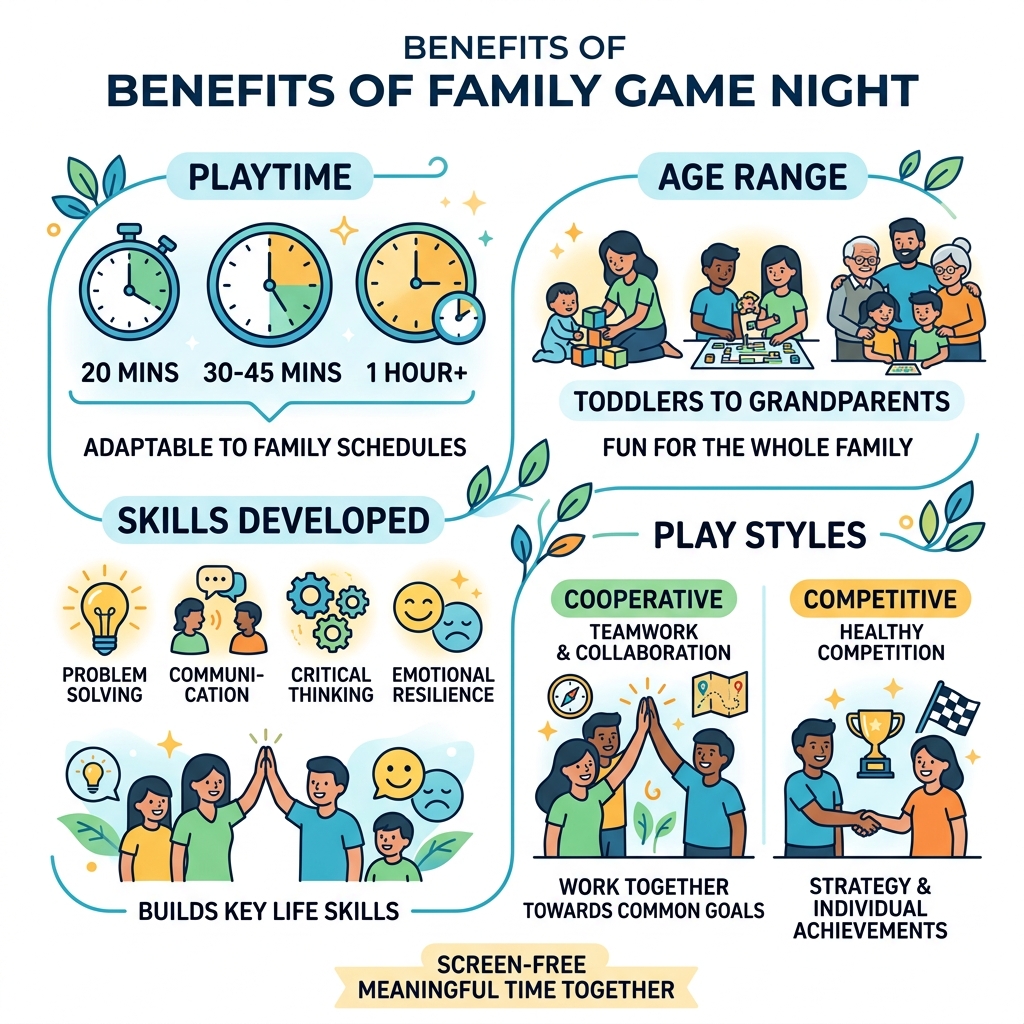
Board games also do a lot more than entertain. Research and player experience consistently show that family game nights build communication skills, critical thinking, and emotional resilience. Cooperative games, in particular, let parents coach kids through challenges without making things unfair — a dynamic that’s hard to replicate anywhere else.
Why Cooperative Play is a Game-Changer for Families
For many of us, childhood board games meant a heated game of Monopoly that ended in tears or a flipped board. While healthy competition has its place, many recommended board games for families today focus on cooperative play. In these games, players work together against the “board” or a common enemy. If one person wins, everyone wins.

The beauty of cooperative games lies in the removal of the “sore loser” or “arrogant winner” syndrome. It allows for natural teamwork and coaching. In a competitive game, if a parent gives a child too much advice, they are essentially playing against themselves. In a cooperative setting, like those discussed in our Underrated Cooperative Board Games Review, adults can mentor children, explaining the logic behind a move without unbalancing the game.
Cooperative play often features “open information,” where everyone’s cards or tiles are visible. This is a fantastic tool for young children who are still learning to read or grasp complex rules. As noted in The best cooperative kids board games that are also fun for adults, this shared experience fosters kindness and shared victory. If you are looking for the latest titles in this genre, check out our list of Recently Released Cooperative Board Games to keep your game nights fresh.
Essential Criteria for Recommended Board Games for Families
Selecting a game isn’t just about the box art. To ensure the game actually gets played, we need to look at the logistics. A game that takes two hours to set up will likely gather dust on the shelf.
When we evaluate recommended board games for families, we look at several key factors:
| Feature | Importance | What to Look For |
|---|---|---|
| Setup Time | High | Under 5-10 minutes is ideal for impatient kids. |
| Player Count | High | Does it support your specific family size (e.g., 2-5 players)? |
| Replay Value | Medium | Variable boards or different characters keep it interesting. |
| Component Quality | Medium | Chunky pieces for small hands; durable cards. |
| Complexity | High | Low enough for kids to grasp, deep enough for adults to enjoy. |
For a deeper dive into how we evaluate these titles, visit our Family-Friendly Board Game Review Guide and our comprehensive Board Game Ratings and Reviews.
Best for Early Learners (Ages 3-5)
At this age, the goal is to develop fine motor skills, color recognition, and the ability to follow simple directions. We want games that are short—usually around 10 to 15 minutes—to match their attention spans.
- The Quest Kids Board Game: This is a standout for this age group. The Quest Kids Board Game introduces a “Competitive with Kindness” mechanic. While players collect stars, they are rewarded with “Kind Kid” cards for helping others defeat monsters. It’s a gentle introduction to fantasy adventuring.
- Robot Turtles: Originally a Kickstarter sensation, this game teaches the fundamentals of coding without a screen. Kids “program” their turtle’s movement using cards, while the adult acts as the “computer” moving the pieces.
- Hoot Owl Hoot: A classic cooperative matching game. Players work together to help the owls fly back to their nest before the sun comes up. It’s great for teaching color coordination and strategic planning as a group.
- Zingo: Think of this as Bingo with a “Zinger” tile dispenser. It’s excellent for image and word recognition, and the nature keeps young children engaged.
Top Recommended Board Games for Families with School-Aged Kids (6-8)
As kids enter elementary school, they can handle more complex logic, deduction, and spatial reasoning.
- Kingdomino: A modern classic that won the 2017 Spiel des Jahres (Game of the Year). According to boardgame geek Kingdomino, players build a 5×5 kingdom using domino-shaped tiles. It’s simple to learn but requires strategy to maximize points through terrain multipliers.
- Outfoxed: A cooperative whodunit. Players move around the board to gather clues and use a special “evidence scanner” to rule out suspects. It’s a brilliant introduction to deductive reasoning.
- Indie Gems: Sometimes the best experiences come from smaller publishers. We recommend exploring the Best Indie Board Games for Kids 2026 and New Indie Board Games for Families 2026 for unique titles that you won’t find in every big-box store.
Strategy and Adventure for Ages 8+ and Teens
By age eight, many children are ready for “gateway” strategy games—titles that are sophisticated enough for adults but accessible for kids.
- Ticket to Ride: This is a premier recommended board game for families. In Ticket to Ride – Days of Wonder, players collect train cards to claim railway routes across North America. It’s easy to learn (about 15 minutes) but offers deep strategy. For those looking to expand their horizons, check out our Ranking the Best Ticket to Ride Titles and Maps.
- CATAN – Family Edition: CATAN is a global phenomenon for a reason. The CATAN – Family Edition is designed specifically for easier setup and play. It focuses on resource management and trading, teaching kids the value of negotiation.
- Between Two Castles: This game offers a unique twist on cooperation. In Between Two Castles – Stonemaier Games, you work with the person to your left to build one castle and the person to your right to build another. Your final score is the lower of the two castles, forcing you to balance your attention and work equally with both partners.
Educational Powerhouses: Learning Through Play
“Gameschooling” is a growing trend where families use board games to supplement traditional education. It’s a great way to break through learning blocks in a low-pressure environment.
- Math and Logic: Games like Prime Climb or Sleeping Queens help with mental math and probability. For those who enjoy a bit of friendly rivalry while learning, explore Fact or Friction: The Best Trivia Family Board Games for Competitive Households.
- Geography and History: Ticket to Ride is a stealth geography teacher, while games like Trekking the National Parks introduce kids to US landmarks.
- Spatial Awareness: Carcassonne is legendary for teaching spatial logic. You can enhance the experience by Building a Better Kingdom with the Best Carcassonne Expansions.
- Literacy and Storytelling: Rory’s Story Cubes or Dixit encourage creative writing and vocabulary. Finding The Best Dixit Expansion for Your Next Game Night can add hundreds of new prompts for your family’s imagination.
Timeless Classics and Travel-Friendly Card Games
Sometimes you don’t have an hour for a full board game session, or you’re headed on a family road trip. This is where card games and travel editions shine.
- Sushi Go!: A “pick and pass” card game where you try to grab the best combination of sushi dishes. It’s adorable, quick, and easy to pack.
- Exploding Kittens: A highly engaging, slightly chaotic game that kids find hilarious. It’s essentially Russian Roulette with kittens and laser pointers.
- Retro Favorites: Don’t overlook the classics. Games like Uno, Sorry!, or Connect 4 are still staples of recommended board games for families. If you’re feeling like a detective, mastering Cluedo Strategy for Aspiring Detectives can give you an edge during your next mystery night.
- Bananagrams: A word game that comes in a small banana-shaped pouch—perfect for travel and improving spelling on the go.
Frequently Asked Questions
How do I choose recommended board games for families that are fun for all ages?
The key is “adult engagement.” Look for games that offer meaningful choices for adults while remaining simple enough for kids to follow. Avoid games that are purely luck-based (like Candyland) if you want to stay sane. Instead, look for games with “scaling difficulty,” where you can add advanced rules as the kids get older. Our Beginner Strategy Guide for Tabletop Games offers more tips on finding that perfect balance.
What are the best cooperative games for mixed age groups?
Forbidden Island and Ghost Fightin’ Treasure Hunters are fantastic for mixed ages. Because the information is shared, an older sibling or parent can help a younger child understand their options without taking over their turn. For more advice on managing different skill levels, see our Tips for Multiplayer Board Game Success.
Where can I find curated family game collections?
Local game stores are an incredible resource. For example, Family Board Games – Mox Boarding House offers a curated selection of over 80 family-focused titles. Online communities like BoardGameGeek also provide community ratings and complexity scores that are invaluable for parents.
Conclusion
At the end of the day, the best recommended board games for families are the ones that actually get taken off the shelf. Whether you are building a railroad across the country, defending a castle from monsters, or just laughing over a silly card game, the goal is bonding and connection.
At iBest Health Insurance, we believe that mental and emotional well-being starts at home with strong family ties. Investing time in a game night is an investment in your family’s health and happiness. For more advice on organizing your next session, check out our Board Game Planning and Decision Tips.
Ready to start your collection? Visit us at https://www.ibesthealthinsurance.com/ for more lifestyle tips and resources for your family.
