
Why Choosing the Right AI Solution Can Make or Break Your Operational Expansion
How to choose AI solutions for operational expansion is one of the most important decisions a growing business can make right now. Get it right, and you can unlock serious efficiency gains. Get it wrong, and you’ve wasted budget, time, and momentum.
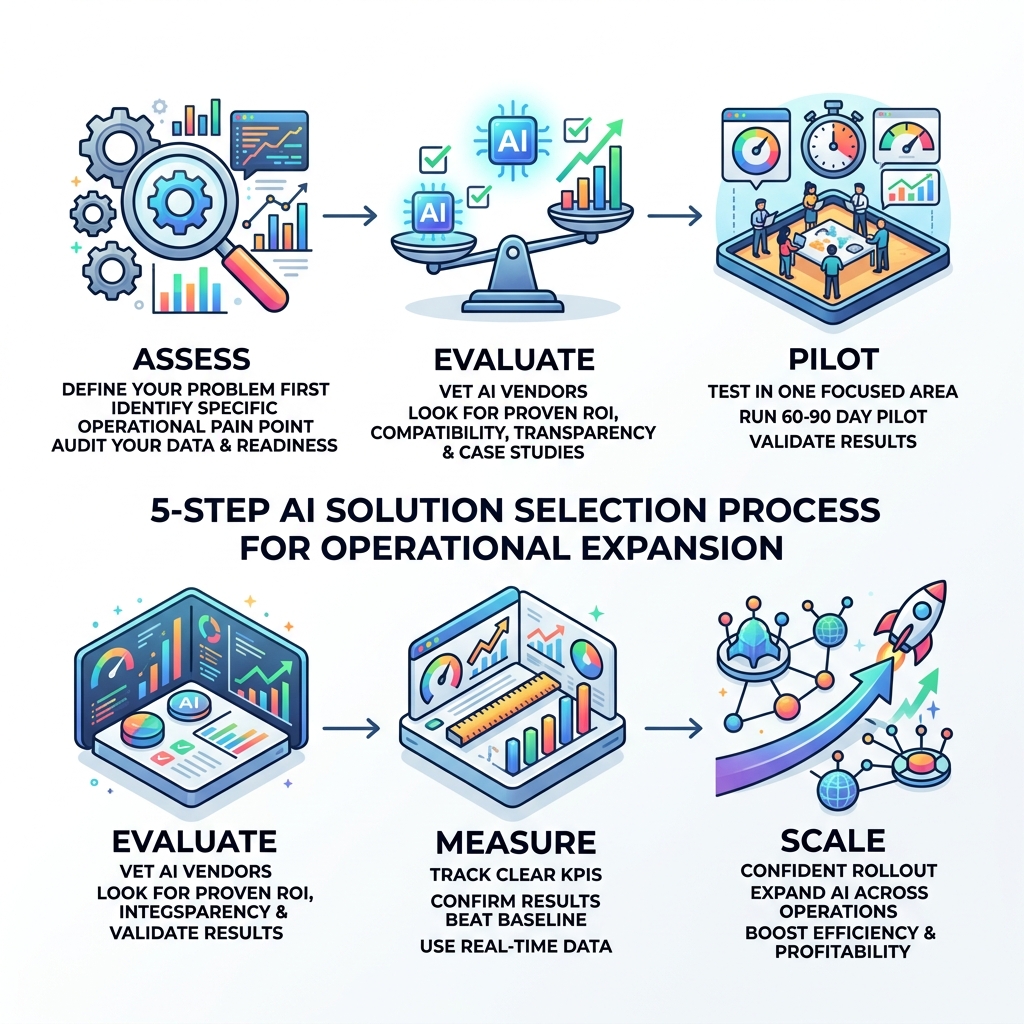
Here’s a quick framework to guide your decision:
- Define your problem first – Identify the specific operational pain point AI should solve (e.g., inventory waste, slow fulfillment, demand forecasting errors)
- Assess your readiness – Audit your data quality, technical infrastructure, and team skills before evaluating any vendor
- Evaluate vendors carefully – Look for proven ROI, integration compatibility, transparency, and real case studies
- Run a pilot – Test in one focused area for 60-90 days before committing to a full rollout
- Measure and scale – Track clear KPIs, confirm results beat baseline, then expand
The stakes are real. According to McKinsey’s 2024 Global AI Adoption report, 44% of manufacturing and supply chain leaders are already piloting or deploying AI, with an expected ROI of 20–30% within two years. Accenture projects AI could increase profitability by 38% by 2035.
But the pressure to “do something with AI” is also pushing many businesses into poor decisions – buying tools based on hype rather than need, skipping pilots, or mistaking basic automation for genuine machine learning.
The goal of this guide is simple: help you cut through the noise and choose an AI solution that actually fits your operations.
Assessing Readiness and Setting Goals for AI-Driven Growth
Before we even look at a shiny new piece of software, we need to take a long, honest look in the mirror. We’ve seen many organizations get swept up in the “AI gold rush,” only to realize they don’t have the tools to dig. Operational expansion requires more than just a credit card; it requires a foundation.
First, we must identify our true operational pain points. Are we struggling with high-volume, repetitive tasks that burn out our staff? Or is our bottleneck a slow manual process that leads to frequent errors? According to A Founder’s Guide to AI Implementation, the most common mistake is starting with the technology and hunting for a problem to solve. Instead, we should identify a specific friction point where AI can provide a clear competitive advantage.
Our “AI maturity” isn’t about how many gadgets we have; it’s about our data readiness. AI systems are only as good as the data they consume. If our data is scattered across legacy systems, messy spreadsheets, and manual logs, even the best AI will struggle. We need to invest in cleaning, organizing, and standardizing our data before we can expect an algorithm to make sense of it.
Furthermore, successful implementation requires executive sponsorship and a workforce with the right skills. We don’t necessarily need an army of data scientists on day one, but we do need leaders who understand AI’s potential and a team that isn’t afraid of the change. With 44% of manufacturing leaders already piloting AI and a projected 38% increase in profitability by 2035, the rewards for being “ready” are massive.
Defining Objectives for How to Choose AI Solutions for Operational Expansion
When we talk about how to choose AI solutions for operational expansion, we need to be specific about what we want to achieve. Vague goals like “improving productivity” are hard to measure and even harder to achieve. We should align our AI choices with specific Key Performance Indicators (KPIs).
Relevant use cases for expansion often include:
- Predictive Maintenance: Moving from reactive repairs to proactive fixes. This can cut unplanned downtime by 20–40% and extend the lifespan of expensive equipment.
- Demand Forecasting: Using machine learning to predict future product needs. Some farms have increased forecasting accuracy by 40%, significantly reducing overstocking and waste.
- Supply Chain Optimization: Improving visibility across the board. Research shows that 60% of logistics firms using AI have reduced lead-time variability by up to 25%.
By aligning our AI choice with these specific operational goals, we ensure that our investment directly supports our growth strategy.
Evaluating Organizational Culture and Governance
AI is as much a “people” project as it is a “tech” project. As noted in Scaling AI Requires New Processes, Not Just New Tools, scaling requires a shift in how we work. We should follow the 10/20/70 rule: 10% of our effort goes to the algorithms, 20% to the technology and data, and a whopping 70% to people and business processes.
This means we need robust change management. We must foster AI literacy across the organization so that employees feel empowered rather than threatened. Governance is also key—who is responsible for the AI’s decisions? What are our ethical standards for data use? Establishing these guardrails early prevents “chaos” later as the system scales. We should choose an operating model—whether it’s a centralized “Center of Excellence” or a decentralized functional model—that matches our current maturity and cultural dynamics.
The Selection Framework: Evaluating Vendors and Avoiding Hype
Now comes the tricky part: picking a partner. The market is currently flooded with vendors claiming their software is “sentient” or “revolutionary.” To navigate this, we need a rigorous evaluation framework.

When we look at How to choose AI solutions for your business, several criteria stand out:
- Transparency: Can the vendor explain how the AI reached a conclusion? “Black-box” models are risky for operations.
- Integration Capabilities: Does the tool play nice with our existing ERP, CRM, and communication platforms? Integration friction is a leading cause of project failure.
- Proven ROI: Can they show us documented results from businesses similar to ours?
- Security and Compliance: Does the vendor meet SOC 2 or ISO standards? Data privacy is non-negotiable, especially in regulated industries.
- Total Cost of Ownership (TCO): We must look beyond the monthly subscription. We need to factor in setup, training, data preparation, and long-term maintenance.
Distinguishing Genuine AI from Basic Automation
One of our biggest challenges is spotting “AI washing”—when a company slaps an AI label on a simple rules-based script. Traditional automation follows “if-then” logic. It’s great for repetitive tasks, but it doesn’t learn. Genuine AI, powered by machine learning and neural networks, is adaptive. It learns from new data and improves its performance over time.
| Feature | Genuine AI | Rules-Based Automation |
|---|---|---|
| Learning | Improves with more data | Stays the same until manually updated |
| Flexibility | Handles unstructured data and nuances | Requires strict, predefined formats |
| Decision Making | Probabilistic (recommends best path) | Deterministic (follows a fixed path) |
| Complexity | High (Neural networks, NLP) | Low (Scripts, macros) |
We should be wary of vendors making “sentient” claims or those who say their tool requires “minimal data” to function. True deep learning usually requires significant historical data to be effective.
Validating Effectiveness Through Vendor Questioning
To ensure we are getting the real deal, we need to put vendors in the hot seat. Here are some questions we should ask:
- “Can you provide a demo showing the AI’s decision-making process in a complex, real-world scenario?”
- “How does your model handle biases in the training data?”
- “Which tasks are fully autonomous, and where is human intervention required?”
- “What are the specific qualifications of your AI development team?”
- “Can you share a case study where this solution was scaled across multiple departments?”
By demanding transparency and evidence, we protect our business from the “vaporware” that often populates the hype cycle.
Strategic Implementation: How to Choose AI Solutions for Operational Expansion
Once we’ve selected a solution, we don’t just “flip a switch.” We need a strategic implementation plan. For many, the big question is: do we buy off-the-shelf, build our own, or partner with a specialist?
According to Buy, Build, or Partner? A Practical Guide to AI Strategy, we should “build” when the AI is a core differentiator for our business and “buy” when it’s a supporting utility (like an internal compliance tool). Buying is faster, but building gives us total control and potentially lower long-term costs if we use it at a massive scale.
We recommend starting with 90-day sprints. This allows us to test a specific “autonomous agent” or tool in a controlled environment, gather feedback, and adjust before a wider rollout. This iterative approach minimizes risk and helps us manage the “technical debt” that can accumulate with poorly planned integrations.
Critical Steps in How to Choose AI Solutions for Operational Expansion
A successful selection and implementation process generally follows these steps:
- Needs Assessment: Conduct a “workflow friction” workshop to find where the team is wasting the most time.
- Vendor Shortlisting: Create a list based on our strict criteria (security, integration, ROI).
- Sandbox/Trial Testing: Run the exact same task through your top two choices in a trial environment.
- The Pilot Phase: Launch the solution with one team for 60–90 days. Set clear success metrics (e.g., “reduce invoice processing time by 50%”).
- Full-Scale Rollout: Once the pilot proves value, expand across the function.
- Continuous Monitoring: AI isn’t “set it and forget it.” We need to monitor for “model drift” and ensure the tool stays aligned with our evolving business rules.
Organizations that follow this structured path report up to 3.7 times greater operational efficiency than those who take a haphazard approach.
Managing Integration and Technical Barriers
Technical barriers are the most common reason AI projects stall. Legacy systems like older ERPs often lack the API compatibility needed for modern AI platforms. We must involve our IT team early to vet security and ensure interoperability.
We also need to avoid “data silos.” If our marketing AI can’t talk to our logistics AI, we lose the “big picture” insights that drive true expansion. Prioritizing cloud-based solutions with robust real-time processing capabilities can help bridge these gaps, ensuring that data flows smoothly across the entire organization.
Measuring Success and Mitigating Long-Term Risks
How do we know if our investment is actually paying off? We have to track the numbers. ROI in AI expansion isn’t always immediate; it often takes 3–6 months to see clear value as the system learns our processes.
Key Performance Indicators (KPIs) to track include:
- Productivity Gains: Hours saved per week on automated tasks (e.g., HR screening time reduced from 10 hours to 2).
- Cost Savings: Reduction in operational costs (e.g., a 12% reduction in transportation costs through route optimization).
- Accuracy Improvements: Lower error rates in data entry or demand forecasting.
- Response Times: Faster customer service resolutions (some companies see a 40% reduction in response times using AI).
- Equipment Lifespan: Increased uptime for machinery thanks to predictive alerts.
By establishing a baseline before we start, we can clearly demonstrate the value to stakeholders and justify further expansion.
Future Trends Influencing Long-Term Scalability
When we think about how to choose AI solutions for operational expansion, we must also look toward the horizon. The AI market in supply chain and logistics alone is expected to grow to $15.3 billion by 2030.
Future-proofing our operations means looking at:
- Generative AI: Using AI to model complex “what-if” scenarios for supply chain disruptions.
- Digital Twins: Creating virtual models of our physical operations to test changes before they happen.
- Sustainability Platforms: Using AI to track emissions and optimize energy use (some data centers have saved 15% on energy using AI cooling).
- Human-Machine Collaboration: Moving away from “replacement” and toward “augmentation,” where AI handles the data crunching so our team can focus on strategy.
Choosing a vendor that stays at the cutting edge of these trends ensures that our solution won’t be obsolete in two years.
Frequently Asked Questions about AI for Business Scaling
How long does it take to see ROI from AI solutions?
For a focused pilot, most organizations see results within 6 to 12 weeks. However, full-scale operational value usually takes 3 to 6 months to materialize as the models refine their accuracy and the team adapts to the new workflows.
What are the biggest risks when choosing an AI vendor?
The primary risks are poor data quality (AI can’t fix bad data), vendor lock-in, and “AI washing.” Additionally, choosing a vendor without strong SOC 2 or GDPR compliance can create massive legal and security headaches down the road.
Can small businesses afford AI for operational expansion?
Absolutely. While custom-built enterprise solutions can cost hundreds of thousands, many SaaS-based AI tools are available for $200 to $2,000 per month. Small businesses can start with low-code or no-code tools and scale their investment as they prove the value.
Conclusion
Choosing the right AI solution is a journey, not a destination. By following a strategic roadmap—defining our problems, assessing our readiness, and running disciplined pilots—we can turn the “hype” of AI into a tangible competitive advantage.
At iBest Health Insurance, we believe that the same care we put into protecting your health should go into protecting your business’s future. Operational expansion is a major milestone, and with the right AI partner, your growth can be as efficient as it is exciting.
