
The Best Set Collection Games to Add to Your Shelf Right Now
Set collection games are board and card games where you score points by gathering groups of matching or complementary items – and the list below covers the best ones available today. At iBest Health Insurance, we believe that a healthy lifestyle includes more than just physical fitness; it also involves keeping your brain active and your social connections strong through engaging activities like tabletop gaming.
Top set collection games at a glance:
- Ticket to Ride – Best overall; collect colored cards to claim train routes
- Sushi Go! – Best quick-play; draft and collect food combos for points
- Jaipur – Best two-player; trade and collect goods for end-game bonuses
- Splendor – Best for strategy beginners; collect gems to build an engine
- Ra – Best auction-based; collect Egyptian tiles through bidding
- Ark Nova – Best heavyweight; collect animals and sponsors for a zoo
- Biblios – Best hidden gem; draft and bid on color-coded book sets
- Point Salad – Best for flexibility; flip cards mid-game to change your scoring
- Lost Cities – Best filler; build color-matched expedition sets head-to-head
- 7 Wonders Duel – Best competitive card drafting with set-based scoring
With over 16,250 games on BoardGameGeek tagged with the set collection mechanic, it’s one of the most widely used in all of tabletop gaming. And it’s not just filler games – top-ranked titles like Ark Nova (#4) and Terraforming Mars (#7) on BGG both use it heavily.
The appeal is simple: most people already understand the idea from childhood games like Rummy or Go Fish. You collect things. Groups score more than individuals. That’s it.
But the best set collection games go far beyond that basic idea – layering in drafting, auctions, dynamic scoring, and tough decisions that keep even experienced gamers hooked.
Whether you’re new to the hobby or looking for your next obsession, this list has something for you.
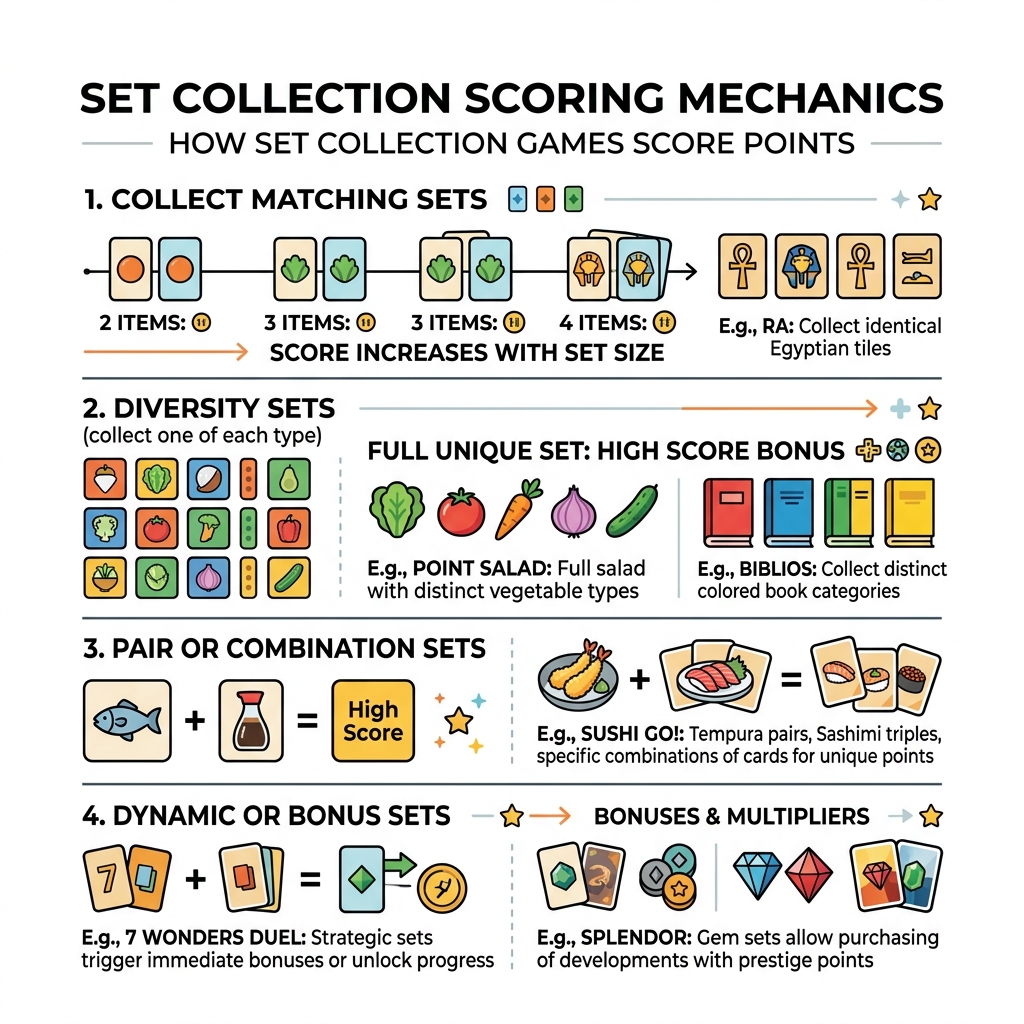
Understanding the Set Collection Board Game Mechanic
At its heart, the Set collection games mechanic is about the power of the group. In these games, the value of an individual item – be it a card, a tile, or a wooden token – is usually low or even zero on its own. However, once that item becomes part of a specific group, its value skyrockets. We call this “synergy,” but you can just think of it as the magic of a matching pair (or trio, or quintet!).

There are generally two ways sets are formed:
- Quantity: You want as many of the same item as possible. Think of collecting five “Iron” cards to build a massive bridge.
- Variety: You want one of every different type. Imagine a traveler trying to collect a souvenir from every continent; having five from Europe isn’t nearly as valuable as having one from each of the seven.
The complexity of these games often comes from how you acquire these items. Do you take them from a shared pool? Do you bid on them? Or do you trade with your neighbors? According to data from BoardGameGeek, there are currently 16,250 board games that feature set collection as a primary or secondary mechanic. This range covers everything from simple 15-minute card games to epic four-hour strategy sessions.
For a deeper look at how this fits into the wider world of gaming, check out our guide on board game mechanics explained review. Beyond the fun, these mechanics offer significant mental health benefits, including improved pattern recognition and problem-solving skills, which are vital for long-term cognitive wellness.
Why Set Collection Games Are So Popular
Why do we love these games so much? For starters, they are incredibly easy to teach. Most of us grew up playing Rummy or Go Fish, so the “language” of set collection is already hardwired into our brains. This creates a very low barrier to entry, making them perfect for family gatherings where you might be playing with Grandma and your young nephew at the same time.
Furthermore, set collection provides a very clear sense of progression. Every time you add a card to your pile, you can see your score potential growing. It’s satisfying to look down at your play area and see a neatly organized “set” coming together. It’s no wonder that many of the Best Set Collection Games according to BGG are also some of the most “giftable” games on the market.
How Set Collection Combines with Other Mechanics
While simple set collection is fun, the modern “Golden Age” of board gaming has found brilliant ways to mix it with other systems:
- Open Drafting: Games like Sushi Go! have you pick one card and pass the rest. This creates tension – do you take the card you need, or the one your opponent desperately wants?
- Auctions: In games like Ra, you don’t just get the cards; you have to bid your limited currency to win them. This turns set collection into a high-stakes psychological battle.
- Worker Placement: In Lords of Waterdeep, you send your agents to different buildings to gather the “adventurers” (sets of cubes) needed to complete quests.
- Card Counting: For the more competitive among us, set collection often involves tracking which cards have already been played. If there are only three “Gold” cards in the deck and your opponent has two, you know it’s time to pivot your strategy.
Top-Ranked Set Collection Games for Every Collection
If you are looking to build out your library, you’ll want a mix of “fillers” (short games) and “main events” (longer games). Here is a quick look at how some of the heavy hitters stack up:
| Game | Player Count | Complexity (1-5) | Main Twist |
|---|---|---|---|
| Ticket to Ride | 2-5 Players | 1.8 | Map-based set collection |
| Sushi Go! | 2-5 Players | 1.1 | Fast-paced card drafting |
| Pandemic Legacy | 2-4 Players | 2.8 | Sets used to cure diseases |
| Ark Nova | 1-4 Players | 3.7 | Zoo-themed engine building |
| Terraforming Mars | 1-5 Players | 3.2 | Multi-layered resource sets |
According to Top Ten Set Collection Games from The Dice Tower, Ticket to Ride remains a perennial favorite, appearing multiple times across different rankings for its perfect balance of simplicity and strategy.
Essential Set Collection Games for Beginners
For those just starting their collection, we recommend “gateway” games. These are titles that are easy to learn but offer enough depth to keep you coming back.
- Lost Cities: A classic two-player game where you play cards in ascending order to fund expeditions. It’s a tense “push-your-luck” game where you can actually end up with negative points if your set isn’t large enough!
- Jaipur: Another two-player masterpiece. You are a trader in the city of Jaipur, trying to collect sets of spices, silk, and gold. The faster you collect them, the more they are worth, but larger sets give you bigger mystery bonuses.
- Coloretto: A brilliant little card game where you want to collect exactly three colors. Any more than that, and they start counting as negative points. It’s a wonderful lesson in “less is more.”
Advanced Strategy in Set Collection Games
Once you’ve mastered the basics, you might want something with more “crunch.”
- Ra: Designed by the legendary Reiner Knizia, this game uses an auction mechanic where players bid on sets of Egyptian tiles. You have to balance collecting “Civilization” sets (for variety) with “Nile” sets (for quantity), all while managing your limited bidding suns.
- 7 Wonders Duel: This is often cited as one of the best two-player games ever made. It uses set collection for scientific progress—collecting different symbols can lead to an instant win!
- Great Western Trail: Here, set collection is used for “contract fulfillment.” You are a rancher herding cattle (sets of cards) to Kansas City. The more diverse your “hand” of cattle is when you arrive, the more money and points you earn.
Innovative Twists: Beyond Simple Sets
Some designers have taken the Set collection games concept and flipped it on its head. These games are perfect for players who think they’ve seen it all.
- Point Salad: This game is the definition of “variable scoring.” Every card has an ingredient on one side and a unique scoring rule on the other. You might take a card that gives you points for carrots, but mid-game, you might decide to flip your strategy and start collecting tomatoes instead. It’s fast, frantic, and fun.
- Biblios: This game is split into two halves. First, you draft cards to build sets of different colored books. Then, you use the cards you didn’t want to auction off the remaining deck. The twist? You can use certain cards to change the value of the sets themselves using dice. That “Blue” set you worked so hard on might be worth 5 points at the start of the game, but only 2 by the end!
- Circus Train: In this game, you recruit talents for your circus. Unlike many games where you “spend” your sets to get points, in Circus Train, you keep your performers permanently as long as you can pay them. It feels more like building a team than just gathering cards.
- Inhabit the Earth: This is a complex game where you evolve different species. You use set collection to trigger migrations and mating, allowing your animals to adapt to different environments across the globe.
Deep Dive: The Iconic SET Card Game
We can’t talk about this genre without mentioning the game that literally shares its name: SET. Designed by Marsha Falco in 1974, this game actually started as a coding system she used in her job as a geneticist!
The game consists of 81 unique cards. Each card has four features:
- Color (Red, Purple, or Green)
- Shape (Oval, Squiggle, or Diamond)
- Number (One, Two, or Three)
- Shading (Solid, Striped, or Outlined)
A “set” consists of three cards where each individual feature is either all the same or all different across the three cards. It is a pure test of visual perception and pattern recognition.
Here are some mind-bending stats about the game:
- There are exactly 1,080 unique sets in the deck.
- Given any two cards, there is exactly one other card in the deck that completes a set with them.
- The probability of three random cards forming a set is 1/79.
- The largest possible layout of cards that contains no valid set is 20 cards (known in mathematics as a “maximal cap set”).
The game is so mathematically deep that determining if a set exists in a generalized version of the game is considered “NP-complete” in computer science. It’s no wonder it won the Mensa Select award in 1991. If you want to master the nuances, you can find the Official SET Rules and Probabilities online to sharpen your skills.
Frequently Asked Questions about Set Collection Games
What is the difference between set collection and drafting?
While they often go together, they aren’t the same. Set collection is the goal (gathering groups for points), while drafting is the method (the way you get the cards). In Sushi Go!, you are drafting cards in order to perform set collection.
Can you play set collection games solo?
Absolutely! Many modern games like Ark Nova and Terraforming Mars have dedicated solo modes. Even the classic SET card game can be played as a solitaire puzzle—just see how many sets you can find before the deck runs out!
What are “contracts” in set collection board games?
A “contract” is a specific type of set collection where the game tells you exactly what you need. For example, a card might say: “Give me two Wood and one Iron to earn 10 points.” Once you complete it, you usually discard those items. This is a bit more structured than general set collection, where you just try to get “as many as possible.”
Conclusion
From the simple joy of matching colors in Ticket to Ride to the intense mathematical challenge of SET, Set collection games offer something for every type of player. They are the “comfort food” of the board gaming world—familiar, satisfying, and always a hit at the table.
At iBest Health Insurance, we know that keeping your mind sharp and your social connections strong is a vital part of a healthy lifestyle. Board games are a fantastic way to bond with family and friends while giving your brain a workout. Whether you’re looking for a quick 15-minute filler or a deep strategic challenge, we hope this list helps you find the perfect game for your next game night.
For more deep dives into how games work, don’t forget to explore more board game mechanics on our site. Happy gaming!
