
Ranking the Best Ticket to Ride Titles and Maps
The Best Ticket to Ride Expansions, Ranked for Every Type of Player
At iBest Health Insurance, we believe that mental fitness is just as important as physical health. Engaging in complex strategy games like Ticket to Ride can help maintain cognitive agility and provide a healthy outlet for stress relief. The best ticket to ride expansion depends on your group, but here are the top picks based on expert rankings and community consensus:
- Ticket to Ride: Europe – Best overall map; adds ferries, tunnels, and stations
- Map Collection 5: UK & Pennsylvania – Best for strategy lovers; shares and tech mechanics
- Map Collection 2: India & Switzerland – Best for 2-3 players; unique mandala loops
- USA 1910 – Best first expansion for USA base game owners
- Nordic Countries – Best for tight, tense 2-3 player sessions
- Europa 1912 – Best upgrade for Europe base game fans
- Map Collection 1: Asia – Best for team play with 4-6 players
Ticket to Ride has been a staple on game tables since winning the Spiel des Jahres (Game of the Year) award and is now celebrating its 20th anniversary as a modern classic. Designed by Alan R. Moon, it turns the simple idea of building train routes across a map into something genuinely competitive and endlessly replayable.
But here’s the problem: there are a lot of expansions.
New maps, new mechanics, new player counts. Some add clever twists like stock shares or technology trees. Others just swap the geography. Knowing which ones are worth your money — and which ones collect dust — takes some digging.
This guide cuts through the noise. Whether you want more strategic depth, a better experience for two players, or a kid-friendly option, there’s a map for that.
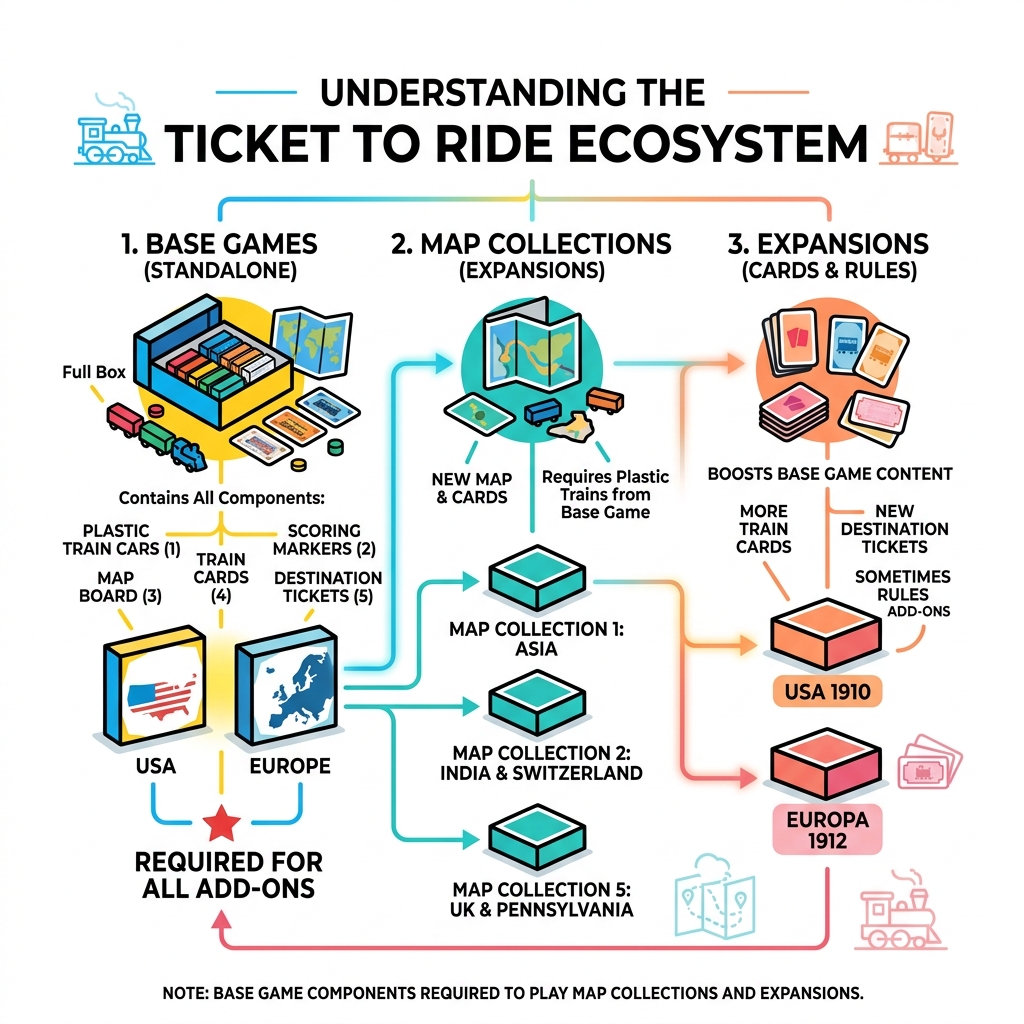
Understanding the Core: Base Games vs. Map Collections
Before we dive into the specific maps, we need to clear up a common point of confusion for new players: the difference between a “Base Game” and a “Map Collection.”
In the Ticket to Ride universe, a base game is a standalone box. It contains everything you need to play: the board, the destination tickets, the train cards, and—most importantly—the plastic train cars. If you buy a Map Collection, you are getting a board and new cards, but you will not have the plastic trains or the wooden scoring markers. You must own a base game to use any of the Map Collections.
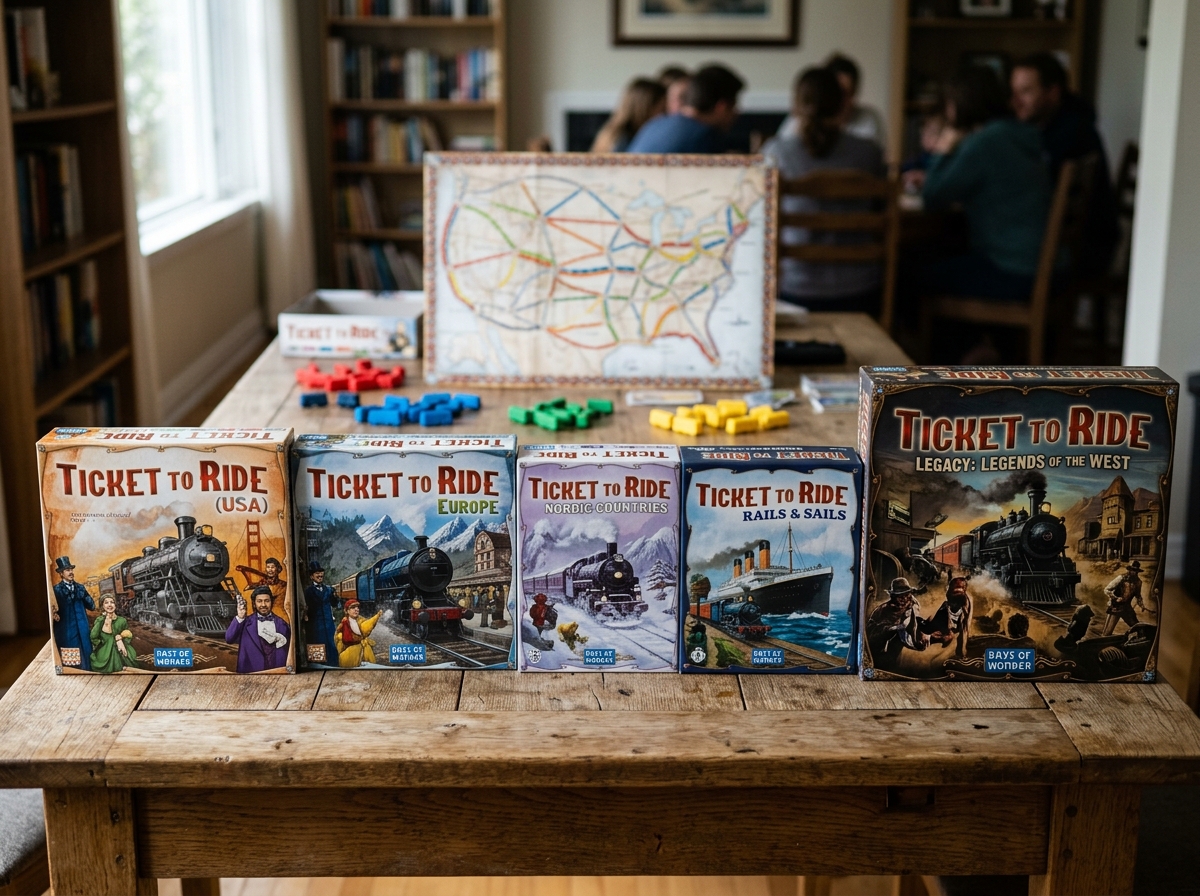
The Major Base Games
- Ticket to Ride (USA): The original. It’s simple, clean, and the best way to learn. However, many veteran players find the map a bit “loose” for 4-5 players.
- Ticket to Ride Europe: Often cited as the superior base game. It introduces Tunnels (which might cost more cards than expected), Ferries (which require locomotive cards), and Stations (which allow you to use an opponent’s route). It’s ranked #1 by many experts for its balanced gameplay.
- Ticket to Ride Nordic Countries: Designed specifically for 2-3 players. It’s a tighter, more “cut-throat” map where routes are blocked quickly. It only includes 40 trains per player (instead of the usual 45) and only supports up to three people.
- Ticket to Ride: Rails & Sails: This is a “heavy” base game. It features a massive double-sided board (World and Great Lakes) and introduces ships. You have to manage two different decks of cards and two different types of plastic pieces. It takes roughly 90-120 minutes—double the time of a standard game.
- Ticket to Ride Legacy: Legends of the West: The newest evolution. This is a 12-game campaign where the board and rules change permanently based on your choices. It’s a massive undertaking but currently holds a staggering 8.7 rating on BoardGameGeek.
When we look at Board Game Mechanics Explained Review, we see that Ticket to Ride relies on “set collection” and “network building.” The expansions we discuss below take these core mechanics and add layers of complexity.
The Best Ticket to Ride Expansion for Every Strategy
If you already own a base game and want to spice up your Friday nights, the Map Collections are where the real variety lives. Each one usually comes with a double-sided board, giving you two maps for the price of one.
UK & Pennsylvania: The Strategic Powerhouse
Many players consider Map Collection 5 to be the best ticket to ride expansion for those who want more “game” in their game. It won the 2015 Golden Geek Best Board Game Expansion award for a reason.
On the Pennsylvania side, we are introduced to the “Shares” mechanism. Every time you complete a route, you claim a share in one of the historic railroad companies associated with that route. At the end of the game, the player with the most shares in each company gets a massive point bonus. It adds a layer of “stock market” strategy that makes every route choice a double-edged sword.
On the United Kingdom side, we have the Technology Tree. You start the game only able to build 1- and 2-train routes in England. To build longer routes, cross into Scotland or Ireland, or use Ferries, you must spend your wild Locomotive cards to “buy” technologies. It turns the game into a race for development.
France & Old West: Creative Construction
Map Collection 6 is for players who like to mess with the board. In France, the tracks are initially uncolored “beds.” When you draw cards, you must also place a colored slat on the board to “claim” what color that track will be. This allows for incredible bluffing—you can lay down a yellow slat to make an opponent think you’re going one way, then pivot entirely.
The Old West map is unique because you must build your network out from a “Home City.” You can’t just jump across the map; everything must connect to your starting point. It also features a fun “Alvin the Alien” variant for those who want a bit of whimsy in their westward expansion.
India & Switzerland: The Small Group Specialists
If you usually play with just one or two other people, Map Collection 2 is essential. Switzerland is widely regarded as one of the best 2-3 player maps because it focuses on country-to-country connections rather than just city-to-city.
India introduces “Mandala” loops. You get bonus points for connecting two cities via two completely different paths. It encourages you to build circular routes rather than just one long line. For more on these, check out Board Game Reviews for Strategy Lovers.
You can also Learn more Ticket to Ride Board Game Buying Guide and Expansions – IGN to see how these stack up against newer releases.
Why USA 1910 is the best Ticket to Ride expansion for beginners
If we own the original USA base game, the USA 1910 expansion is practically mandatory. Why? Because the original game came with tiny “midget” cards that were hard to shuffle and easy to lose.
USA 1910 replaces the entire deck with large-format cards (the same size as the Europe version). It also adds 35 new Destination Tickets and a new “Globetrotter” bonus card for the player who completes the most tickets. It offers three new ways to play:
- 1910 Rules: Using only the new tickets.
- Big Cities: Using only tickets that connect to major hubs like Chicago and New York.
- Mega Game: Using every single ticket in the box for a chaotic, high-scoring marathon.
For those looking for New Expansion Packs for Board Games, this is the gold standard for refreshing an old favorite.
Finding the best Ticket to Ride expansion for Europe fans
If we prefer the Europe base game, Europa 1912 is our equivalent to 1910. It doesn’t just add 55 new destination tickets; it introduces Warehouses and Depots.
In this variant, every player has a Warehouse. Every time you draw train cards, you must place one in someone’s Warehouse. If you claim a route into a city where someone has a Depot, you get to take all the cards in their Warehouse. It adds a “push-your-luck” element that makes the Europe map feel much more competitive. You can see how this affects rankings in our Board Game Ratings and Reviews.
Top Picks for Specific Player Counts and Families
Not every expansion works for every group. A map that is perfect for a couple might be a disaster for a party of six.
The Best for 2 Players: Nordic Countries
While it is technically a standalone base game, we have to mention Nordic Countries here. It is the most balanced experience for two people. The map is tight, the “Locomotive” cards work differently (they can only be used on Ferries and Tunnels), and the snowy aesthetic is beautiful. If you don’t want to buy a whole new base game, Switzerland (from Map Collection 2) is the best alternative expansion for two.
The Best for 6 Players: Team Asia
Most Ticket to Ride games cap out at 5 players. Map Collection 1: Asia changes that. It includes a “Team Asia” map where four or six players compete in teams of two. You and your partner share a common pool of trains and some “shared” tickets, but you also have private tickets you can’t show each other. You have to communicate through your actions on the board, which leads to hilarious (and occasionally frustrating) moments when your partner accidentally blocks the route you were working on.
The Best for Families: First Journey and Ghost Train
If you have younger children (ages 6-10), the standard games might be too long. The First Journey series (available in USA and Europe versions) takes the core mechanics and simplifies them. The maps are smaller, the tickets are easier to read, and the game ends when someone completes six tickets.
For a spooky twist, we highly recommend Ghost Train. It’s a Halloween-themed version of First Journey where you connect “locations” like the Mad Scientist’s Lab and the Pumpkin Patch. It’s a fantastic way to introduce the hobby to kids. We’ve covered similar family-friendly options in our New Expansion Packs for Board Games.
Digital Platforms and Community Critiques
Sometimes we can’t get everyone around a physical table. Fortunately, Ticket to Ride has a strong digital presence, though it has seen some controversy recently.
The Digital Landscape
For years, the “Classic Edition” on Steam was the gold standard. However, it was discontinued in late 2023. The new version, developed by Marmalade Studios, is the current supported platform.
- Steam/Mobile: The base game is usually around $14.99, with expansions like Europe and Nordic Countries costing between $4 and $10.
- Board Game Arena (BGA): This is a fantastic web-based option. If one person has a Premium membership ($3/month), the whole group can play the USA or Europe maps for free. The interface is clean and handles all the scoring automatically.
Community Mixed Reviews
Not every expansion is a home run. While we love the variety, some maps have received mixed reviews from the hardcore community:
- The Heart of Africa: This map is notoriously difficult. It introduces “Terrain Cards” that can double the value of your routes, but if you don’t draw the right terrain at the right time, you can be left in the dust. It’s often cited as being too luck-dependent.
- Nederland: This map uses “Bridge Tolls.” You have to pay coins to build routes. If you run out of coins, you have to take a loan, which costs you points at the end. Some players find the bookkeeping of the coins to be “fiddly” and distracting from the fun of the trains.
For a deeper dive into which versions to avoid, check our Board Game Expansions Review Guide.
Frequently Asked Questions about Ticket to Ride Expansions
Do I need a base game to play the Map Collections?
Yes. Map Collections (like Asia, India/Switzerland, UK/Pennsylvania, etc.) do not include the plastic train cars or the train card deck (usually). You need the pieces from either the original Ticket to Ride or Ticket to Ride Europe to play them.
Which expansion adds the most complex new mechanics?
Ticket to Ride: United Kingdom is widely considered the most complex due to its technology tree. You aren’t just building routes; you are managing a “tech economy” where you must decide whether to invest in the ability to build longer tracks or the ability to cross water. Pennsylvania and its share system also add significant strategic weight.
What is the difference between the Express versions and full expansions?
“Express” versions like Ticket to Ride: New York, London, Paris, and San Francisco are small, standalone games. They use plastic taxis or buses instead of trains and take only 15 minutes to play. They are great for a quick “filler” game but don’t have the depth of the full-sized expansions.
Conclusion
At iBest Health Insurance, we believe that staying mentally active and socially connected is a key part of a healthy lifestyle. Strategic games like Ticket to Ride offer more than just entertainment; they provide cognitive exercise and foster the social bonds that contribute to long-term emotional well-being.
If you are just starting your journey, grab Ticket to Ride: Europe and the USA 1910 expansion. If you are a seasoned pro looking for a challenge, Map Collection 5 (UK & Pennsylvania) is the best ticket to ride expansion to test your skills.
No matter which map you choose, the core joy of the series remains the same: the tension of waiting for that one blue card you need, the satisfaction of completing a long-distance ticket, and the friendly rivalry of a well-placed block.
Ready to expand your tabletop collection further? Explore more tabletop guides to find your next favorite game.
