
Picking the prettiest patterns in our Azul expansion guide
Introduction & Understanding the azul expansions comparison guide
When Michael Kiesling designed the original Azul, he likely didn’t realize he was creating a cultural phenomenon in the tabletop world. Released by Plan B Games, the title quickly ascended the ranks to become the gold standard for abstract strategy. Its core loop is deceptively simple: players take turns drafting colorful “bakelite” tiles from central “factories” to their player boards, aiming to complete specific patterns for points.
However, the “simple” part of that description is exactly why the azul expansions comparison guide is so necessary. As the game grew in popularity, winning the Spiel Des Jahres in 2018 and sitting comfortably near the top of the BoardGameGeek abstract rankings, players began looking for more variety, more challenge, and better table presence.
This led to a branching path of development. On one hand, we received true “add-on” expansions that require a base game to play. On the other, we saw the release of standalone sequels that use the same drafting DNA but change the rules entirely. Understanding this distinction is the first step in building your perfect Azul collection.
For readers at iBest Health Insurance, this kind of guide fits into a broader interest in screen-free hobbies that support relaxation, focus, and social connection. Board games like Azul are often chosen for calm, repeatable gameplay that can make game night feel both mentally engaging and low stress.
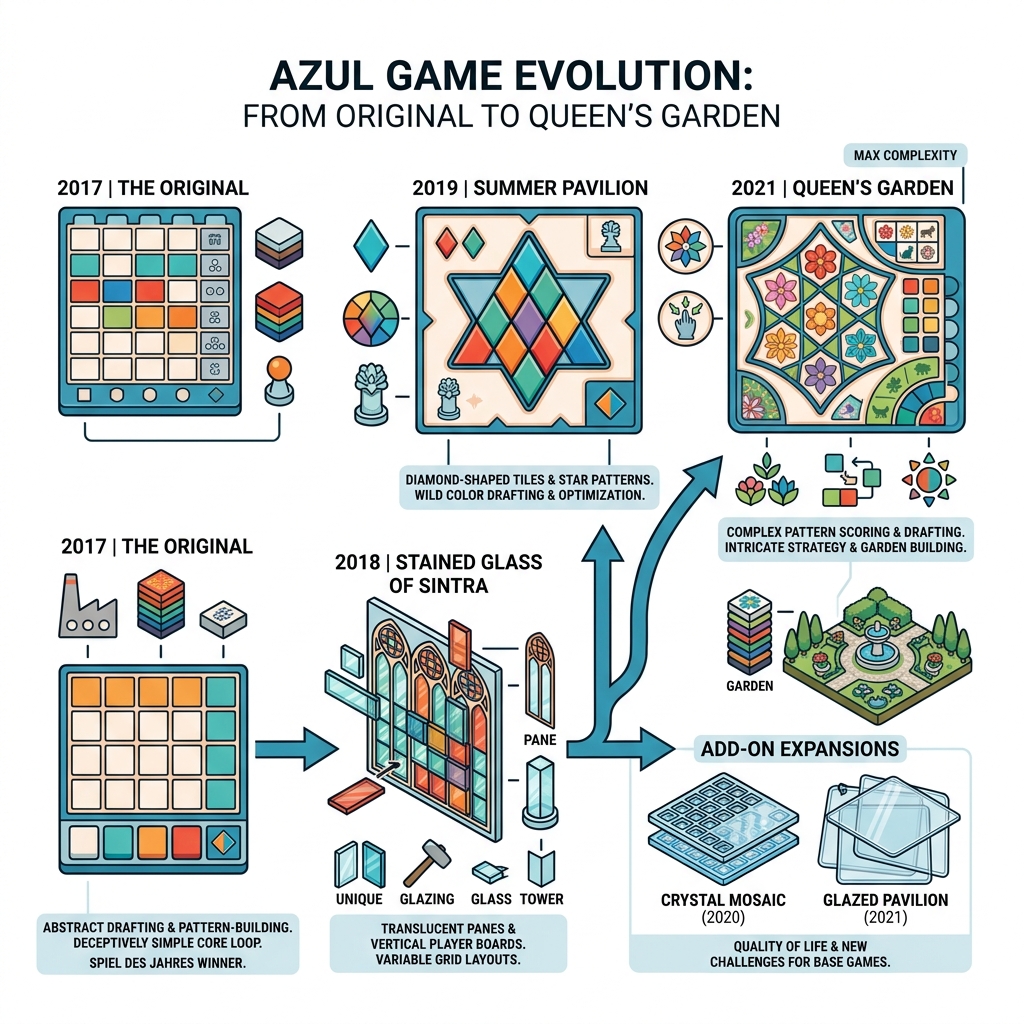
Enhancing the Classics: Crystal Mosaic and Glazed Pavilion
If you already love your copy of the original Azul or Summer Pavilion but want to “level up” the experience without learning a completely new game, the official expansions are your best bet.
Azul: Crystal Mosaic
This was the first true expansion for the original game. It doesn’t change the drafting rules, but it significantly improves the “quality of life” for players. The star of the show is the set of four plastic overlays. These transparent sheets sit on top of your player boards, featuring recessed slots that lock your tiles in place. No more “disaster strikes” when the table is nudged!
Beyond the plastic, Crystal Mosaic includes four new double-sided player boards. These offer new scoring variants, such as boards with pre-printed multipliers or specific placement restrictions that force you to rethink your usual “go-to” strategies. For instance, some boards feature blank spaces where you must decide which color to commit to early on, significantly increasing the risk-reward ratio of every draft. It’s a fantastic way to breathe new life into old favorites.
Azul: Glazed Pavilion
Following the same logic, Glazed Pavilion serves as the expansion for Azul: Summer Pavilion. Just like its predecessor, it provides those much-coveted plastic overlays to keep your diamond-shaped tiles from wandering. It also includes new player boards and scoring maps that introduce more “crunchy” decisions for veteran players. These boards often require more precise planning to maximize the bonus points available from the central star patterns.
| Feature | Crystal Mosaic | Glazed Pavilion |
|---|---|---|
| Required Base Game | Original Azul | Summer Pavilion |
| Primary Component | 4 Plastic Overlays | 4 Plastic Overlays |
| New Boards | 4 Double-sided (8 layouts) | 4 Double-sided (8 layouts) |
| MSRP | $14.99 | $14.99 |
| Focus | Stability & Scoring Var. | Stability & Strategic Depth |
For more details on how these fit into the broader market, you can check out this Azul Board Game Buying Guide – IGN or explore our thoughts on new expansion packs for board games.
Beyond the Base: Sequels and Variants

While the expansions mentioned above are add-ons, the titles below are standalone games. You do not need the original Azul to play these. Each one takes the drafting mechanic and spins it in a new direction.
- Azul: Stained Glass of Sintra: Instead of a flat wall, you are building vertical window panes. It introduces a “Glazier” pawn that limits where you can place tiles, adding a layer of tactical movement.
- Azul: Summer Pavilion: This version uses diamond tiles and introduces “wild” colors that change every round. It’s widely considered the “gamer’s choice” because it allows you to save tiles between rounds, reducing the “feel-bad” moments of the original.
- Azul: Queen’s Garden: The “heavyweight” of the family. It uses hexagonal tiles and adds a second layer of drafting (patterns and colors). It’s the longest and most complex version by far.
- Azul: Master Chocolatier: This is a thematic reskin of the original game. It’s functionally the same but features chocolate-themed tiles. It does include an “Advanced Mode” with special factory effects that add a tiny bit of extra variability.
- 5211: Azul Edition: This is actually a card game (a reskin of the game 5211) that uses Azul’s art style. It’s a filler game, not a tile-layer.
- Azul Mini: A shrunken-down version of the original. It’s perfect for travel and features a clever board design where the tiles “snap” into place, acting like a built-in version of the Crystal Mosaic expansion.
Choosing between these can be tough. If you’re looking for crowdsourced winners for the best board game expansions, you’ll find that the Azul series consistently ranks high for its variety. For a deeper dive into the standalone titles, see Which Azul is Best? – Bitewing Games.
Comparing sequels in the azul expansions comparison guide
When comparing these sequels, we have to look at the “vibe” of the table. The original Azul is often called a “knife-fight in a phone booth.” It’s mean. You can easily “hate-draft” tiles to force your opponent to take massive negative points.
In contrast, Summer Pavilion is like a “sunny day at the beach.” It’s more forgiving. Queen’s Garden is a “meditative puzzle” that might make your brain hurt but feels incredibly rewarding when a plan comes together. If you’re interested in how these have aged, we’ve enjoyed looking back at the best board game expansions from 2017 to today to see how the series evolved from simple drafting to complex engine-building.
Strategic Shifts and Player Experience
Each entry in the azul expansions comparison guide shifts the strategy in a unique way. In the original, your focus is on the “Floor Line”—avoiding the trash heap. In Sintra, the strategy shifts to the “Glazier,” where you must manage your position on the board to avoid “resetting” and losing a turn. This adds a layer of spatial movement that requires you to think about where you are, not just what you are taking.
Summer Pavilion introduces “Bonus Loops.” By surrounding certain symbols on your board, you get to pluck extra tiles from a central supply. This creates a satisfying “combo” feel that the original lacks. Queen’s Garden throws all of that out the window in favor of hexagonal adjacency rules where you must match either the color or the icon of neighboring tiles, but never both. This creates a spatial puzzle that is far more demanding than the original’s grid-based system, requiring players to plan several turns in advance to ensure they don’t block their own progress. It is the ultimate test for those who have mastered the earlier iterations.
Azul Complexity Scores (BGG Scale 1-5):
- Azul (Original): 1.76 (Easy to learn, hard to master)
- Stained Glass of Sintra: 1.89 (A bit more “fiddly”)
- Summer Pavilion: 2.01 (The sweet spot for most hobbyists)
- Queen’s Garden: 3.02 (A significant jump in “brain burn”)
For those who love analyzing these shifts, our board game expansions review guide offers more insights into how these mechanical changes affect long-term replayability.
Frequently Asked Questions
Common queries in the azul expansions comparison guide
Can I mix tiles between different Azul versions? Generally, no. The original tiles are square, Sintra tiles are translucent “cough drops,” Summer Pavilion tiles are diamonds, and Queen’s Garden tiles are hexagons. They are physically incompatible. However, the Crystal Mosaic and Glazed Pavilion expansions are designed specifically to work with their respective base games. Mixing them would not only break the rules but also the physical layout of the boards.
Are the plastic overlays worth the extra cost? In our opinion, yes—if you play the game frequently. At an MSRP of $14.99, they solve the biggest complaint about the series (slippery tiles). They not only provide functional stability but also give the game a more premium, “deluxe” feel that enhances the overall tactile satisfaction of the hobby. If you only play once a year, you can probably skip them, but for “Azul addicts,” they are essential.
Which expansion is best for two players? While all Azul games play 2-4 players, the original Azul (with or without Crystal Mosaic) is arguably the best at two players because it is the most “cutthroat.” You can track exactly what your opponent needs and deny them much more effectively than in the later, more complex versions. In a two-player game, every tile you take is a tile your opponent cannot have, making the drafting phase incredibly tense.
Conclusion
Whether you are looking for the tactile stability of Crystal Mosaic or the deep, garden-growing puzzles of Queen’s Garden, there is an Azul title for almost every type of tabletop player. A practical path is to start with the original game, then add Crystal Mosaic if you want better tile stability and extra board variety. If you want a standalone sequel with a friendlier feel, Summer Pavilion is often the next step.
For iBest Health Insurance readers, tabletop games are an easy example of how leisure activities can support a balanced lifestyle. They encourage time with friends and family, light strategic thinking, and a break from screens, which is why hobby guides like this can still be a natural fit for a wellness-minded audience.
Ready to expand your horizons? Explore our other guides to find the perfect tabletop experience for your next game night!
