
Why Every 7 Wonders Duel Fan Needs to Know About the Expansions
At iBest Health Insurance, we believe that a healthy lifestyle involves more than just physical activity; it is also about keeping your mind sharp and your social connections strong. 7 Wonders Duel expansions give one of the best two-player board games an even bigger punch, offering new ways to challenge your brain. There are two official expansions to choose from:
| Expansion | Released | BGG Rating | Complexity (out of 5) | Best For |
|---|---|---|---|---|
| Pantheon | 2016 | 8.0 | 2.31 | New and returning players |
| Agora | 2020 | 8.1 | 2.91 | Experienced players |
Both are designed for 2 players, ages 10+, and keep playtime around 30-45 minutes.
7 Wonders Duel is already a top-ranked game. It sits at #24 overall on BoardGameGeek, with an 8.1 average rating from over 107,000 players. Designed by Antoine Bauza and Bruno Cathala and published by Repos Production, it packs a full civilization-building experience into just 30 minutes.
But after a while, the base game can start to feel familiar. That’s exactly where the expansions come in. Pantheon adds gods and divine blessings. Agora adds a Senate board, political power, and secret conspiracies. Both change how you think about every turn – without making the game slow or bloated.
If you’re trying to decide which expansion to buy (or whether to get both), you’re in the right place.
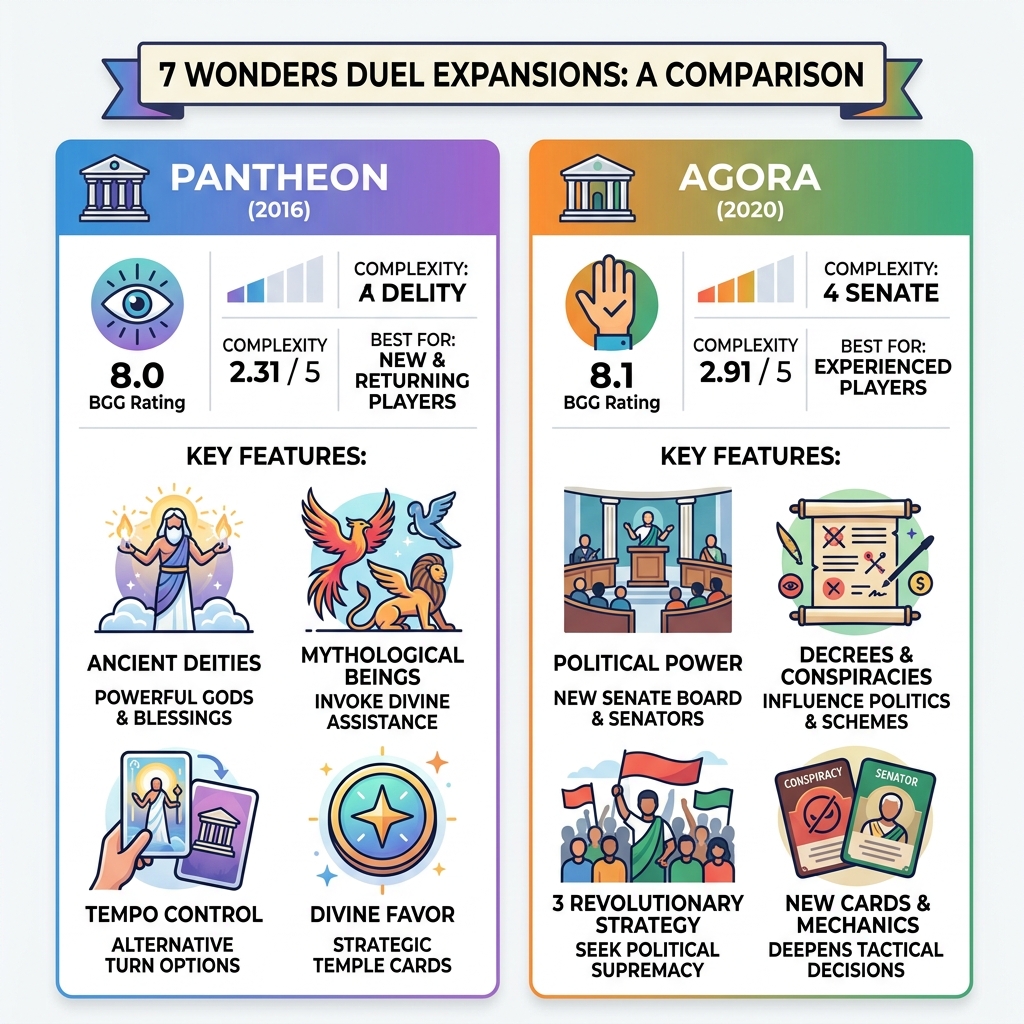
The Pantheon Expansion: Divine Intervention for Your Civilization
If we feel like the base game is getting a bit too predictable, the 7 Wonders Duel: Pantheon Expansion is usually our first recommendation. Released in 2016, this expansion introduces the literal power of the gods into your match. From a cognitive health perspective, adding these new layers of strategy is a fantastic way to improve mental flexibility and long-term planning skills.
In the base game, you are forced to take a card from the structure on every turn. Sometimes, you know that taking a card will reveal a perfect card for your opponent. It is a frustrating “damned if you do, damned if you don’t” situation. Pantheon fixes this by giving us an alternative action: activating a God.
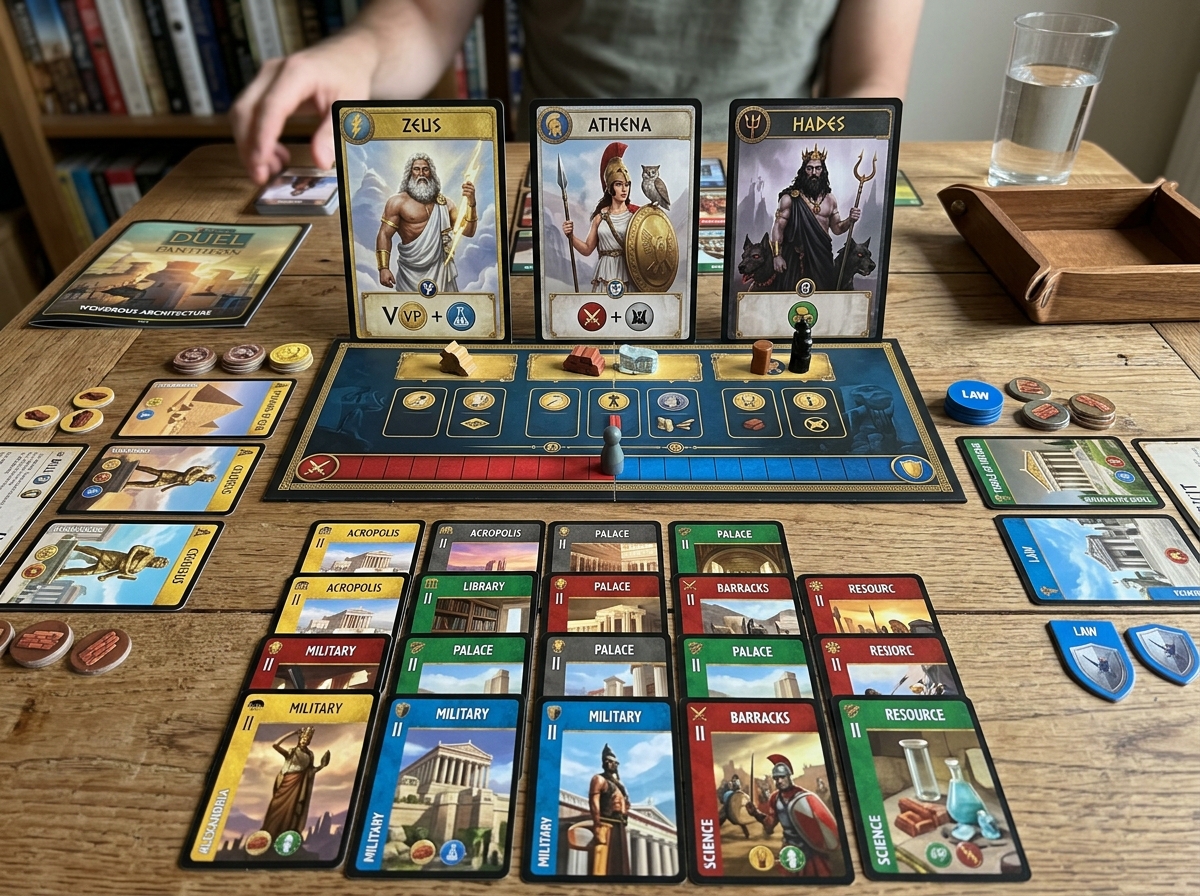
Strategic Depth in 7 Wonders Duel Expansions
The core of this expansion is the Pantheon board, which sits above the main board. During Age I, we collect Mythology tokens that allow us to choose which deities will populate the Pantheon. There are five different ancient Mediterranean cultures represented:
- Greek: Focuses on civilization and scientific advancement.
- Roman: Provides military strength to push that conflict pawn further.
- Egyptian: Helps with Wonder construction and resource management.
- Phoenician: All about the money (gold/coins).
- Babylonian: Offers scientific symbols to help trigger a scientific victory.
In Age II, instead of taking a card from the pyramid, we can spend coins to activate one of these Gods. This is a huge strategic shift. It allows us to “skip” a turn in the card structure, forcing our opponent to reveal cards they didn’t want to. This added layer of competitive gaming makes the game feel much more like a high-stakes chess match, providing a great mental workout.
We also get the Gate card, which acts as a wildcard to access the top card of any mythology deck, and the Minerva pawn, which can block the military conflict pawn from moving forward, acting as a divine shield for our city.
New Wonders and Progress Tokens
Pantheon isn’t just about the gods; it also brings new toys to the table. We get two new Wonders:
- The Sanctuary: This gives us an extra turn and allows us to activate a God for a reduced price.
- The Divine Theater: This provides points and lets us peek at the top of the mythology decks.
Additionally, three new Progress tokens are added to the mix, and Age III is shaken up by Grand Temples. These replace the Guild cards from the base game. Grand Temples are worth significant victory points based on how many “Mythology tokens” we’ve collected throughout the game. If you’ve spent the whole game courting the gods, these temples can be the difference between a narrow loss and a crushing victory.
The Agora Expansion: Mastering the Art of Political Intrigue
While Pantheon looks to the heavens, the 7 Wonders: Duel Agora expansion keeps its eyes firmly on the ground – specifically, in the shadowy hallways of the Senate. Released in 2020, Agora is the “political” expansion. Engaging in these types of high-interaction games is a great way to foster social bonding and reduce stress through shared play.
Political Victory in 7 Wonders Duel Expansions
The biggest addition in Agora is the Senate board. This board is divided into six chambers, each offering a “Decree” (a special bonus) to whoever controls it. We control chambers by placing influence cubes.
How do we get those cubes there? Through Senator cards. These cards are mixed into the Ages alongside the standard buildings. There are two types:
- Politicians: These allow us to place influence cubes or move them between chambers.
- Conspirators: These allow us to place a single cube or perform a “Conspiracy.”
Agora also introduces a third way to win the game instantly: Political Supremacy. If we manage to control all six chambers of the Senate, the game ends immediately, and we win. This adds a constant tension – you can’t just watch the military track and the science symbols anymore; you have to watch the Senate, too.
Conspiracy Cards and Dark Corridors
Conspiracy cards are perhaps the most “spicy” addition to the 7 Wonders Duel expansions library. When we recruit a Conspirator, we can choose to draw Conspiracy cards. These stay face-down and secret from our opponent.
Each Conspiracy card has a powerful effect that we can trigger on a later turn. These can range from stealing coins to destroying an opponent’s building or even taking an extra turn. Because they are hidden, they add a layer of psychological warfare. Our opponent knows we have a “plot” ready, but they don’t know what it is or when it will strike. This tactical disruption is a highlight in many Pantheon and Agora reviews.
Comparing 7 Wonders Duel Expansions: Pantheon vs. Agora
Choosing between these two can be tough. They both offer incredible value for your mental health and cognitive engagement, but they cater to different styles of play. Let’s look at how they stack up side-by-side.
| Feature | Pantheon | Agora |
|---|---|---|
| Primary Focus | Divine Powers / Turn-Skipping | Political Control / Secret Plots |
| BGG Complexity | 2.31 / 5 | 2.91 / 5 |
| New Victory Condition? | No (but replaces Guilds) | Yes (Political Supremacy) |
| Player Interaction | Moderate (Passive-Aggressive) | High (Direct and Secret) |
| Best For | Smoothing out the base game | Adding deep strategic layers |
If you are looking for more information on how these fit into the wider world of 7 Wonders, check out our complete 7 Wonders buyer’s guide.
Complexity and Gameplay Style
Pantheon is often called the “essential” expansion. It doesn’t add a lot of “rules overhead.” Once we understand how the gods work, the game flows just as quickly as the base game. It feels like a natural patch to the original design, making the drafting process feel fairer and more strategic.
Agora, on the other hand, is a “gamer’s expansion.” With a complexity rating of 2.91 on BoardGameGeek, it asks us to track a lot more information. We have to manage our influence cubes, watch the Senate chambers, and prepare for (or defend against) Conspiracies. It makes the game feel “heavier” and more intense, providing a more rigorous mental challenge.
Which Expansion Should You Buy First?
For most players, we suggest starting with Pantheon. It is easier to teach, integrates seamlessly, and fixes the “forced move” issue of the base game. It is currently owned by over 51,000 users on BoardGameGeek, proving its status as a community favorite.
However, if we are veteran gamers who have played 100+ games of the base version and want something that feels like a brand-new challenge, Agora is the way to go. The political tug-of-war is incredibly satisfying, and the “Conspiracy” mechanic adds a level of excitement that the gods don’t quite reach.
Typical price ranges for both expansions are between $24.99 and $26.99, making them an affordable way to breathe new life into our game nights.
Can You Play Both Expansions Together?
The short answer is: Yes! Both expansions were designed to be compatible with each other. But just because we can doesn’t always mean we should – at least not right away.
Pros and Cons of the Mega-Game
Playing with both Pantheon and Agora creates what fans call the “Mega-Duel.”
The Pros:
- Ultimate Strategic Depth: There are so many ways to win and so many ways to thwart our opponent. It is the ultimate 2-player strategy experience for cognitive development.
- Amazing Synergy: Some gods from Pantheon can help us get more coins to buy Senators in Agora. Some Agora decrees can make activating gods cheaper.
- Variety: No two games will ever be the same. The combination of deities, senators, and wonders is nearly infinite.
The Cons:
- Table Space: Between the base game board, the Pantheon board, the Senate board, and our individual cities, we are going to need a bigger table!
- Analysis Paralysis: With so many options on every turn, the game can slow down. The “30-minute” playtime will likely stretch to 45 or 60 minutes.
- Complexity Overload: For a new player, this is way too much to handle. We only recommend combining them once both players are very comfortable with each expansion individually.
Replayability and Long-term Value
The beauty of these 7 wonders duel expansions is how they evolve the “meta” of the game. In the base game, military and science are often seen as “distractions” while you go for points. With the expansions, every victory path becomes viable and dangerous. We have seen reviews from players on their 100th game who say that combining the expansions makes the game feel fresh every single time. They aren’t just “add-ons”; they are essential components for any serious collector looking to keep their mind active.
Promo Cards and Hidden Gems for 7 Wonders Duel
Beyond the big boxes, there are a few “hidden gems” that we should keep an eye out for. These are often small promo cards or mini-expansions that add a little extra flavor and keep the mental challenge fresh.
- 7 Wonders Duel: Solo: Released in 2020, this allows us to play against an “automated” opponent. It is perfect for maintaining mental agility when our gaming partner is busy. You can find more about the essential two-player game and its solo mode on the Repos Production site.
- Statue of Liberty Promo: A unique Wonder card that was released in 2016.
- The Messe Promo: A card that gives bonuses based on the number of Wonders built.
- Tu Quoque Fili: A 2021 promo card for the Agora expansion that adds even more political treachery (named after the famous line attributed to Julius Caesar).
These promos aren’t necessary, but for completionists, they are the “cherry on top” of a great collection.
Frequently Asked Questions about 7 Wonders Duel Expansions
Do I need the base game to play these expansions?
Yes. Both Pantheon and Agora are expansions and require the original 7 Wonders Duel base game to play. They include components that integrate directly with the base game’s cards and boards.
Can I use Pantheon and Agora at the same time?
Absolutely! They are fully compatible. However, we recommend being very familiar with both before trying to play them together, as it significantly increases the complexity and the number of things we need to track.
Which expansion is better for beginners?
Pantheon is definitely the better choice for beginners. Its rules are more intuitive, and it fixes some of the minor frustrations of the base game without adding too many new symbols or win conditions.
Conclusion
At iBest Health Insurance, we believe that staying mentally sharp and socially connected is a vital part of a healthy lifestyle. Engaging in deep strategy games like 7 Wonders Duel is a fantastic way to bond with a partner or friend while giving your brain a workout.
Our final verdict? If you love the base game, 7 Wonders Duel expansions are not just optional—they are game-changers. Pantheon is the “fix” that makes the game feel perfect, while Agora is the “challenge” that keeps you coming back for more. Whether you’re courting the favor of the gods or plotting in the shadows of the Senate, these expansions ensure that your civilization will stand the test of time.
Ready to upgrade your game night? Grab Pantheon first, master the divine, and then head into the Senate with Agora. Your table—and your opponent—won’t know what hit them!
