
The Best Trivia Family Board Games to Buy Right Now
Trivia family board games are one of the best ways to get everyone — from kids to grandparents — around the same table and genuinely competing. But with over 2,000 options on Amazon alone, picking the right one is harder than it looks.
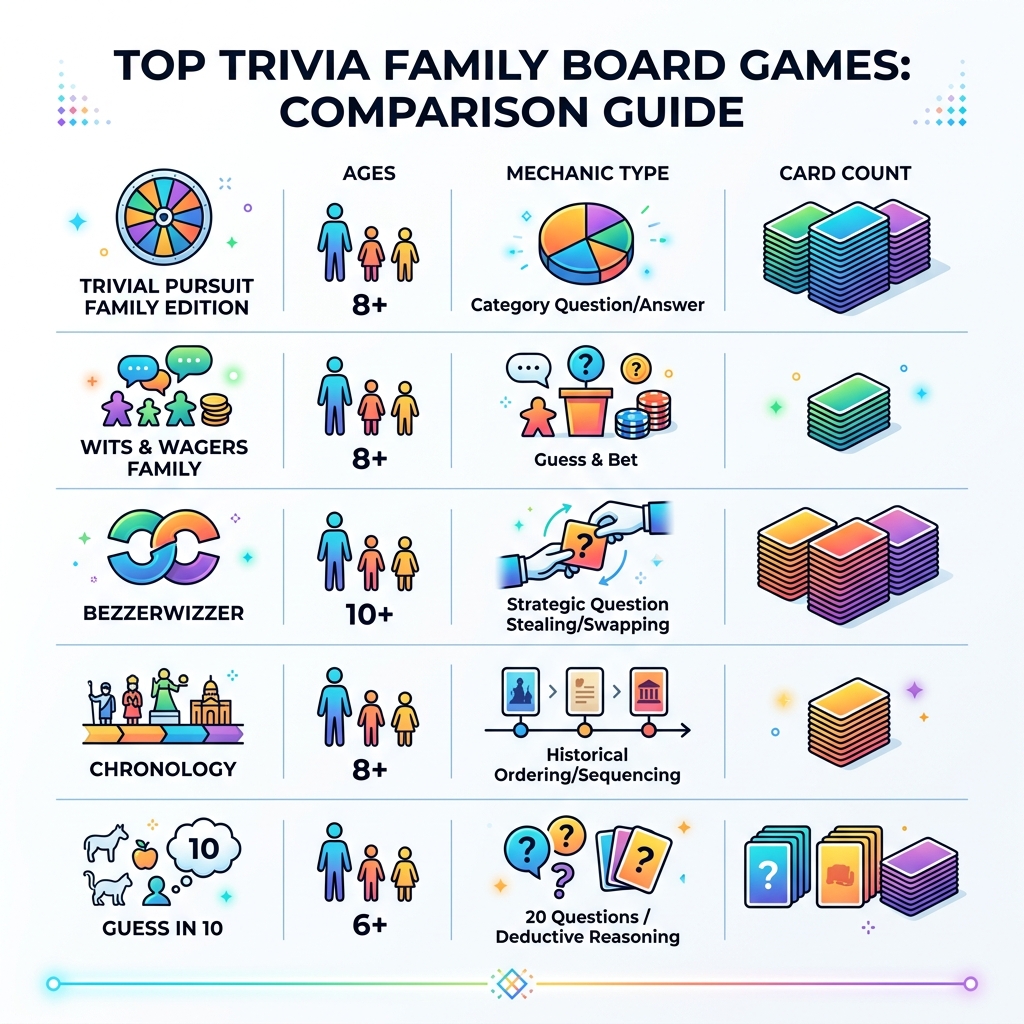
Here are the top picks to consider first:
| Game | Best For | Ages |
|---|---|---|
| Trivial Pursuit Family Edition | Classic all-rounder | 8+ |
| Wits & Wagers Family | Non-experts and mixed ages | 8+ |
| Bezzerwizzer | Strategic trivia fans | 10+ |
| Chronology | History lovers | 8+ |
| Guess in 10 | Young kids | 6+ |
These games cover a wide range of mechanics, themes, and age groups — so there’s something here for almost every household.
Not all trivia games are created equal. Some put younger players at a serious disadvantage. Others run out of fresh questions after a few plays. A few have mechanics that let one dominant player steamroll everyone else — and that kills the fun fast.
The good news? The best trivia games today are designed to fix exactly those problems. Betting mechanics level the playing field. Dual question sets keep kids in the game. High card counts mean you won’t see repeats for years.
This guide breaks down the top options so you can find the right fit for your family — without the guesswork.
Top-Rated Trivia Family Board Games for Every Generation
When we think of trivia family board games, the mind usually goes straight to the classics. However, the landscape has evolved significantly. While the “big names” still hold weight, modern titles have introduced mechanics that prevent the “smartest person in the room” from winning every single time.
Trivial Pursuit Family Edition
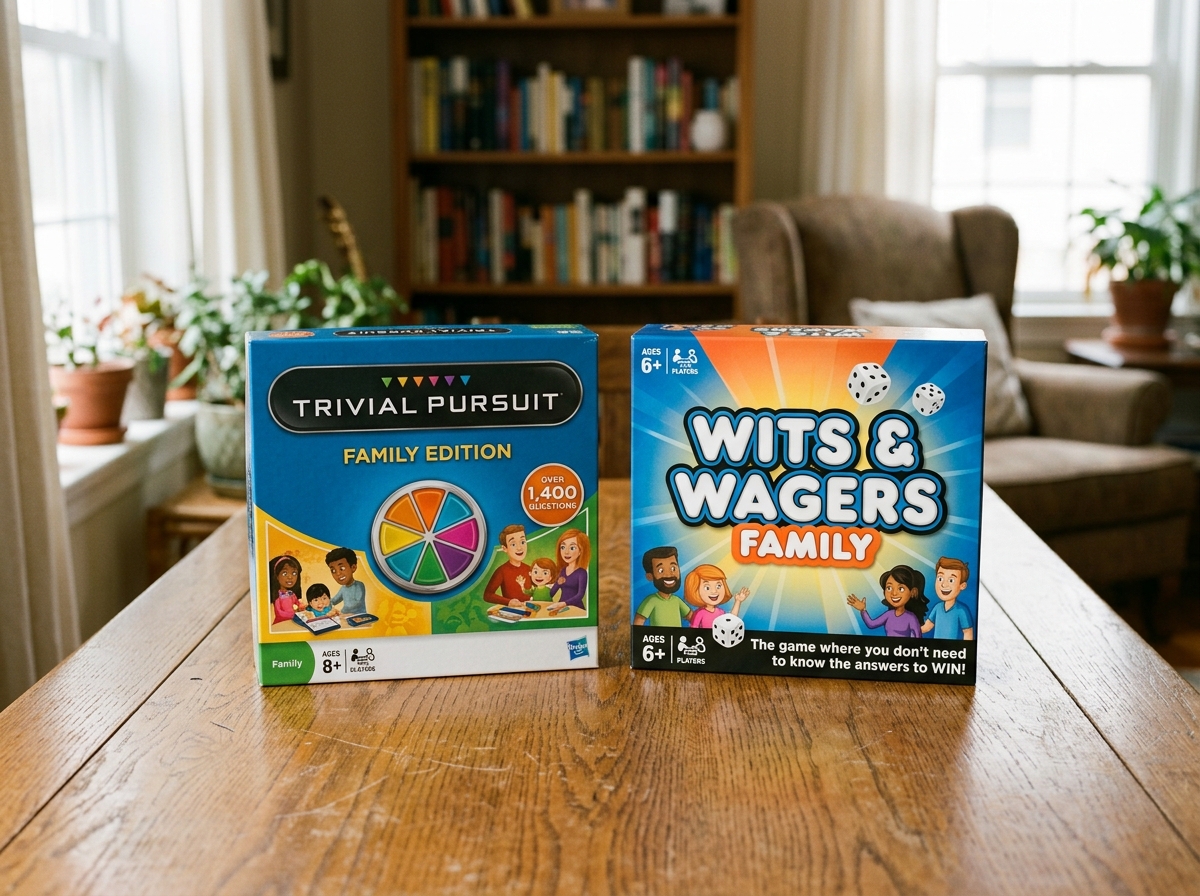
This is the gold standard for a reason. Trivial Pursuit Family Edition Game – Hasbro Games is specifically designed to bridge the gap between generations. It features 1,400 to 2,400 questions (depending on the specific version) split into two distinct sets: yellow cards for kids and blue cards for adults.
The categories remain the classics we know: Geography, Entertainment, History, Sports and Leisure, Arts and Literature, and Science and Nature. What makes this edition a standout for us is the “Showdown” challenge. This mechanic allows two players to compete for a wedge simultaneously, which speeds up the game and adds a layer of high-stakes excitement that the original version lacked. You can find more details on how this fits into a broader gaming strategy in our family-friendly board game review guide.
Bezzerwizzer
If your family enjoys a bit of “take-that” strategy with their facts, Bezzerwizzer is a must-own. It has been a staple on tables for over 15 years because it balances pure knowledge with tactical wagering.
In Bezzerwizzer, you pull category tiles from a bag and must decide which order to play them in. If you are a history buff, you put the History tile in your 4-point slot. If you know nothing about sports, you put that in the 1-point slot. The real friction comes from the “Bezzerwizzer” and “Zwapping” tiles, which allow you to steal questions or swap categories with opponents. It turns a standard quiz into a battle of wits and resource management.
Chronology
For families that love history but hate memorizing exact dates, Chronology is a breath of fresh air. The goal is simple: build a timeline of events. You don’t need to know that the Slinky was invented in 1943; you just need to know if it happened before or after the invention of the lightbulb.
One of the biggest advantages of Chronology is its sheer value. When comparing it to similar games like Timeline, the card count is a major factor in replayability.
| Feature | Chronology | Timeline Series |
|---|---|---|
| Card Count | 428-480 cards | 55-110 cards |
| Mechanic | Building a personal timeline | Placing cards in a central line |
| Value | High (more questions, lower price per card) | Moderate (requires expansions quickly) |
| Best For | Long-term family play | Quick, portable sessions |
Balancing Knowledge Levels in Trivia Family Board Games
The biggest “fun killer” in trivia is a massive knowledge gap. If Dad is a history professor and the youngest child is in third grade, a standard game of Trivial Pursuit Classic is going to end in tears.
To solve this, we look for games that use dual-level cards. As mentioned, Trivial Pursuit Family Edition uses separate boxes for seniors and juniors. This ensures that the 8-year-old is being asked about Minecraft or community helpers while the adults are grilled on 1970s cinema.
Another brilliant solution is the “betting” mechanic found in Wits & Wagers Family on BoardGameGeek. In this game, every answer is a number. You don’t have to know the exact answer; you just have to guess. Once everyone has written their guess on a dry-erase board, you lay them out in numerical order. Then, everyone bets their “meeples” (little wooden people) on which guess they think is closest to the truth without going over.
This creates scoring parity. A child can win by realizing that Grandpa usually knows a lot about science and betting on Grandpa’s guess. It shifts the game from “who knows the most” to “who is the best at reading the room.”
Themed Trivia for Specific Interests
Sometimes, a general knowledge game feels too broad. If your household has a specific obsession, themed trivia family board games are the way to go.
- Disney Enthusiasts: Disney Trivia games consistently rank high (4.7 out of 5 stars) because they span generations, from Steamboat Willie to Encanto.
- Animal Lovers: The Guess in 10 series by Skillmatics is fantastic for younger kids. It uses a “20 Questions” style mechanic where players use clue cards to guess the animal.
- Academic Buffs: Educational trivia games by Quokka offer specialized sets for History, Geography, and Science. Their “Who Knows Better?” set has a near-perfect 4.9-star rating from verified customers, making it a solid choice for families who want to sneak some learning into game night.
- Pop Culture: Games like Smart Ass or I Should Have Known That! focus on things you think you know but might forget under pressure.
Innovative Mechanics: Why Some Trivia Games Engage Better Than Others
The reason some trivia games gather dust while others are played every weekend comes down to engagement mechanics. Traditional trivia often involves a lot of “downtime” — sitting around while one person thinks. Modern games have fixed this.
SMART10 and Portability
SMART10 is a revolution in the genre. It’s a handheld 6×6 inch square device that holds 100 double-sided question cards. Each question has 10 possible answers hidden behind “nubbins” (small plastic plugs).
- The Hook: On your turn, you pick an answer and pull the nubbin. If you’re right, you keep the nubbin as a point.
- The Risk: You can pass and keep your points, or keep going. If you get one wrong, you lose all points for that round. It’s rapid-fire, portable, and involves zero pens, paper, or boards.
Wagering Systems
We’ve discussed Wits & Wagers, but the official game rules for Wits & Wagers Family Edition highlight why it works so well for families. You get a small meeple (1 point) and a large meeple (2 points). You can split your bets between two different guesses. This “safety net” encourages kids to take risks without the fear of being completely wrong. To see how these mechanics compare to other modern releases, check out our list of the latest tabletop games for families.
Numerical Guessing
Games like CONFIDENT? or Terra also use numerical ranges. Instead of saying “The Eiffel Tower is 330 meters tall,” you might say “I think it’s between 250 and 400 meters.” The smaller your range, the more points you get — but if the actual answer falls outside your range, you get zero. This allows for “educated guessing,” which is a much more inclusive mechanic than “exact recall.”
Avoiding Common Pitfalls in Family Trivia Selection
Even a highly-rated game can be a “dud” for your specific family if you aren’t careful. Here are the common pitfalls to watch out for:
- The “Steamrolling” Mechanic: Some games, like Outsmarted!, have been criticized in gaming forums because a single dominant player can take long turns and leave others sitting idle. If one person can answer 20 questions in a row without passing the die, the rest of the family will check out.
- Outdated Questions: Trivia ages poorly. A “current events” game from 2015 is now a history game. When buying, check the “published” date. This is why classics like Trivial Pursuit release “Decades” editions.
- Low Card Volume: As we saw with the Chronology vs. Timeline comparison, some games only come with 50-100 cards. If you play for two hours, you’ve seen half the deck. Look for games with at least 300+ cards to ensure longevity.
- Downtime: Avoid games where the “reader” is excluded from the fun or where turns take more than a minute. Games like SMART10 or Color Brain keep everyone involved simultaneously.
- Subjective Difficulty: I Should Have Known That! has over 33,000 reviews and a 4.5-star rating, but some find it frustrating because it penalizes you for not knowing things that seem obvious. For some families, this is hilarious; for others, it’s a recipe for an argument.
If you’re looking for something a bit more off the beaten path, you might find a winner in our guide to the best hidden gem board games for families.
Frequently Asked Questions about Trivia Family Board Games
What makes a trivia game replayable for years?
Replayability is driven by two things: content volume and varied mechanics. A game like Bezzerwizzer stays fresh because you aren’t just memorizing facts; you’re playing the players. Even if you’ve heard a question before, the strategy of when to play your “Bezzerwizzer” tile keeps the game dynamic.
Additionally, look for games that offer expansion packs. If you love the base game, being able to buy a “Movies” or “80s” pack extends the life of the board. For the latest on what’s coming to the market, see our preview of new indie board games for families 2026.
Are there trivia games suitable for children under eight?
Absolutely. While most trivia family board games target the 8+ or 12+ demographic, brands like Skillmatics and Quokka have “Junior” editions. These often use visual cues rather than text. For example, Guess in 10 Junior focuses on animals, community helpers, and food — topics a 5 or 6-year-old is already an “expert” in. You can find more age-appropriate suggestions in our review of the best indie board games for kids 2026.
How do betting mechanics help non-experts win?
Betting mechanics (like those in Wits & Wagers) turn trivia into a game of probability and observation. If you know your sister is a huge movie buff and a question about the Oscars comes up, you don’t need to know the answer. You just need to bet on her answer. This levels the playing field for kids and adults alike. For more on how these mechanics foster inclusive play, check out best indie board games for kids 2026-2.
Conclusion
At iBest Health Insurance, we believe that family wellness isn’t just about physical health — it’s about the social bonding and mental stimulation that comes from spending quality time together. Trivia family board games are a fantastic tool for this. They encourage “active” entertainment over “passive” screen time, spark interesting conversations, and keep our minds sharp at every age.
Whether you choose the classic appeal of Trivial Pursuit, the strategic depth of Bezzerwizzer, or the inclusive betting of Wits & Wagers, the goal is the same: to create a space where everyone feels they have a fair shot at the win. By selecting games with high card counts, dual-age questions, and innovative mechanics, you can ensure your next game night is filled with “Aha!” moments rather than friction.
Ready to find your next family favorite? Explore our family-friendly board game review guide for even more expert recommendations and deep dives into tabletop gaming.
