
What Every Player Needs in a Diplomacy Board Game Strategy Guide
A diplomacy board game strategy guide is the fastest way to stop losing and start winning one of the most complex negotiation games ever made. Here’s what you need to know right away:
Quick-start essentials:
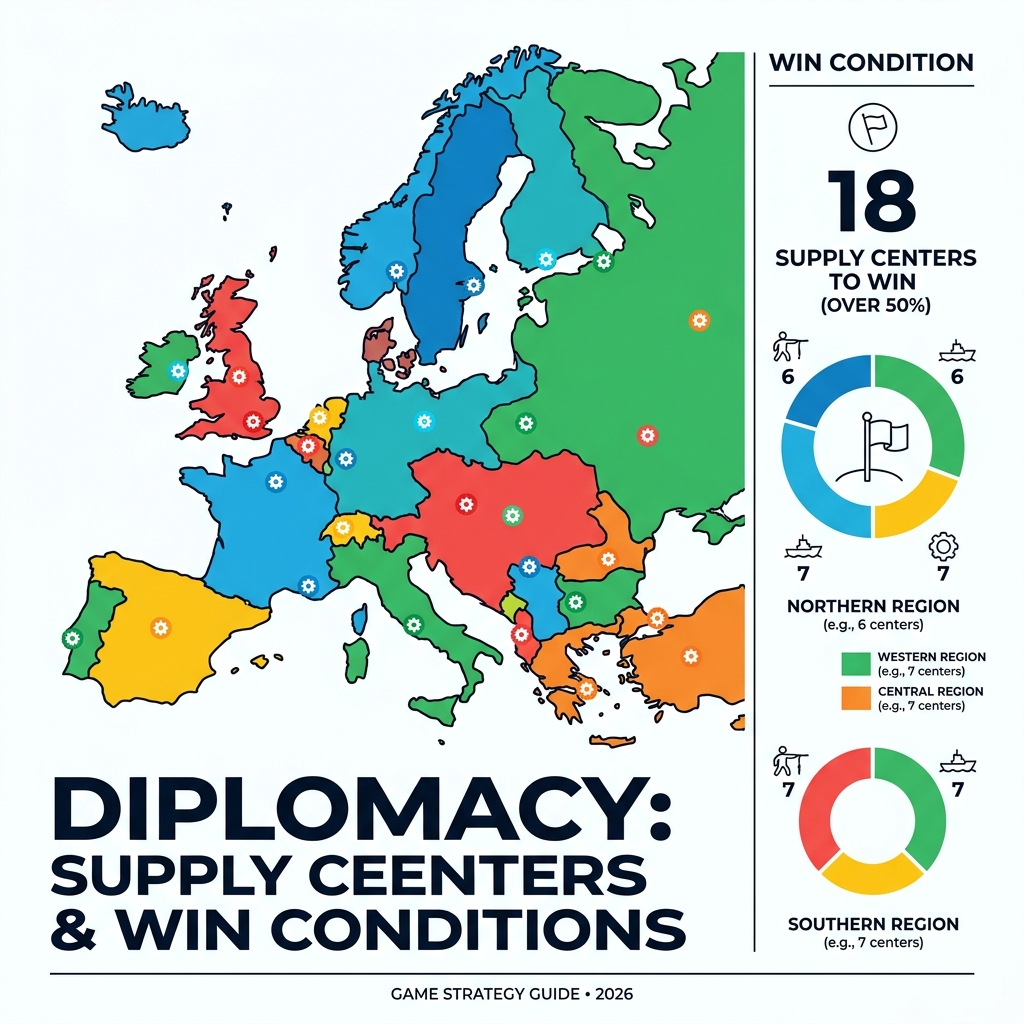
- Goal: Control 18 of 34 supply centers to win
- Players: Exactly 7 (each controls one of Europe’s Great Powers)
- No luck: No dice, no cards — only negotiation and tactics decide the winner
- Core skills: Alliance-building, unit support, and knowing when to betray your allies
- Best practice tool: Backstabbr.com lets you practice orders before your first real game
- Time to play: Expect 4 to 6 hours for a full in-person session
There’s a reason Diplomacy has sold roughly half a million copies since its 1959 debut. Created by Allan Calhamer, the game drops seven players onto a pre-WWI European map and gives them one simple instruction: conquer the continent.
But here’s the catch — you can’t do it alone.
Every unit you move, every territory you take, and every alliance you form depends entirely on the words coming out of your mouth in the negotiation phase. Diplomacy is often described as a mix of Chess-like tactics and Poker-like psychology. The tactics are simple enough to learn in an afternoon. The psychology? That’s what this guide is for.
Whether you’re overwhelmed by the seven powers, confused by support orders, or terrified of destroying a friendship with a well-timed betrayal — you’re in the right place.
Mastering the Diplomacy Board Game Strategy Guide
To truly master the diplomacy board game strategy guide, we must first look at the board not as a battlefield, but as a puzzle of physics. Unlike other wargames, there are no “stronger” units. An Army is equal to a Fleet in combat strength. Victory is determined solely by math: who has more support?
The Mechanics of Movement
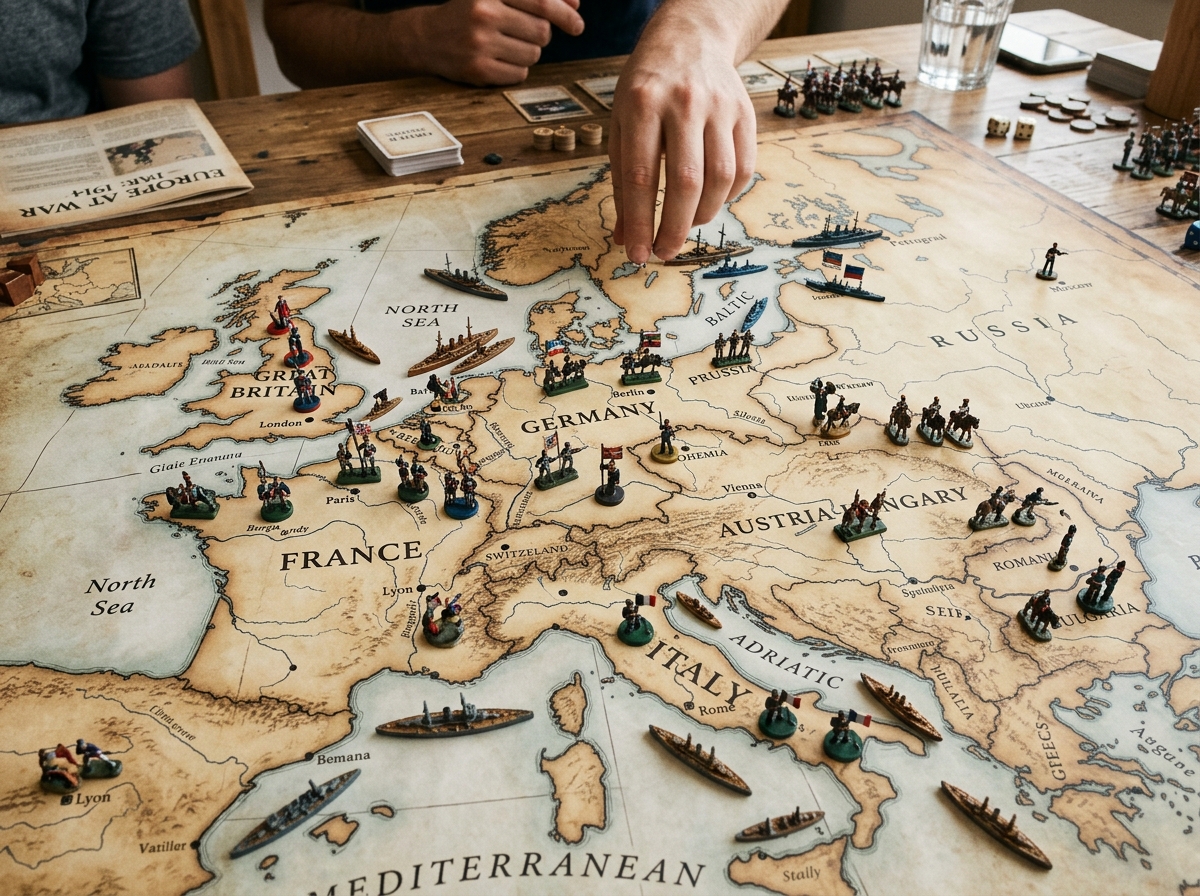
In Diplomacy, units move simultaneously. We all write our orders in secret, then reveal them at once. This creates the “Diplomacy Phase,” a 15-to-30-minute window of frantic whispering where we try to coordinate moves with neighbors.
- Armies: Move across land and can be convoyed across sea provinces.
- Fleets: Move across sea provinces and coastal land provinces. They are essential for island nations like England.
- Support Hold: A unit stays put but adds its strength to a neighbor to prevent them from being moved.
- Support Move: A unit adds its strength to another unit’s attack on a specific province.
For a deeper dive into the technicalities, Avalon Hill’s Official Rulebook is the gold standard. Understanding these rules is the foundation for planning ahead in board games, as a single miswritten order can collapse an entire empire.
Core Tactics for Every Diplomacy Board Game Strategy Guide
Tactics in Diplomacy are often described as “simple to learn, impossible to master.” To protect our borders, we need to understand a few advanced maneuvers:
- Cutting Support: This is the most vital defensive move. If an enemy unit is supporting an attack against us, we can “cut” that support by attacking the supporting unit itself. Even if our attack fails to move them, their support is nullified for that turn.
- Convoy Mechanics: Fleets can act as a bridge. An Army in London can move to Picardy in a single turn if a Fleet in the English Channel is ordered to “Convoy” it.
- Bouncing Units: If two units of equal strength try to enter the same empty province, they “bounce,” and both stay where they started. Experienced players often use “planned bounces” to keep a neutral territory empty and safe from either side.
- Dislodgement and Retreats: When a unit is forced out of a province by superior force, it must retreat to an adjacent empty space. If no such space exists, the unit is disbanded (destroyed).
- Winter Adjustments: This is the “accounting” phase. For every supply center (SC) we control at the end of a Fall turn, we are allowed one unit. If we have more SCs than units, we build new ones in our home centers. If we have fewer, we must remove units.
For those who want to see every possible weird interaction, the Diplomacy Adjudicator Test Cases provide visual examples of complex rules.
The Seven Powers: Opening Moves and Country Strategies
Each of the seven powers in Diplomacy has a unique “flavor” and strategic hurdle. Statistical data from decades of tournaments shows that while some countries are harder to play, the win ratios are surprisingly balanced over long periods.
| Power | Starting Units | Primary Neighbors | Strategic Vibe |
|---|---|---|---|
| England | 2 Fleets, 1 Army | France, Germany, Russia | Naval isolation; slow but steady. |
| France | 1 Fleet, 2 Armies | England, Germany, Italy | Best defensive position; high flexibility. |
| Germany | 1 Fleet, 2 Armies | Everyone (Central) | High growth potential; high risk of being dogpiled. |
| Italy | 1 Fleet, 2 Armies | France, Austria, Turkey | The “wildcard”; needs strong negotiation. |
| Austria | 1 Fleet, 2 Armies | Italy, Russia, Turkey | High reward; usually the first to die or the first to win. |
| Russia | 2 Fleets, 2 Armies | England, Germany, Austria, Turkey | Only power with 4 units; straddles the North and South. |
| Turkey | 1 Fleet, 2 Armies | Russia, Austria, Italy | The “Corner Fortress”; incredibly hard to eliminate. |
Country-Specific Insights
- England: We must secure the North Sea. Our biggest threat is a “Channel Alliance” between France and Germany. To win, we need to leverage our best opening moves for board games to secure Scandinavia early.
- France: We are the masters of the Atlantic. If we can keep England and Germany fighting each other, we can slowly expand into the Iberian Peninsula and the Mediterranean.
- Germany: Centrality is our curse. We must pick an ally (usually England or Austria) immediately. If we try to fight on three fronts, we will be eliminated by 1903.
- Italy: Often underestimated, Italy is excellent for experienced negotiators. The “Lepanto” opening — a famous set of moves designed to convoy an army into Turkey — is a classic way to secure a foothold in the East.
- Austria: We live in the “Balkan Meat Grinder.” We must make a deal with either Russia or Turkey. If they team up against us (the “Juggernaut”), we are in trouble.
- Russia: Starting with four units is a massive advantage, but it makes us a target. We must decide if we are a Northern power or a Southern power.
- Turkey: We are the defensive stalwarts. Even with just three units, the geography of the corner makes us almost impossible to root out. Our goal is to slowly grind through the Balkans.
Regional Alliances in Your Diplomacy Board Game Strategy Guide
Alliances are the lifeblood of the game. Here are the most famous “named” alliances we might encounter:
- The Juggernaut (Russia/Turkey): Perhaps the most feared alliance. If these two work together, they can steamroll the entire eastern half of the map.
- The Western Triple (England/France/Germany): Rare and fragile. These three agree not to fight and instead move together into Russia and Italy. It rarely lasts because someone always sees an opening to “stab” a neighbor.
- The Balkan Juggernaut: An alliance between Austria and Russia to split the Balkans and eliminate Turkey early.
For more on how to navigate these social waters, check out these tips for multiplayer board game success.
The Psychology of Negotiation and the Art of the Backstab
This is where the diplomacy board game strategy guide moves from the board to the brain. In Diplomacy, no agreement is binding. We can promise to support our ally into Paris, and then instead move our unit into their empty home center.
The Art of the Deal
Expert players rarely lie. This sounds counterintuitive, but if we gain a reputation as a “liar,” no one will work with us in the mid-game. Instead, we use the “Silver Tongue” — speaking in truths that benefit us or omitting details that don’t.
When we do decide to betray someone (the “stab”), it must be decisive. A “one-center stab” is usually a mistake; it ruins our reputation for a tiny gain. A “game-winning stab,” where we take three or four centers at once and cripple an ally’s ability to retaliate, is how we win.
Managing Emotions and Maintaining Friendships
Diplomacy is famous for “ruining friendships.” To avoid this, we must set expectations early. We need to remind our friends that “what happens on the board stays on the board.”
- Thick Skin: We must expect to be stabbed. It isn’t personal; it’s math.
- Post-Stab Reconciliation: If we get stabbed, we shouldn’t scream. Instead, we should point out to the traitor that their new neighbors are now more of a threat to them than we were.
- Social Deduction: Use the same skills you’d use in games like Werewolf or Among Us. Watch for who is talking to whom for too long.
If you’re looking for a community that understands this balance, the Intro to webDiplomacy page is a great place to start. It’s a competitive board game strategy guide in its own right, emphasizing that a 24% win rate is considered world-class.
Advanced Mid-Game and End-Game Victory Paths
As the game progresses, the map begins to “lock up.” This leads to the most important concept in high-level Diplomacy: Stalemate Lines.
A stalemate line is a string of provinces that, if held by a certain number of units, cannot be broken regardless of how much support the opponent has. The most famous is the “Main Stalemate Line,” which runs diagonally from St. Petersburg down through Switzerland to North Africa.
Pursuing the Solo Victory
To win solo (reaching 18 centers), we must cross a stalemate line before our opponents realize we are close to winning and form a “Draw-In-Scent” (a coalition to stop the leader).
- Protecting Home Centers: Never leave our back door open. Even the most loyal ally will take an undefended capital if it puts them closer to 18.
- Preventing a Draw: If we see the game heading toward a stalemate, we must sow discord between the other players. Remind them that a three-way draw is just “losing together.”
For help with these high-level decisions, we recommend reviewing board game planning and decision tips.
Digital Tools and Resources for Practice
We don’t have to wait for six friends to have a free Saturday to get better at Diplomacy. The digital age has brought incredible tools to the hobby:
- Backstabbr: The best “sandbox” for beginners. It has an “adjudicator” that lets us input orders to see what happens before we commit to them in a real game.
- webDiplomacy: A massive community for “Press” (negotiation) and “Gunboat” (no talking) games. It uses an Elo-derived system called Ghost Ratings to rank players.
- GitHub: For the tech-savvy, the GitHub Project Intro – webDiplomacy shows how the logic of the game is coded.
One tip for first-timers: set a turn limit. Tournament games often end in 1907 or 1912. This prevents the game from dragging on for ten hours and ensures a definitive winner based on SC count.
Frequently Asked Questions about Diplomacy Strategy
Is Italy a good country for beginners?
Italy is often called the “hardest” country because its path to 18 centers is less obvious than England’s or Turkey’s. However, for a beginner who loves the “social” aspect, Italy is fantastic. You are rarely the first target, giving you time to learn the mechanics while acting as a power broker between the East and West.
How do I handle a friend who stabs me?
Keep an emotional even keel. The biggest mistake is “playing for revenge.” If we spend the rest of the game trying to destroy the person who stabbed us, we both lose, and a third party wins. Instead, try to negotiate your way back into their good graces—or find a new ally who is now scared of the person who just got stronger.
What is the most powerful alliance in the game?
The Juggernaut (Russia/Turkey) is statistically very strong because it secures the corner of the map. However, many experienced players will “dogpile” this alliance as soon as they see it forming. The “Anglo-German” alliance is often more sustainable because England and Germany can split the map into North and South very effectively.
Conclusion
Mastering Diplomacy isn’t about being the best tactician; it’s about being the most reliable person at the table — until the exact moment you aren’t. It requires strategic patience, a silver tongue, and a very thick skin.
At iBest Health Insurance, we know that whether you’re navigating the complex borders of 1901 Europe or the nuances of insurance plans, having a solid strategy is key to peace of mind. If you enjoyed this guide, you might also find our look at winning tactics for card-based board games helpful for your next game night.
Now, go forth, gather your six bravest friends, and remember: keep your friends close, but your Fleets closer.
