
Why Game of Thrones Board Game Strategy Is Harder Than It Looks
Game of Thrones board game strategy is unlike almost any other board game you’ve played. It blends military conquest, political diplomacy, and psychological warfare into one ruthless package — and most players lose not because they fight badly, but because they think badly.
Quick answer — the core strategies that win:
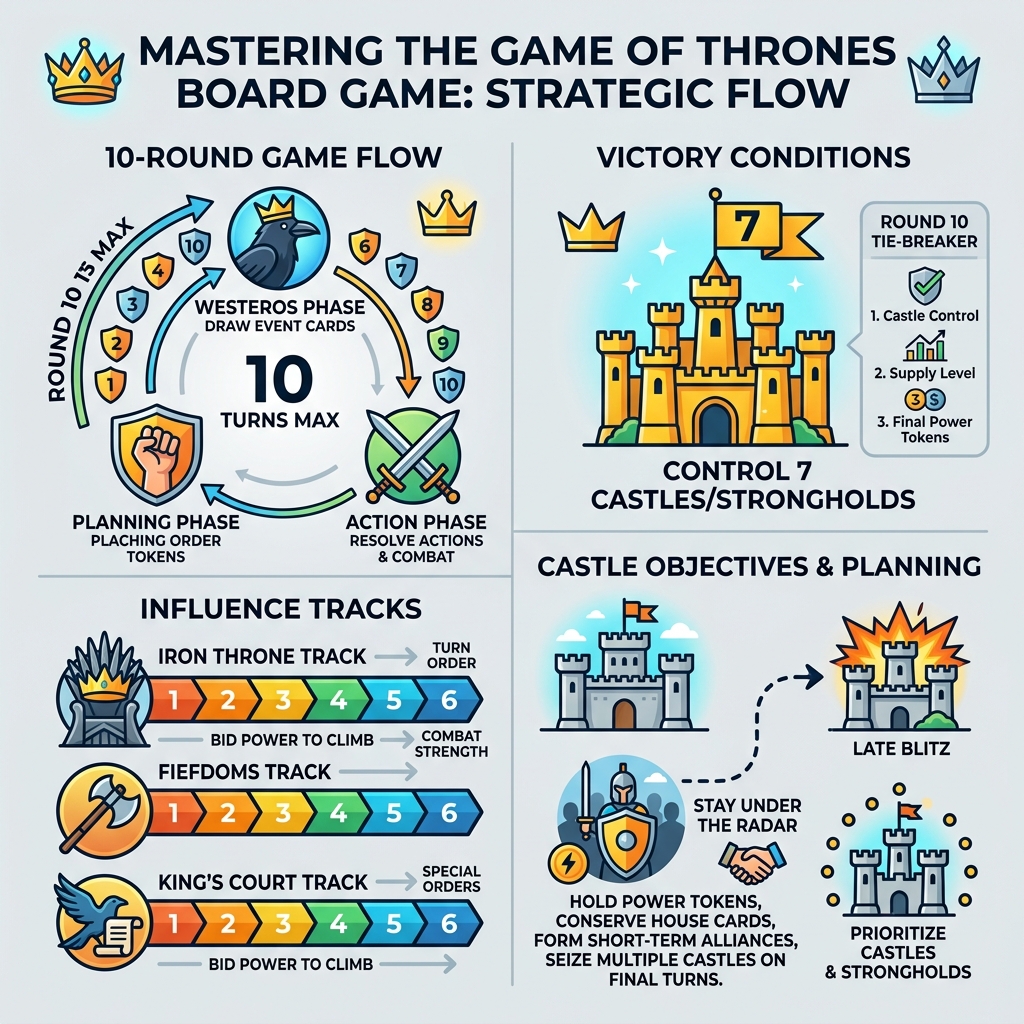
- Stay under the radar — don’t lead until the final turns
- Prioritize King’s Court on the influence tracks
- Form short-term alliances lasting 6-8 turns, then adapt
- Hold your strongest House Cards in reserve for decisive moments
- Execute a late blitz — seize 2-3 castles in a single final turn
- Leave a footman behind your lines every turn to farm Power Tokens
- Avoid Raid tokens and Siege Towers — they rarely pay off
- Choose Lannister or Baratheon if you’re playing a 4-player game
The goal is simple: control 7 castles before anyone else does, across up to 10 rounds. But the path there is anything but simple.
This game rewards patience above aggression. Attack too early and every other player turns on you. Sit too passive and someone else blitzes to victory before you react. The sweet spot — and the whole art of this game — is threading that needle for nine turns, then striking hard when it counts.
As the saying goes in Westeros: “When you play the game of thrones, you win or you die.” On the tabletop, there’s a third option too — you get ganged up on by turn 6 and spend the rest of the night watching others play. This guide will help you avoid that fate.
Mastering the Game of Thrones Board Game Strategy: The Core Mindset
To win consistently, we must adopt a mindset that differs from traditional “war games” like Risk. In Westeros, the loudest player is often the first to be silenced. We recommend the “Mario Kart Theory” of game of thrones board game strategy. Much like the racing game’s rubber-banding mechanics, being in first place early is actually a disadvantage. If you hold five or six castles by turn four, the other five players will naturally form a coalition to tear you down.
Instead, aim to stay in a comfortable 2nd or 4th place for the majority of the game. This allows you to build your resources while others exhaust their House Cards and power tokens fighting one another. Keep your cool, man—patience is your greatest weapon. By planning ahead in board games, you can prepare for a 10-turn timeline where the first eight turns are merely a setup for a massive, two-turn finale. Success requires balancing asymmetric play; every House has a different “clock” and different geographical hurdles. Our tips for multiplayer board game success emphasize that reading the table is just as important as reading the map.
Early Game of Thrones Board Game Strategy for Territory Control
The first turn is a frantic land grab. After the first round, most Houses typically control 4-5 territories, including sea areas. Your primary goal in the opening is not to kill enemy units, but to secure “Supply” (the barrel icons) and “Power” (the crown icons).
When considering best opening moves for board games, focus on expanding into adjacent neutral forces or unoccupied lands that increase your muster capabilities. For example, Stark should almost always move into the Shivering Sea, while Baratheon should look toward King’s Landing. A winning strategy often involves acquiring a total of 10 territories over 10 turns, which translates to taking and holding a new area approximately every two turns. Don’t overextend; if you take a territory you can’t defend, you’ve wasted an order and likely painted a target on your back.
The Art of Diplomacy and Betrayal
Diplomacy in Westeros is a consumable resource. Alliances in this game are rarely permanent; research suggests they typically last 6-8 turns. When forming an alliance, we should look for mutual benefits that allow both parties to ignore a shared border and focus their military might elsewhere.
Effective board game planning and decision tips suggest using “Support” orders as a diplomatic olive branch. By placing a Support order near an ally’s conflict, you prove your utility without moving your troops. However, always watch for the signs of betrayal. If an “ally” begins moving navies into sea zones that can reach your home port, or if they stop placing Support orders and start placing “March -1” orders on your border, the alliance is over. Psychological warfare is key: keep your opponents talking and doubting each other so they don’t focus on your slow, steady accumulation of power.
Choosing Your House: Strengths, Weaknesses, and Player Counts
Your game of thrones board game strategy must shift radically depending on which House you control. The game is notoriously asymmetric, and certain Houses perform better at specific player counts.
| House | Starting Difficulty | Key Strength | Primary Vulnerability |
|---|---|---|---|
| Lannister | Hard | High Power / Central | Surrounded by enemies |
| Baratheon | Easy | Naval Access / King’s Landing | Exposed to Martell/Stark |
| Stark | Medium | Large North / Defensive | Slow to expand south |
| Greyjoy | Medium | Offensive Power / Sea Control | Poor diplomacy / Brittle |
| Tyrell | Easy | High Supply / Strong Cards | Weak Influence Tracks |
| Martell | Medium | Defensive Corner / Surprise | Limited expansion routes |
In 4-player games, there is a known imbalance where Lannister and Baratheon tend to be the strongest due to their central positioning and the removal of southern threats. If you are a newcomer, our beginner strategy guide for tabletop games suggests starting with Baratheon or Tyrell, as their geographical positions are more forgiving. Stark requires a heavy investment in navies to protect their massive coastline, while Greyjoy must play aggressively early to cripple Lannister before the “Lion” can build a defensive wall.
The Sinews of War: Units, Orders, and Combat Tactics
Understanding the math of combat is essential. You aren’t just comparing unit strengths; you are calculating support, house cards, and track bonuses.
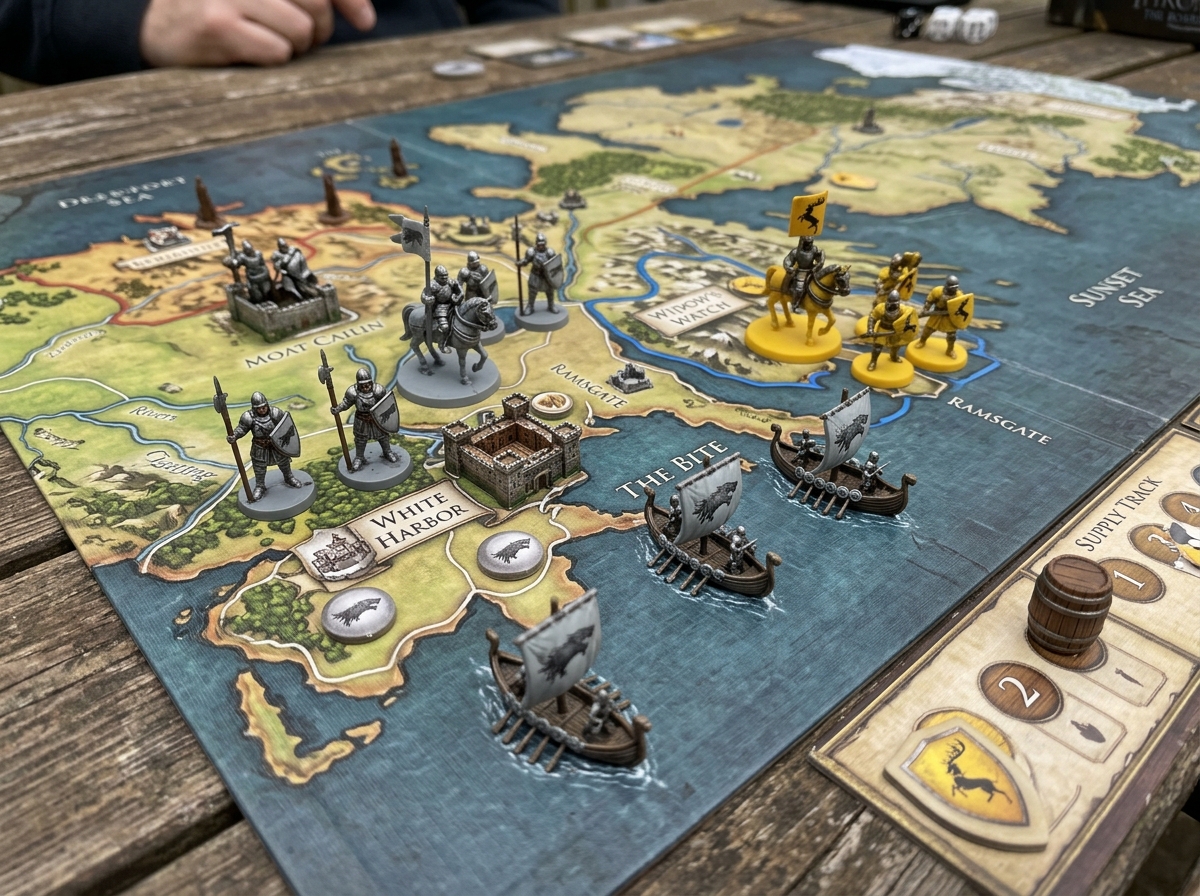
The four unit types serve distinct roles:
- Footmen (Strength 1): The backbone of your army. Their best use is “farming.” A single footman dedicated to generating power tokens via “Consolidate Power” can yield 6-8 power tokens over several turns.
- Knights (Strength 2): Your primary offensive tool. They provide high mobility and punch.
- Siege Towers (Strength 4 on attack): These are a “mirage.” While they look powerful, they are useless on defense and cannot be used against units in the open. Most experts agree it is better to buy two Knights than one Siege Tower.
- Navies (Strength 1): Perhaps the most important unit. Ships allow for “bridge” movement and provide Support to coastal land battles. Control the sea, and you control the pace of the game.
For a deeper dive into the mechanics, we recommend the Official Video Guide. Regarding orders, use “March” to expand and “Support” to hold the line. Avoid “Raid” tokens unless you have a specific “dick move” planned to strip an opponent’s Consolidate Power token. Our competitive board game strategy guide notes that a well-placed Support order is often worth three times as much as a March order.
Advanced Game of Thrones Board Game Strategy for House Card Cycling
Every House has a deck of seven cards. You must understand that you will enter combat on the defensive approximately half the time. Managing these cards is about more than just playing the highest number.
Baiting and Recycling: If you know you are going to lose a battle, don’t waste your “4” card. Play a “0” or “1” to “bait” your opponent into using their strongest card. This “sacrificial attack” allows you to cycle through your deck faster. Once you play all seven cards, your hand refreshes.
Key Cards to Watch:
- Lannister (Ser Gregor): His sword icons can wipe out an entire army even if he loses the battle.
- Tyrell (Mace Tyrell): He can immediately destroy a footman, which is devastating during an opponent’s carefully planned march.
- Stark (Roose Bolton): He is the exception to the “hold your best cards” rule. You want to play your other high cards (Eddard, Robb) before Roose so that Roose’s ability can bring them back to your hand immediately.
Managing the Tracks: Influence, Power, and Supply
The three influence tracks are the heartbeat of your political power. During a “Clash of Kings” event, you must bid your accumulated power tokens.
- The Iron Throne: Determines turn order. Being first is great for Greyjoy, but less critical for defensive Houses like Martell.
- The Fiefdoms: Provides the Valyrian Steel Blade, which gives a +1 in combat and breaks ties. This is the “combat track.”
- The King’s Court: This is the most valuable track. It determines how many “Special (Starred) Orders” you can place. Starred orders are strictly better than regular orders. Being high on this track allows you to use the Messenger Raven to swap an order after seeing what others have done—a massive tactical advantage.
Planning ahead in board games 2 means keeping a reserve of power tokens for the Wildling threats. If the Wildlings attack and the players fail to contribute enough power, the “lowest bidder” suffers a catastrophic penalty, such as losing half their units. Always keep at least 2-3 tokens in reserve for these emergencies.
The Final Blitz: Securing the Seven Castles
The game ends immediately when a player hits seven castles. Because of the “Mario Kart” effect, the final turn is usually a “blitz.” A successful late-game blitz can involve seizing 2-3 castles in a single turn to secure victory.
To pull this off, you need to have positioned your units in “striking distance” (within 1-2 territories) of your targets without looking threatening. This is where naval transport is vital; a fleet in the Golden Sound or the Narrow Sea can drop an army almost anywhere on the coast.
If the game reaches turn 10 without anyone hitting seven castles, the winner is decided by who has the most castles, with ties broken by supply and then power tokens. In these final moments, transition your “farming” footmen into defensive blockers. Our tips for multiplayer board game success 2 suggest that in the final round, you should stop caring about your long-term economy and burn every resource you have to take that seventh castle.
Frequently Asked Questions about Game of Thrones Strategy
Which House is the best for beginners?
We recommend House Baratheon or House Tyrell. Baratheon has a strong starting position near King’s Landing and easy access to the sea. Tyrell has excellent “Supply” icons nearby, allowing them to build large armies (stacks of 4-3-2-2) more easily than the resource-starved Lannisters or Starks.
Are Siege Towers worth the cost?
Generally, no. They are a “mirage.” While they have a strength of 4, they only provide that strength when attacking a castle or stronghold. They provide 0 strength on defense and are immediately destroyed if they are forced to retreat. Two Knights provide the same offensive power but are much more versatile.
How do I win if I’m being ganged up on?
If you are being targeted by multiple players, you must use your House Cards defensively. Cards like Arianne Martell or The Blackfish can cancel an opponent’s march or prevent them from moving into your territory entirely. Focus on holding your “choke points” and use your diplomacy to convince one of your attackers that the other attacker is actually the one poised to win.
Conclusion
Mastering game of thrones board game strategy is a journey of strategic patience and calculated betrayal. Whether you are leading the Direwolf of Stark or the Golden Lion of Lannister, the map is only half the battle – the other half is the players sitting across from you. By staying under the radar, managing your influence tracks, and preparing for a final-turn blitz, you can claim the Iron Throne for yourself.
While this article is a light strategy guide for board game fans, the bigger takeaway is universal: good outcomes usually come from planning ahead, managing risk, and adapting when conditions change. Those same habits matter off the tabletop too. At iBest Health Insurance, More strategy tips at iBest Health Insurance are available for readers who value thoughtful decision-making and preparation.
Now, go forth and conquer the Seven Kingdoms!
